Flipping the SaaScript: From Opex to Innovation
As AI rewrites SaaS economics in the US, India is poised to lead with a decisive edge.
SaaS 1.0: Category Creation in the U.S., Global Execution from India
Over the past two decades, SaaS has become the dominant model for enterprise technology. The U.S. has led this transformation by building platforms that defined entire categories and creating a $300B+ industry. India, meanwhile, has emerged as a global hub by leveraging cost-efficient talent, disciplined engineering, and sharp go-to-market execution to scale companies like Zoho, Freshworks, and BrowserStack.
In the traditional model, growth was driven by S&M-heavy spend, while R&D lagged. With AI copilots, automated onboarding, and product-led growth, the cost of sales is compressing, while innovation becomes the new engine of distribution. Differentiation now comes from proprietary data, model fine-tuning, and vertical intelligence, forcing SaaS companies to rebalance spend toward R&D. In the U.S., incumbents are retooling, with Salesforce pouring billions into Einstein GPT, HubSpot pivoting resources from quota-carrying reps to AI engineers, and Snowflake and Databricks scaling through AI-native products.
The next frontier of Indian SaaS is to leapfrog directly into this R&D-led era. Companies like Postman, Icertis, Observe.AI, and Uniphore are already proving that India can move beyond execution-led growth to build innovation-first platforms that stand on the global stage. With AI as the catalyst, India is uniquely positioned to create the next generation of category-defining SaaS leaders.
Value Creation Is Pivoting from Distribution to Innovation
At its foundation, the SaaS model has always rested on exceptionally high gross margins, typically between 75-85%. Software has near-zero marginal delivery costs once built, with each incremental customer adding to the contribution margin. The challenge, and the lever of differentiation, has sat below the gross margin line: how companies allocate operating expenses across Sales & Marketing (S&M), Research & Development (R&D), and General & Administrative (G&A) functions.
Traditionally, U.S. SaaS companies prioritised growth, often devoting 40-50% of revenue to S&M. This reflected a playbook of aggressive customer acquisition and category capture. R&D, while critical, tended to stabilise in the 20% of revenue range, sufficient to maintain product competitiveness but rarely the dominant expense driver. G&A typically remained lean, in the low teens. The result was a margin profile designed for rapid scale, even if that meant sustained losses in pursuit of market leadership. Taken together, this expense profile has often left SaaS businesses deferring profitability until sufficient scale delivers operating leverage.
Since the SaaS market peak in 2021 and the subsequent correction, investors have become equally focused on profitability and growth. As a result, public SaaS companies have been forced to tighten their operating expenses without compromising long-term product innovation. In the past three years, a structural shift has emerged. According to benchmarks from Blossom Street Ventures, public SaaS companies collectively adjusted their spend profile between 2022 and 2024: S&M spending declined from 46% of revenue in 2022 to 40% in 2023, and further to 38% in 2024, while R&D grew and remained resilient, sitting at 27% in 2022 and tapering only slightly to 25% in 2023 and 2024. This indicates a growing emphasis on operational efficiency: sales burn is being trimmed, while investment in innovation remains central.
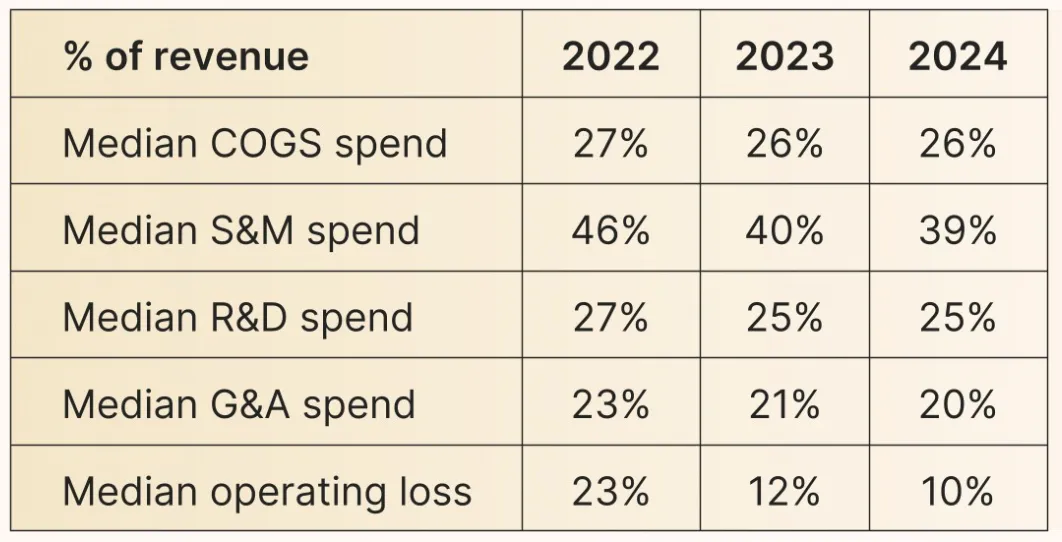
This pattern underscores a critical trend: losses have narrowed primarily through S&M discipline, reflecting investor scrutiny and operational efficiency. COGS and G&A have also trended down modestly, contributing to healthier margins. Yet, unlike other spend lines, R&D continues to receive strong backing, signalling that innovation remains central to sustaining long-term competitive advantage.
Additional insights from SaaS Capital’s 2025 benchmarks reinforce the same theme on the private side: among private B2B SaaS firms, R&D as a percentage of ARR increased from 18% to 22% year-on-year, even as overall spending tightened. Top-quartile early-stage SaaS companies ($1-20M ARR) allocate as much as 55-60% of revenue to R&D. In other words, even in a capital-constrained environment, R&D has become a protected and expanding budget line.
Interestingly, this expansion of R&D spend occurred despite a policy change in 2022 (reversed in 2025) that required businesses to capitalise and amortise domestic R&D costs over five years rather than deduct them immediately. In effect, the reported numbers likely understate the true intensity of R&D investment during this period.
The primary driver behind the reorientation of SaaS economics is the rapid and sustained adoption of artificial intelligence. Enterprise AI spending is experiencing unprecedented growth, with estimates indicating a 94% YoY increase for software businesses. This surge reflects a fundamental shift, as AI transitions from experimental pilots to core components of IT infrastructure and innovation strategies. By 2024, over 70% of SaaS companies had integrated AI into their products, up from 40% in 2022.
AI is transforming both sides of the P&L: reducing acquisition costs through automation and personalization while demanding higher R&D outlays for AI-first product development.
- Sales & Marketing compression: AI-driven automation, intelligent onboarding, and personalized in-product experiences are reducing S&M dependence. For instance, Salesforce's AI initiative, Agentforce, has enabled the company to reduce its customer support workforce by 4,000 positions and cut costs by 17% in 2025.
- R&D ramp-up: Leading SaaS firms are aggressively increasing R&D intensity to develop defensible AI capabilities. HubSpot increased R&D spend from ~25% of revenue in 2022 to ~30% in 2024, dedicating resources to AI-powered marketing and sales intelligence features. Snowflake has similarly expanded its R&D budget by over 64% YoY, with R&D rising from 38% to 46% of revenue directed toward AI-driven data platform enhancements.
For investors, this translates to a new margin archetype: S&M in the high-30s, R&D in the mid-20s (and trending upward for early-stage firms), stable G&A, and resilient gross margins.
R&D is increasingly proving to be the more effective engine of topline growth compared to S&M. AI-driven product innovation not only sharpens differentiation but also fuels adoption, retention, and expansion within existing accounts. In contrast, S&M efficiency is showing signs of saturation, with rising acquisition costs driving diminishing returns. Data from 2024 illustrates this divergence clearly: the median R&D payback multiple for listed US SaaS companies stood at 0.73, while S&M efficiency declined to 0.38 (down from 0.43), underscoring that innovation delivers faster and more durable payback than marketing spend.
For early stage private companies,, R&D payback ranges between 2-4x.
The broader implication is clear: innovation is becoming the new distribution. Whereas the last decade of SaaS leadership was built on go-to-market execution and heavy S&M spend, the next decade will be defined by who can most effectively integrate AI into their product fabric. Future SaaS winners will not just sell software more efficiently, they will build AI-powered products that adapt continuously, and generate long-term, defensible moats.
India’s SaaS Trajectory Led By Price & Distribution
India’s SaaS trajectory over the last decade has been markedly different. Flagship players like Zoho, Freshworks and Chargebee rode the wave of cost-efficient engineering talent and disciplined go-to-market execution to sell globally at a fraction of U.S. cost bases. The shorthand became: “Build in India, for the world.”
But India’s growth model leaned even more heavily on distribution and price competitiveness. Indian SaaS firms often spent aggressively on sales and customer acquisition, sometimes mirroring U.S. S&M intensity, but allocated just 10–15% of revenue to R&D. As a result, Indian SaaS became synonymous with value-for-money solutions and faster execution.
This approach enabled Indian players to scale into the global SMB and mid-market, where cost sensitivity is highest, and to reach profitability earlier than U.S. peers. However, it also introduced structural limits. Competing primarily on price created a low ceiling on defensibility. As global buyers shift expectations from “low cost software” to “transformative, AI-powered platforms”, Indian SaaS is evolving to leverage greater innovation.
The market has reflected this divergence. U.S. SaaS companies that leaned into R&D-driven innovation—Snowflake, Datadog, ServiceTitan—commanded premium multiples at IPO and beyond. By contrast, even successful Indian IPOs like Freshworks struggled to sustain valuation premiums, as investors questioned whether distribution- and cost-led SaaS models could deliver enduring moats in a post-AI era.
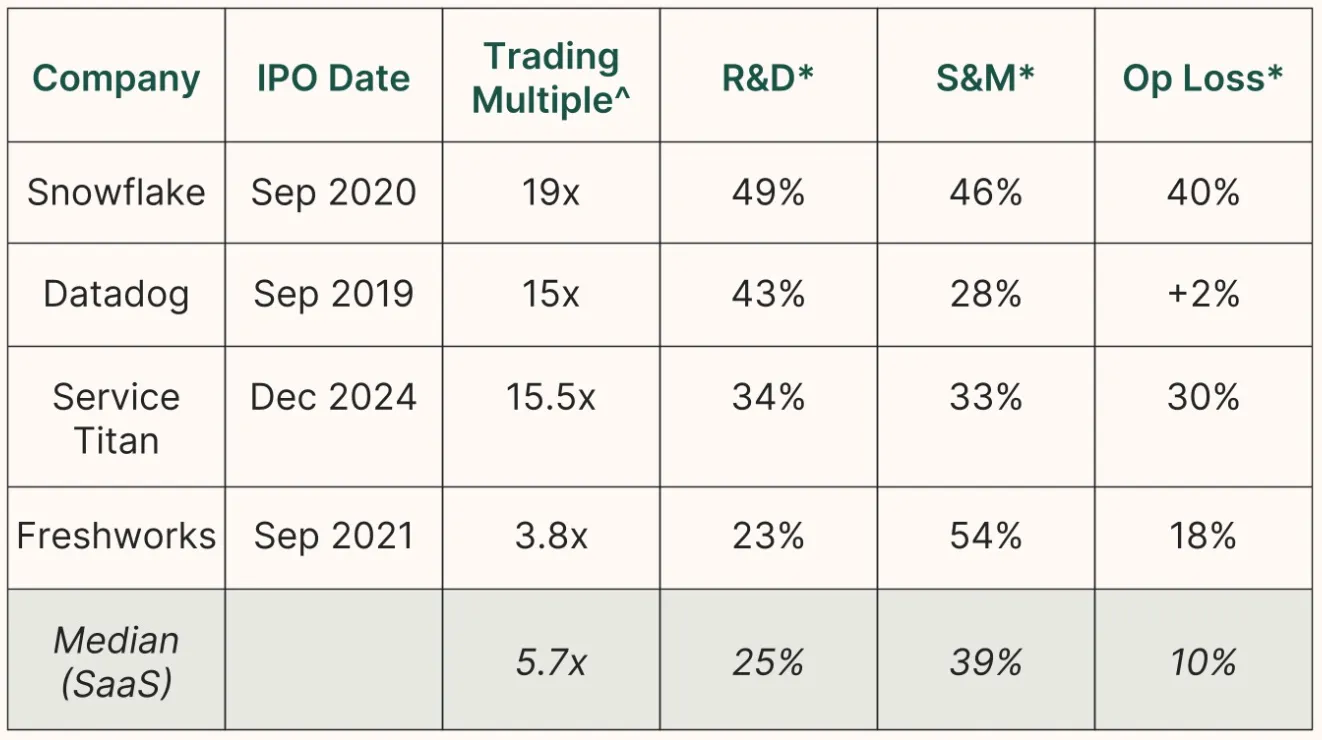
In essence, while U.S. SaaS is evolving into an innovation-led model, India’s SaaS to date has been execution-led. The opportunity is no longer just in capital efficiency or market reach, it is in the ability to fund and commercialize deep product innovation, especially as AI redraws the competitive frontier.
AI-Powered Opportunity For Indian SaaS
AI is catalyzing a fundamental shift in SaaS, moving the model from execution-led growth to innovation-led growth, redefining how value is created and where margins expand.
For Indian SaaS, this represents a once-in-a-generation opportunity. Historically seen as the execution engine, India has excelled at cost-effective global growth and is well poised to channel those strengths into creating category-defining products. AI now demands that shift. With a deep engineering talent pool, a growing cadre of AI researchers, and proven global distribution capabilities, Indian SaaS firms can now invest aggressively in AI-led R&D.
Pre-trained models, open-source frameworks, and GPU-as-a-service infrastructure have lowered the barriers to experimentation, but creating fully autonomous, domain-specific SaaS products still requires substantial R&D investment, often 30-40% of revenue for leading firms. This investment fuels critical capabilities such as
- Domain-specific data pipelines to generate verticalized datasets for high-accuracy intelligence
- Model training and fine-tuning for generative, predictive, and prescriptive functionality
- AI agent development to autonomously execute complex, multi-step workflows
- Seamless product integration to embed intelligence into core SaaS platforms
The future of SaaS lies in a unified AI continuum, where vertical AI drives AI agents. Vertical AI delivers deep, industry-specific intelligence across healthcare, finance, legal, supply chain, and more. AI agents leverage this intelligence to autonomously manage workflows, optimise operations, and deliver proactive insights. Together, they enable end-to-end, self-directed SaaS solutions, transforming traditional go-to-market, service, and operational processes while creating defensible, innovation-led platforms.
Companies like Darwinbox, Everstage and Smallest.ai are early proof points out of India:
Darwinbox is a Hyderabad-based, AI-powered cloud HCM (Human Capital Management) platform founded in 2015, offering end-to-end HR solutions spanning recruitment, onboarding, payroll, performance, and predictive analytics through its mobile-first interface. Today, it powers over 3 million employees across 1,000+ enterprise clients in more than 130 countries.
The company grew revenues 58% to $50M last year while investing 46% of operating revenue in R&D, a 43% increase over the prior year. Its innovation-led strategy is reinforced by strategic IP acquisitions, including a compensation management platform that has scaled 15x post-acquisition. This focus helped Darwinbox raise a $140M round led by global investors KKR and Partners Group, pushing its valuation above $1B. Darwinbox positions itself as a product- and R&D-first company, competing successfully with legacy HR tech players on product merit. Its heavy R&D commitment underpins AI-powered innovations such as Darwinbox Sense, a GenAI engine, and a Model Context Protocol (MCP) Server, designed to deliver richer employee experiences and actionable HR insights. With deep investment in product development and global expansion, Darwinbox is emerging as a next-generation HR tech leader.
Everstage is a Chennai-based, AI-powered sales commission and revenue intelligence platform founded in 2020, helping enterprises manage performance, incentives, and forecasting through its flagship product Crystal. Today, it serves fast-scaling enterprises such as GrayTV, Wiley, Diligent, and Trimble.
On the back of its AI-powered sales performance and commission management, which offers real-time forecasting and BI-driven reporting for enterprise sales teams, the company achieved 300% YoY revenue growth. Everstage went on to secure $30 million in Series B funding in October 2024. The capital is earmarked for a significant expansion of its R&D efforts, global product development, and scaling of its in-house professional services team. A key innovation is the upcoming AI Agent Creation Studio, designed to empower Revenue Operations and finance teams to build custom AI assistants capable of generating insights, automating repetitive workflows, and handling sales performance analysis and planning.
Smallest.ai is a San Francisco–and Bengaluru–backed AI startup, founded in 2023 by IIT alumni Sudarshan Kamath and Akshat Mandloi, focused on full-stack voice AI for enterprise contact centers and voicebots.
Their flagship Lightning TTS model generates up to 10 seconds of human-quality audio in just 100 milliseconds, supports multiple languages and accents, and costs as little as $0.02 per minute, making voice automation vastly more accessible. Independent benchmarks show that Smallest.ai consistently outperforms incumbents like ElevenLabs and Cartesia on both latency and audio quality. Against ElevenLabs, it delivers faster response times essential for real-time applications while achieving superior MOS (Mean Opinion Score) ratings. Compared to Cartesia, Smallest.ai completes full audio generation nearly three times faster. These advantages are not incidental, they are the result of deliberate, R&D-heavy investments in model training, proprietary datasets, and infrastructure optimisation, establishing Smallest.ai as the new benchmark in conversational AI.
On the regulatory front, Section 35 of the Income Tax Act was amended in 2021 to phase out the earlier weighted deduction regime, which had allowed businesses to claim up to 200% of their R&D spend. However, companies can still expense 100% of their R&D expenditure in the very year it is incurred.
The broad potential is transformational. By re-weighting spend toward R&D while leveraging execution strengths, Indian SaaS can leapfrog U.S. incumbents, creating defensible, innovation-first platforms that command premium valuations. If the last decade was defined by cost efficiency and distribution muscle, the next can be defined by AI-driven innovation, establishing India as a global SaaS innovation hub.
The New SaaS Spend Stack
The SaaS playbook is being rewritten. AI is shifting the engine of growth from sales-led expansion to innovation-driven product leadership. U.S. trends show that re-weighting spend toward R&D while optimizing S&M creates defensible, high-margin businesses. For Indian SaaS, this is not just a signal but a strategic opening.
But the shift isn't a clean R&D-up, S&M-down reallocation. AI disrupts both sides simultaneously. R&D costs can compress as AI augments engineering work – fewer hands needed to ship better products. Similarly selling AI products may require more education and effort. What matters isn't raw R&D spend – it's innovation intensity per dollar.
The next decade of Indian SaaS will be won not by who sells fastest, but by who builds the smartest, AI-first products – transforming India from a global execution hub to a center of SaaS innovation.
DISCLAIMER
The views expressed herein are those of the author as of the publication date and are subject to change without notice. Neither the author nor any of the entities under the 3one4 Capital Group have any obligation to update the content. This publications are for informational and educational purposes only and should not be construed as providing any advisory service (including financial, regulatory, or legal). It does not constitute an offer to sell or a solicitation to buy any securities or related financial instruments in any jurisdiction. Readers should perform their own due diligence and consult with relevant advisors before taking any decisions. Any reliance on the information herein is at the reader's own risk, and 3one4 Capital Group assumes no liability for any such reliance.Certain information is based on third-party sources believed to be reliable, but neither the author nor 3one4 Capital Group guarantees its accuracy, recency or completeness. There has been no independent verification of such information or the assumptions on which such information is based, unless expressly mentioned otherwise. References to specific companies, securities, or investment strategies are not endorsements. Unauthorized reproduction, distribution, or use of this document, in whole or in part, is prohibited without prior written consent from the author and/or the 3one4 Capital Group.
.jpg)