It's Time To Swim Upstream in The Electronics Value Chain
India has spent the past decade building electronics assembly capacity. The PLI schemes brought in Apple's contract manufacturers and Samsung, and the country today runs one of the larger mobile assembly bases outside China, with electronics production around US$115bn in FY24 and still growing close to 25% a year (Avendus). That investment has created jobs, supplier networks, and logistics infrastructure on which the industry can expand.
The next question is where India can capture more value. Components, circuit boards, substrates, and proprietary design offer opportunities for stronger differentiation and margins. Indian capabilities remain limited, but companies are investing in these areas and policy support is expanding.
India assembles phones but imports much of what goes into them
Domestic value addition remains low despite rising production volumes. ICEA puts domestic value addition somewhere around 18 to 20%, against roughly 40% in China, and wants to reach 30 to 35% by the end of the decade (ICEA via Angel One). The Centre for Development Studies suggests that a more accurate number once you count the local suppliers that have grown up around the assembly lines is closer to 23% (CDS and ICEA, summarised in our theme research). Counterpoint also identifies component dependence as a constraint on domestic value addition.
The trade figures illustrate the gap. Electronics imports rose from US$98.65bn in FY25 to US$116.17bn in FY26. Against approximately US$48bn of electronics exports in FY26, this implies a trade deficit of roughly US$68bn (The Week). Components by themselves were US$34.4bn of imports in a single year, one of the biggest things India buys from abroad, more than half of it from China and Hong Kong. Expanding assembly without localising component production leaves much of this dependence in place. ECMS seeks to reduce this dependence by supporting domestic production of components, including passives and semiconductor packaging.
Where margins differ across the value chain
Acer founder Stan Shih described this pattern in 1992 as the smiling curve. R&D, IP, and product design tend to capture more value at one end of the chain; brands, software, and distribution sit at the other. Standardised fabrication and assembly often face tighter margins, although specialised manufacturing can be an important exception.
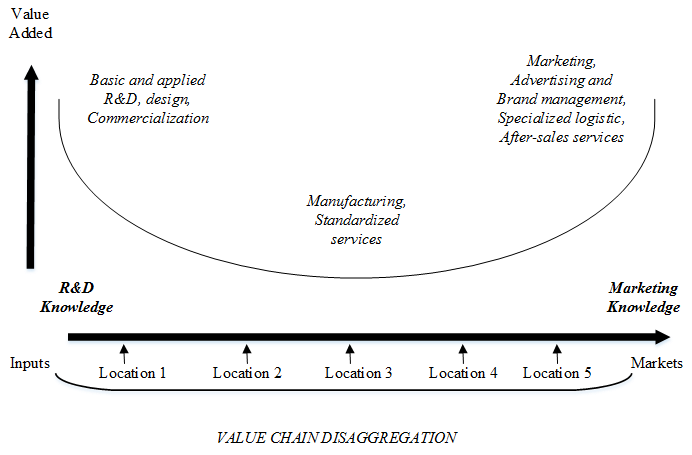
Across the global industry, brand owners and firms that design components have reported gross margins around 32%, compared with roughly 10% for contract manufacturers and less than 5% in commodity assembly. Brand owners may capture a large share of industry profits (Shin, Kraemer & Dedrick, 2012). Some specialised manufacturing activities also earn higher margins.
The differences are visible among Indian listed electronics manufacturers. Dixon, with its high-volume assembly model, did about ₹38,860 crore of revenue in FY25 on mobile growth near 195%, and reported a 3.9% EBITDA margin and a net margin near 2% once a one-off gain is stripped out (ICICI Direct). Kaynes, which owns more of the design and does harder industrial and automotive work, earned a 15.1% EBITDA margin and 10.8% net the same year, with Syrma in between. The margin gap is substantial, although product mix, customers, and manufacturing complexity also differ.
Why PCB economics vary so widely
Printed circuit boards (PCBs) show how widely profitability can vary within a single product category.
Victory Giant is a Chinese board maker, founded in 2003 and listed in Shenzhen since 2015. It moved into high-density interconnect boards in 2019, ended up as Nvidia's main supplier of the boards that go into AI servers and GPUs, and now reportedly does more than 70% of its business with Nvidia. In 2025 it booked ¥19.3bn of revenue, about US$2.83bn, and ¥4.3bn of net profit, about US$632m, up 273% in a year (Asia Business Outlook). Its share of the AI board market jumped from 1.7% in 2024 to 13.8% in the first half of 2025, its Shenzhen stock rose more than 580% on the year, and a Hong Kong listing in early 2026 raised HK$2.6bn with shares rising 60% on the first day.
Victory Giant earned roughly 22% net in 2025, nearly twice the 11% it made the year before, by focusing on specialised boards. Its net margin exceeds that of some semiconductor manufacturers. PCB profitability depends on technical requirements, customer qualification, and competitive intensity. The contrast with a 2% net-margin assembly business is instructive, even though their models differ.
JLCPCB offers a contrasting business model. JLCPCB, which sits inside the privately held JLC group next to the LCSC components distributor and the EasyEDA design tool, will sell you five prototype boards for about two dollars, turns over more than 20,000 orders a day, and has run orders for over four million customers and six million engineers (JLCPCB). Its advantage comes from low-cost prototyping at scale. Standardised online ordering reduces the cost and lead time of small PCB runs, making prototyping more accessible. India has limited domestic capacity in high-end boards and lacks a prototyping platform of comparable scale.
The market figures indicate the scale of the opportunity. The global board market is about US$74bn and China makes 50 to 56% of it, with 43 of the hundred largest board companies based there (Prismark, summarised in our theme research). India's own bare-board market is around US$5bn, and we import most of what we use. ELCINA reckons domestic makers cover only 30 to 35% of demand, Avendus puts the import share closer to 90%, and either way India makes the simple boards and buys in the rest while multilayer and flex demand is growing at 27 and 30% a year (Avendus).
Policy support is expanding to components
Component imports show where India's supply chain remains dependent on overseas production. Past the bare boards, India buys in the chips, the passives, the camera and display modules and the battery cells that together make up 40 to 50% of what sits inside a device. The Electronics Components Manufacturing Scheme, notified in April 2025 at ₹22,919 crore, was introduced to encourage domestic component production (PIB / MeitY). ECMS enables a mix of capex, turnover and hybrid support to reduce the upfront cost of setting up component production. It covers multilayer, flex and HDI boards, passives, connectors, camera and display modules, lithium cells, as well as laminates and manufacturing equipment. The government nearly doubled this outlay to ₹40,000 crore in the 2026-27 budget to extend support (Business Today). Sitting next to the India Semiconductor Mission and its newer push into equipment, materials and homegrown design IP, the policy focus on components and design is clear.
Where we see investment opportunities
Not every opportunity requires owning a fabrication plant. Components and advanced boards require substantial capital, which is why ECMS leans on capex support. Design and systems engineering can serve global customers without comparable manufacturing capital requirements. This creates opportunities for India's engineering-led companies.
Several Indian companies are already operating in these areas. VVDN runs end-to-end ODM work across networking, Wi-Fi and IoT, owning the product design, the RF and PCB engineering and the firmware (VVDN). Tessolve does chip design and semiconductor testing for global firms, and recently raised US$150m from TPG (TPG). Sahasra opened the country's first SME-led plant for semiconductor assembly, test and packaging at Bhiwadi in May 2026 (PIB).
Assembly was an important starting point. The next opportunity is to build more of the components, processes, and proprietary designs behind finished products. Victory Giant demonstrates the economics of specialised manufacturing. JLCPCB illustrates the advantages of scale and automation. India's imports and policy incentives show both the opportunity and the work required to build domestic supply. We see opportunities in design-led electronics companies, specialised component and board manufacturers, and systems engineering for global customers. We favour businesses that control design, tooling, and quality, and use manufacturing partners where that does not compromise their differentiation.
The assembly base is established. The next phase will require stronger capabilities in intellectual property, system architecture, and advanced components. Over the next decade, India's share of value added will matter alongside its production volumes. We are interested in founders building differentiated capabilities across this value chain.
Conclusion
The opportunity is to build electronics companies with lasting technical advantages and global customers, whether their strength lies in design, components, or specialised manufacturing.
If that is what you are building, we would like to talk.
DISCLAIMER
Details of all the funds managed by 3one4 Capital can be found here: https://www.3one4capital.com/aif-registration-details
For informational purposes only. This content does not constitute an offer to sell or a solicitation of an offer to buy units of any fund. Investments in AIFs involve market risks.
The views expressed herein are those of the author as of the publication date and are subject to change without notice. Neither the author nor any of the entities under the 3one4 Capital Group have any obligation to update the content. This publications are for informational and educational purposes only and should not be construed as providing any advisory service (including financial, regulatory, or legal). It does not constitute an offer to sell or a solicitation to buy any securities or related financial instruments in any jurisdiction. Readers should perform their own due diligence and consult with relevant advisors before taking any decisions. Any reliance on the information herein is at the reader's own risk, and 3one4 Capital Group assumes no liability for any such reliance.Certain information is based on third-party sources believed to be reliable, but neither the author nor 3one4 Capital Group guarantees its accuracy, recency or completeness. There has been no independent verification of such information or the assumptions on which such information is based, unless expressly mentioned otherwise. References to specific companies, securities, or investment strategies are not endorsements. Unauthorized reproduction, distribution, or use of this document, in whole or in part, is prohibited without prior written consent from the author and/or the 3one4 Capital Group.