.jpg)
Story Is the Ultimate Venture Moat. Audience-First Frameworks Must Replace the AI Glut
AI Architecture Is Fundamentally Sender-First
LinkedIn just dropped a new feature where users/readers can flag posts on their feed as AI slop. Slop. Merriam-Webster named "slop" its 2025 Word of the Year, defining it as low-quality digital content produced in quantity by artificial intelligence. The naming signals a profound structural shift all of us see and feel across platforms and the content we consume. The validation is significant because an institution tracking the English language since 1828 has confirmed that content creation and consumption patterns have changed enough to require a new definition.
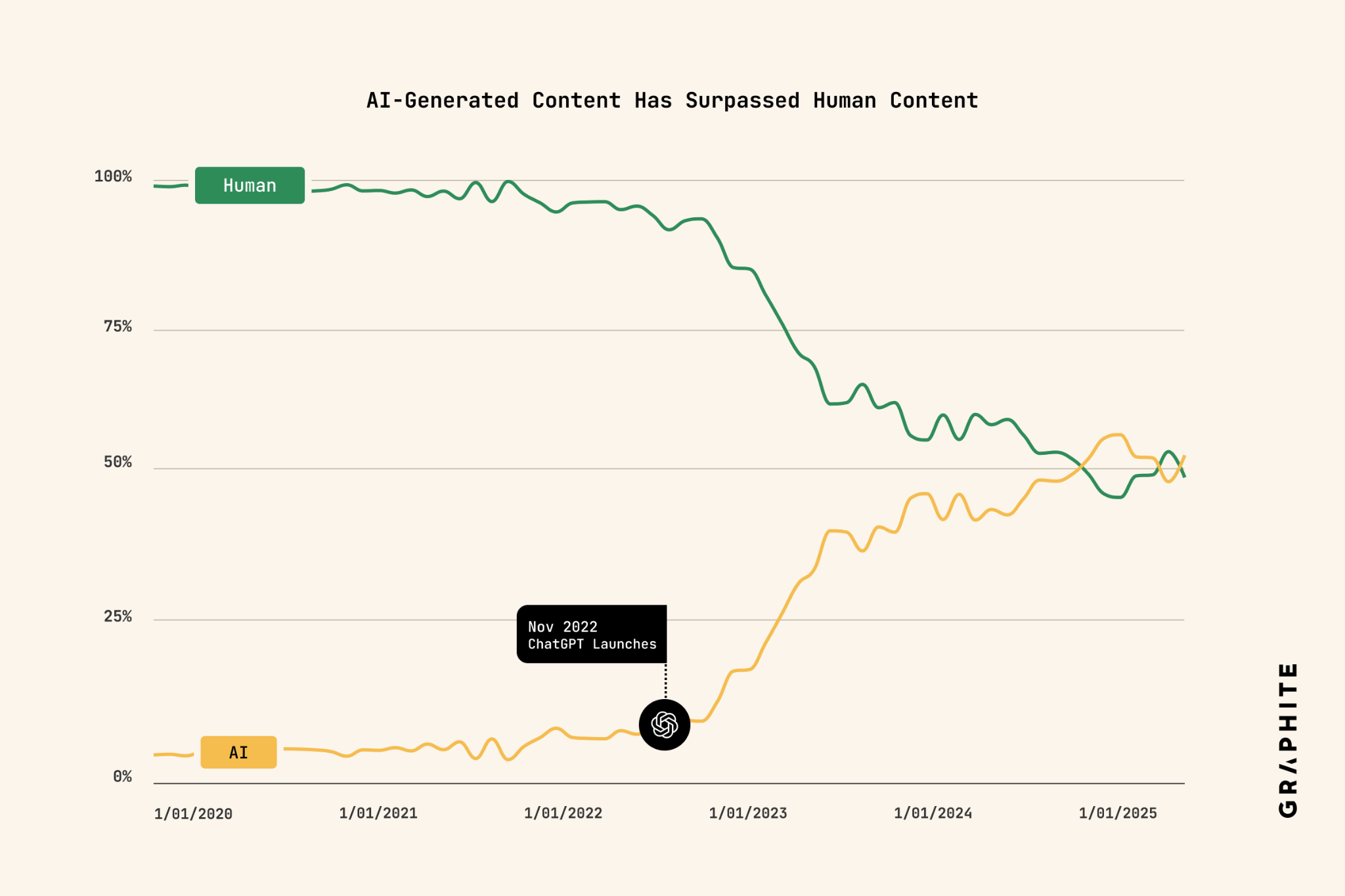
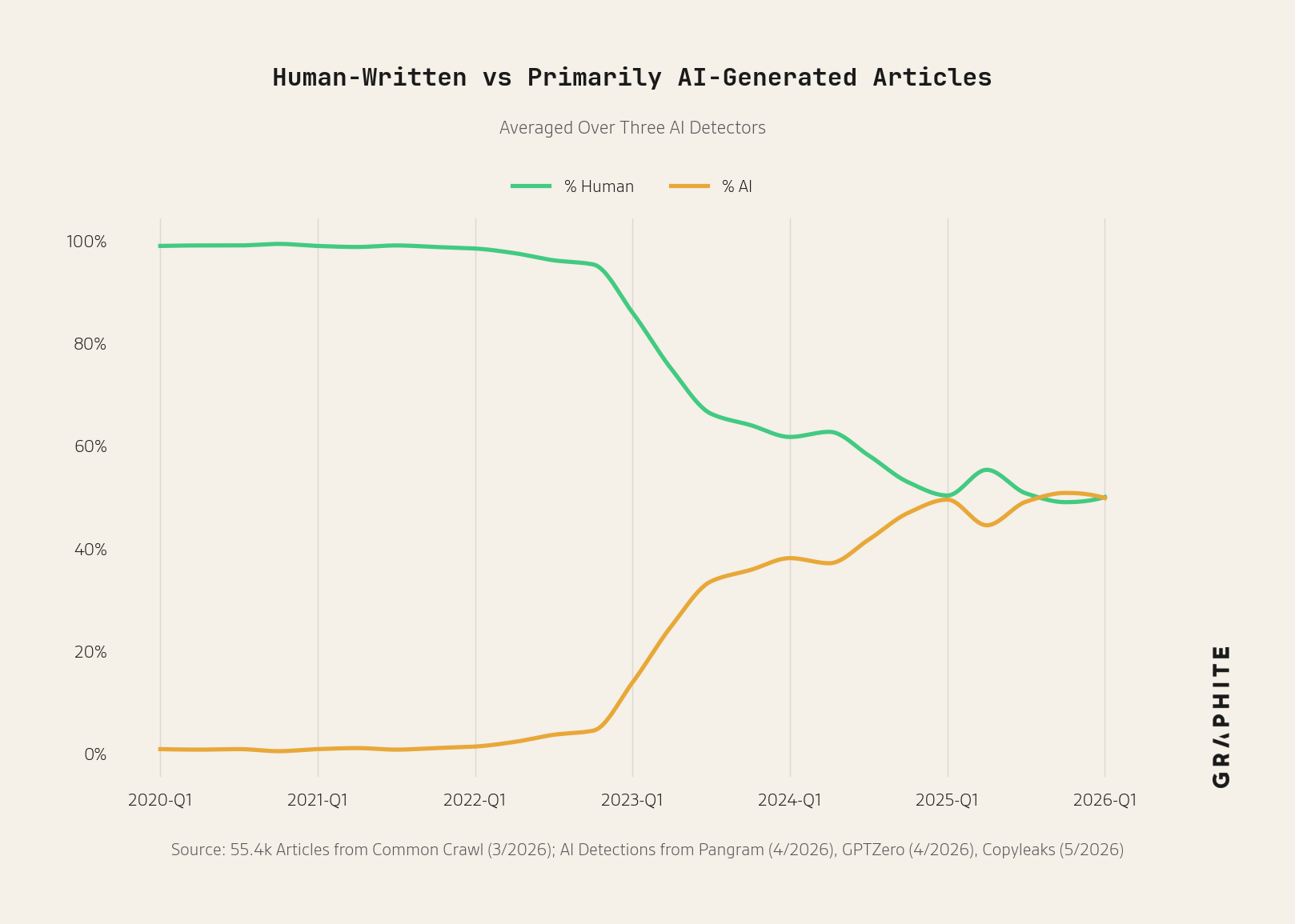
An analysis of over 65,000 URLs by SEO firm Graphite in 2025 revealed that there was significant growth in AI-generated articles coinciding with the launch of ChatGPT in November 2022. After only 12 months, AI-generated articles accounted for nearly 39% of articles published. Their research in 2026 showed that the number of articles published on the internet that are primarily AI-generated (50%) is equal to the number written by humans (50%).
Concurrently, Dr. Gloria Mark's longitudinal research at UC Irvine found that sustained digital attention dropped from 150 seconds in 2004 to just 47 seconds by 2023. The attention decline is further evidence that the supply of content is rising exponentially while human capacity to absorb it shrinks. The dual acceleration occurs because producing content now costs virtually nothing, eliminating the baseline economic incentive to maintain quality.
Most creators and companies are responding to the shift in content consumption and creation with superficial adjustments like refining prompts, increasing human editing, or injecting a line of personality before the call to action. The adjustments fail to solve the actual problem.
Cornell University researchers presented a study at CSCW 2025 detailing how online moderation groups handle automated text. Drawing on interviews with moderators from over 100 subreddits representing up to 32 million members, the paper received an honourable mention for best research. Moderators described AI-generated text as highly general and defensive rather than authentic. They identified AI content as a triple threat that degrades content quality, erodes human connection, and introduces governance challenges that are nearly impossible to manage.
The vocabulary used by the moderators highlights a deeper structural failure. Terms like "general" and "defensive" describe text that is technically present but completely hollow of personality. It is content that does not speak to the reader.
Current AI models are trained on historical data, optimised for volume, and built entirely around what the creator wants to broadcast. The technology has no built-in mechanism to understand the receiver. Output remains sender-first every time, regardless of how well the prose is polished. Better prompts simply produce better sentences following the system’s broken architecture.
The Creative Sequence Dictates the Value of the Tool
Distinct approaches to AI adoption yield vastly different outcomes across the market.
The non-user writes everything from scratch on principle. While their intellectual rigour is real, their output cannot scale, and this approach fails to compound over time.
Meanwhile, the slop producer delegates the entire writing process to machines without doing the thinking first. Volume becomes their default strategy, and they produce text that is structurally present but entirely forgettable. They skip the foundational questions required for resonance, failing to consider who they are talking to and what those readers are carrying into the piece.
The structured user operates differently by prioritising preparation through research first. They build a clear outline, identify the specific condition of their audience, and then use AI to draft and refine multiple iterations of their content. The core thinking happens before the writing begins, allowing technology to accelerate execution without diluting depth.
Reviewing corporate communications across the broader market reveals a consistent pattern of how content that generates genuine engagement invariably comes from a structured user. Content that disappears is built backward as AI is frequently deployed to facilitate lazy work rather than to scale well-researched outlines.
Audience-First Architecture Is the Answer to Wavering Attentions
The Panchatantra, attributed to Vishnu Sharma and dated to approximately 300 BCE, was written for three princes who needed to master governance and statecraft and were uninterested in every traditional method of instruction. Sharma answered with five interwoven books of stories. The framework relies on a premise most modern content creators ignore. Begin with understanding who is in the room and what they care about, and let the content you produce follow from that. AI cannot replicate this architecture, because knowing a reader requires a human being to pay close attention before generating a response.
The receiver-centred model is validated by modern communication history.
As Dave Dye documents on his blog, davedye.com, in the analysis titled "How to write good," the International Paper Company encountered an intense commodity problem in 1979. Because basic paper stock is an undifferentiated physical product, competing industrial firms could not stand out based on technical material features alone. To solve this commodity trap, Ogilvy and Mather executive Billings S. Fuess Jr. bypassed standard corporate broadcast methods. The agency chose instead to capture the strategic high ground by reaffirming an institutional commitment to the utility of publishing.
Before writing a single line of advertising copy, the agency surveyed young, college-educated adults to discover exactly what writing advice they wanted to receive and whose voices they trusted to give it. The resulting print campaign, "The Power of the Printed Word," generated a spectacular 27 million requests for copies because it positioned the audience's immediate informational needs before the company's broadcast agenda.
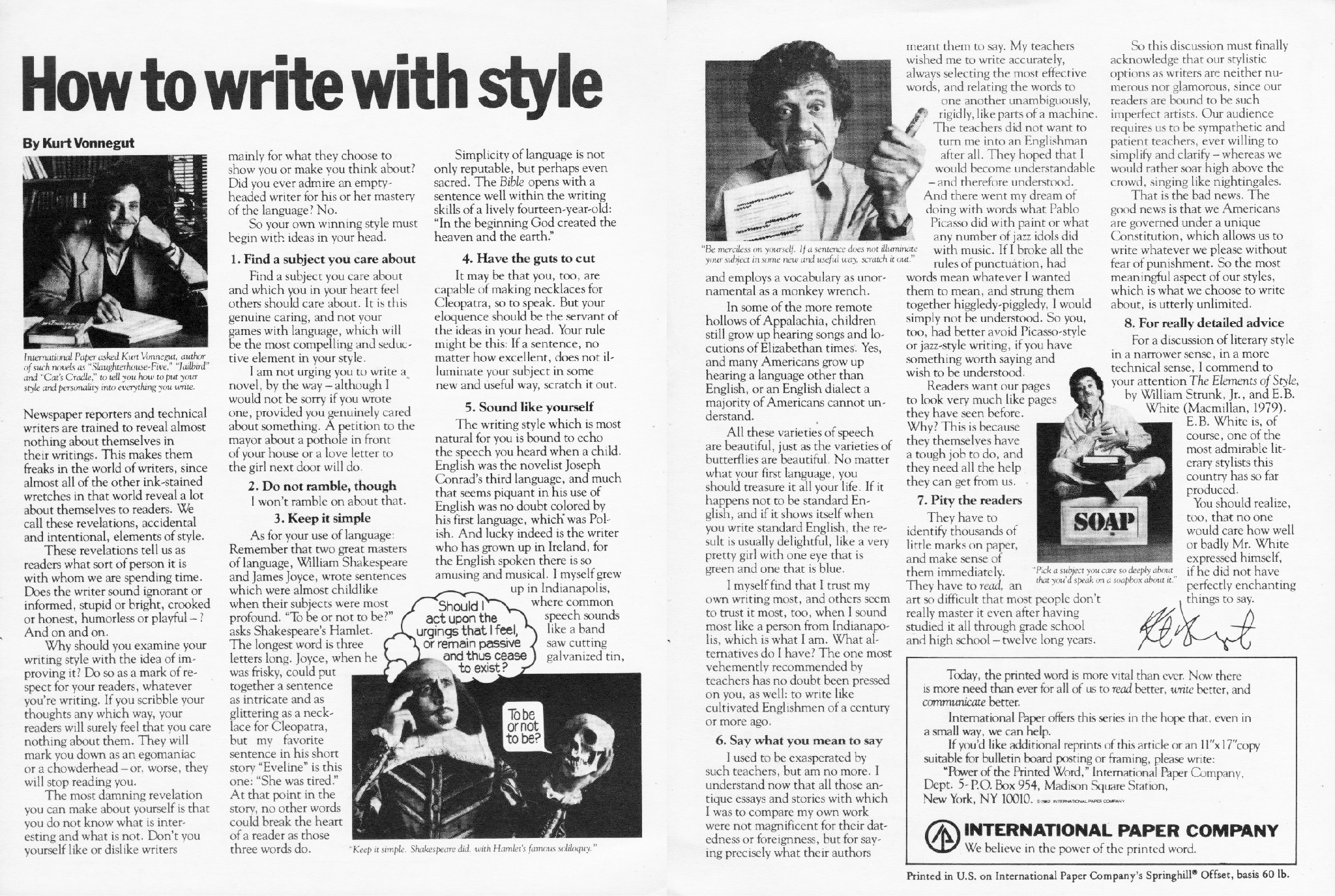
Many respected authors built out these manuals by executing the hard human thinking before drafting began. Kurt Vonnegut wrote the core guidelines on style, warning authors that writing about a subject they do not genuinely care about would lead to their readers dropping off. Vonnegut explicitly commanded writers to pity their readers by keeping the mechanics of the language simple, showing that masters like William Shakespeare and James Joyce used childlike sentence structures when handling profound themes. He challenged creators to have the guts to ruthlessly cut any sentence that fails to illuminate the subject in a new and useful way.
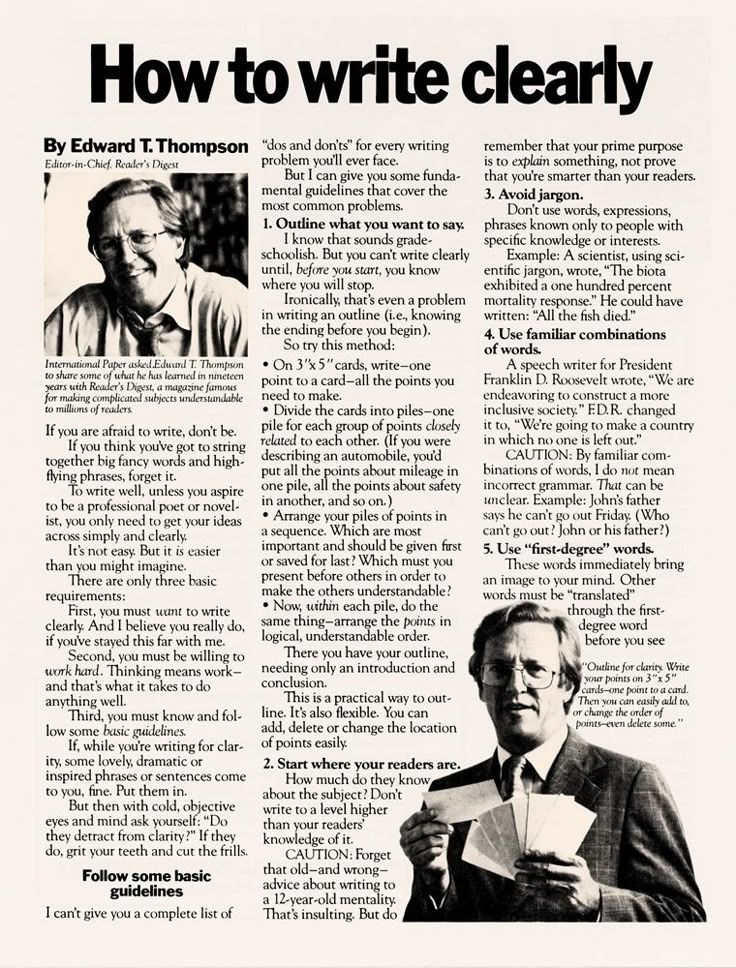
Operating from the same premise, Reader's Digest Editor-in-Chief Edward T. Thompson authored the campaign's foundational essay on clear writing. Thompson instructed authors never to waste words telling people what they already know, and to arrange their arguments onto logical index cards to ensure a strict progression before typing. He proved that clarity requires deliberate structural compression, urging writers to choose concrete first-degree words that immediately evoke mental images, eliminate professional jargon, and actively purge passive verbs that dilute the sentence. The series succeeded because it respected the listener.
All writers, storytellers and marketers are wordsmiths.
As Rudyard Kipling said, “I am, by calling, a dealer in words; and words are, of course, the most powerful drug used by mankind.”
Neuroscience Validates the Power of Ancient Narrative Structures
Princeton neuroscientist Uri Hasson found that when a narrative connects cleanly, neural activity across both the speaker's and listener's brains becomes nearly synchronous. This neural coupling means the listener does not simply process data they receive. They mirror the experience, mapping the speaker's brain patterns within their own mind. Crucially, this alignment vanishes the moment the audience disengages. The mechanism is unique to narrative, activating only when a story is deeply understood and felt.
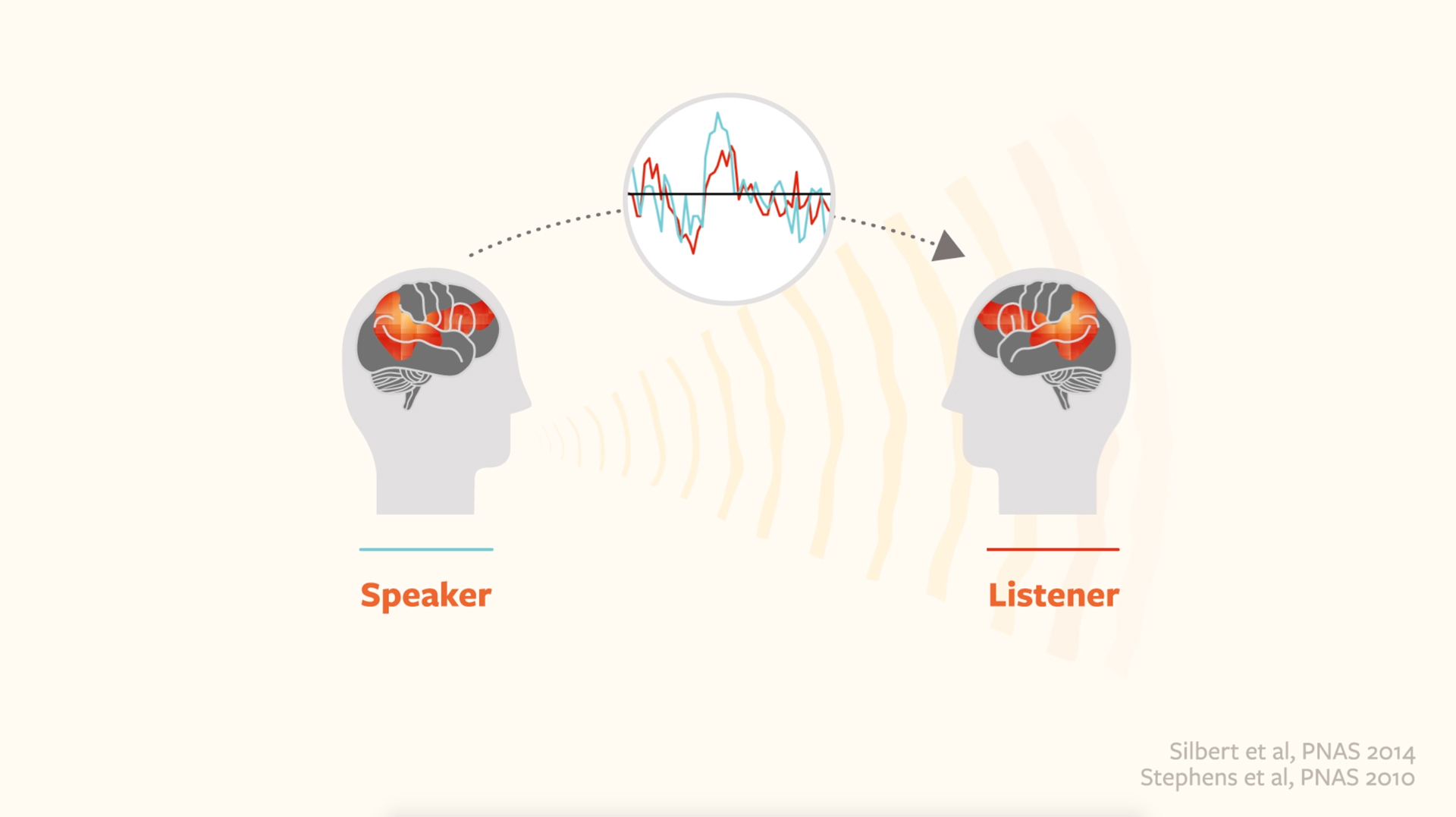
A follow-up study from Hasson's lab identified a collective phenomenon called the herding effect. As individual listeners mirror the speaker's brain activity, the entire audience clusters together in tight neural alignment. One precise story, tailored to a specific condition the audience cares about, can synchronise an entire room and keep it hooked. This effect applies directly to high-stakes founder environments including pitches, keynotes, essays, and video communications. The cognitive alignment is real, but it triggers only when the story explicitly accounts for its audience. The Panchatantra produces this effect automatically. Sender-first content cannot achieve it, regardless of how polished the prose appears.
Granular Specificity Drives Audience Resonance
An audience-first narrative breaks the moment a creator optimises purely for reach, because the specificity driving the story requires prior knowledge of the listener. Scaling an audience without maintaining that precision produces content that is broadly visible but not effective.
Starting with what you want to say produces sender-first content. Starting with the specific condition of your reader produces audience-first content. The gap between them is a fundamental sequencing error, and is instantly visible to the receiver. The right approach leaves a memory and creates a preference for content to be consumed on a regular basis.
In an environment where automated text generation has eliminated marginal production costs, generational companies build an un-commoditisable moat by capturing deep audience clarity even before opening a document.
Timeless Narrative Structures Permanently Outlast Changing Media
The Panchatantra has survived over two millennia of shifting media environments. It travelled from Sanskrit to Pahlavi, Arabic and Latin, outlasting every tectonic shift in distribution technology. The architecture endured because it governs the fundamental relationship between the teller and the listener rather than relying on a specific medium.
Creation tools are now completely commoditised, allowing anyone to publish at zero marginal cost. The volume of digital text will continue to climb, and the proportion generated by machines will rise with it. The rare capacity to understand an audience before typing a word remains un-commoditisable.
For founders, understanding an audience before writing to it is an economic asset that compounds over time. Every piece of audience-first precision deposits trust that the next piece builds upon. Every piece of automated slop erodes it. The divergence compounds faster than most leadership teams realise.
AI is a tool. The question is whether you use it to produce more content or to tell better stories. In this age of storytelling, with content now abundant and attention scarce, audience-first architecture remains the only way to earn the engagement you ask for.
DISCLAIMER
Details of all the funds managed by 3one4 capital can be found here: https://www.3one4capital.com/aif-registration-details
For informational purposes only. This content does not constitute an offer to sell or a solicitation of an offer to buy units of any fund. Investments in AIFs involve market risks.
The views expressed herein are those of the author as of the publication date and are subject to change without notice. Neither the author nor any of the entities under the 3one4 Capital Group have any obligation to update the content. This publications are for informational and educational purposes only and should not be construed as providing any advisory service (including financial, regulatory, or legal). It does not constitute an offer to sell or a solicitation to buy any securities or related financial instruments in any jurisdiction. Readers should perform their own due diligence and consult with relevant advisors before taking any decisions. Any reliance on the information herein is at the reader's own risk, and 3one4 Capital Group assumes no liability for any such reliance.Certain information is based on third-party sources believed to be reliable, but neither the author nor 3one4 Capital Group guarantees its accuracy, recency or completeness. There has been no independent verification of such information or the assumptions on which such information is based, unless expressly mentioned otherwise. References to specific companies, securities, or investment strategies are not endorsements. Unauthorized reproduction, distribution, or use of this document, in whole or in part, is prohibited without prior written consent from the author and/or the 3one4 Capital Group.


-p-500.webp)