

The Economics Behind: Structuring Finance Teams For Your Start Up
Introduction
In the high growth era of the past decade, startups were celebrated for chasing scale at all costs. Global capital poured into companies that could demonstrate traction, user acquisition, and rapid expansion, even if the underlying business model was far from profitable. That world has changed. Today, global investors are re-orienting their focus toward sustainability, governance, and a credible path to profitability.
In this new landscape, finance, a function often overlooked in early-stage companies, has become mission critical. For founders, building a lean and capable finance team is a foundational investment for early-stage startups, essential for driving long-term resilience, credibility, and value creation rather than just a later-stage requirement.
Finance serves as a strategic partner in early-stage startups, securing cash flow as the company's lifeblood, clarifying runway, and optimising unit economics. By ensuring transparent reporting and strong governance, finance builds essential investor trust while equipping founders with the data-driven insights required to navigate growth, hiring, and expansion.
In short, the finance team is evolving from a back-office support function into a strategic partner. In an environment where capital is scarce and scrutiny is high, startups that establish strong financial discipline early on will not only survive but stand out. Hence, ensuring you have the right finance team in place across all early stages of growth is imperative.
On the back of this, we will explore how founders/ senior finance leaders should look at structuring their finance teams and the accelerated evolution of these teams, considering the current focus on governance, transparency in reporting and path to profitability.
Teams and areas of coverage
Before looking at the key considerations in structuring finance teams during the early stages of a startup’s growth, it is important to first outline the responsibilities that such a team is expected to undertake:
Accounting
Accounting is often seen as the most basic finance function, but in early-stage startups it sets the stage for everything else. Clean, accurate books provide the backbone for decision-making, investor reporting, and future audits. Accounting at this stage moves beyond basic expense tracking to become a cornerstone of organisational discipline.
- Expense categorisation ensures founders know where money is being spent and can identify areas to cut or invest further.
- Revenue recognition (especially in SaaS or subscription models) helps prevent misleading topline numbers.
- Audit readiness becomes critical as companies prepare for later-stage fundraising or potential M&A.
Startups that neglect proper accounting early often face painful cleanups down the road, delaying investment rounds and creating governance concerns.
Safe to say that if your accounting is in doubt, so is your next round of funding.
Accounts Payable (AP) & Accounts Receivable (AR)
Cash is oxygen for startups, and AP/AR management determines how well that oxygen flows through the entire system. The finance team ensures that money comes in on time and goes out in a way that preserves runway.
- On the AP side, this means negotiating favourable vendor terms, avoiding unnecessary liabilities, and ensuring payments are made strategically without damaging relationships.
- On the AR side, it means setting up efficient billing and collection processes so revenue doesn’t get stuck in limbo.
In early stage startups, even a few delayed receivables or poorly managed payables can create a liquidity crisis. Effective AP/AR management will stretch cash flow and build credibility with suppliers, partners, and customers.
Financial Reporting & Analysis [FP&A]
Numbers alone don’t drive decisions — analysis does. Financial reporting and analysis help founders and investors understand not just what happened, but why, and what should happen next.
- Monthly management reports provide clarity on revenue, expenses, margins, and cash position.
- Cohort and unit economics analysis reveals the profitability of customers, products, or geographies.
- Scenario planning and forecasting enable founders to weigh trade-offs, such as delaying a hire or expanding into a new market.
At its best, financial analysis is a decision-support system that helps founders balance growth with sustainability, spotl risks, and guide strategic priorities.
Fundraising & Investor Relations
In today’s VC climate, investors expect clear, credible financials and a founder team that can demonstrate fiscal responsibility along with a compelling story.
- During fundraising, finance prepares detailed models, data rooms, and forecasts that withstand investor scrutiny.
- Post-investment, ongoing investor relations means timely updates, transparent reporting, and responsiveness to queries.
A strong finance function reassures investors that capital will be managed wisely, improving both the likelihood of raising funds and the quality of long term relationships.
Compliance & Risk Management
Startups often underestimate the importance of compliance until it becomes a problem. From tax filings to labour laws to international accounting standards, regulatory missteps can cause delays, fines, or even reputational damage.
- Regulatory compliance ensures the business meets tax, payroll, and statutory obligations in every market it operates in.
- Governance frameworks (internal controls, approval processes) reduce the risk of fraud or financial mismanagement.
- Risk management includes everything from FX exposure to insurance coverage to cybersecurity and data protection.
Good governance sends a strong signal to investors and partners that the company is professional, disciplined, and built for the long term.
Key factors to consider prior to structuring
Not every startup needs a CFO or a full accounting department at the incorporation stage. The right structure depends on the nature of the business, its scale, and the complexity of its operations. These four factors, the stage of growth, business model, technology stack, and the choice between outsourcing vs. building internally, all play a defining role.
Business Model: B2B vs. B2C
The type of business fundamentally shapes the structure of finance operations.
- B2B:
- Deals are typically larger, but cash collection can be slower, creating pressure on working capital.
- Finance teams need strong AR processes, contract management, and credit control.
- Revenue recognition can be complex (e.g., long-term contracts, SaaS subscriptions, milestones), so early investment in accounting expertise is valuable.
- B2C:
- Transaction volumes are high, but individual values are small, requiring systems that can handle large-scale AP/AR automation.
- Finance focuses more on unit economics (CAC vs. LTV, churn rates, contribution margins) to guide marketing and pricing.
- Fraud detection, payments reconciliation, and revenue assurance become critical as customer bases grow.
Technology Stack Adopted
The tools a startup chooses can dramatically reduce (or increase) the need for headcount in finance.
- At Seed Stage: Founders can leverage simple cloud-based solutions like Zoho Books, Tally for bookkeeping, alongside payroll and expense tools. These reduce manual work and keep operations lean.
- At Growth Stage: As complexity increases (multiple entities, multi-currency, or international operations), startups benefit from more complex ERP systems like NetSuite, SAP or AR automation & revenue reconciliation tools such as Growfin, ZenStatement, etc.
Choosing the right tech stack can delay the need for additional hires in accounting or FP&A. Conversely, under-investing in tools often leads to fire drills, errors, and expensive clean-ups later.
Outsourcing vs. Building Internally: Cost vs. Control
Early-stage startups often rely on outsourcing, but the balance shifts as the business grows.
- Outsourcing (Good for Seed–Series A):
Cost-effective, access to specialist expertise (accounting, tax, compliance) without full-time hires. But it is essential to find the right partner with the right expertise for your business. - Building Internally (Essential from Series B onwards):
Dedicated team with deeper understanding of the business, faster reporting cycles, ability to partner with leadership on strategic decisions.
Many startups also adopt a hybrid approach — outsourcing transactional tasks like bookkeeping or payroll while hiring an internal finance lead to handle investor reporting, analysis, and strategy.
In the early stages, outsourcing keeps costs low. As the company scales, building an in-house team becomes critical for speed, control, and strategic alignment.
Stage of Growth: Matching Complexity with Capability
This serves as the primary determinant of the finance team’s structure and therefore warrants a closer examination.
A startup’s financial needs evolve as it matures. Trying to “overbuild” too early can be wasteful, while underinvesting at critical inflection points can stall growth or block funding.
Seed
.webp)
At this point, the priority is cash preservation and credibility with investors. Finance can usually be handled with a lean setup — outsourced bookkeeping, basic accounting software, and a founder reviewing the numbers. What matters most is accuracy, compliance, and visibility on the cash runway. These services help ensure the company's financial operations are handled accurately and efficiently, allowing the founders and core team to focus on growing the business.
However, if strategic guidance from a senior professional is required, a Fractional Finance Leader is typically considered. This is most likely if the company is building up to a key milestone, such as a fundraise or geographical/product expansion and requires occasional support from someone who has been there, done that previously.
Depending on the level of operations at this stage, it may also be fruitful to look to hire a finance manager who understands the financial operations of the business and to coordinate between third party accounting teams, auditors, and investors for data requests.
At this stage, the finance function should remain lean, with a focus on cash preservation, investor credibility, and maintaining accurate, compliant financial records. Basic bookkeeping and accounting software, often supported by outsourced providers, are typically sufficient, with founders overseeing critical reviews to ensure visibility on cash runway.
Where strategic guidance is required, particularly in anticipation of milestones such as fundraising or market expansion, engaging a Fractional CFO can provide valuable expertise. Additionally, depending on operational complexity, appointing a finance manager may be beneficial to coordinate with external accountants, auditors, and investors, ensuring smooth financial operations and timely data management.
Series A
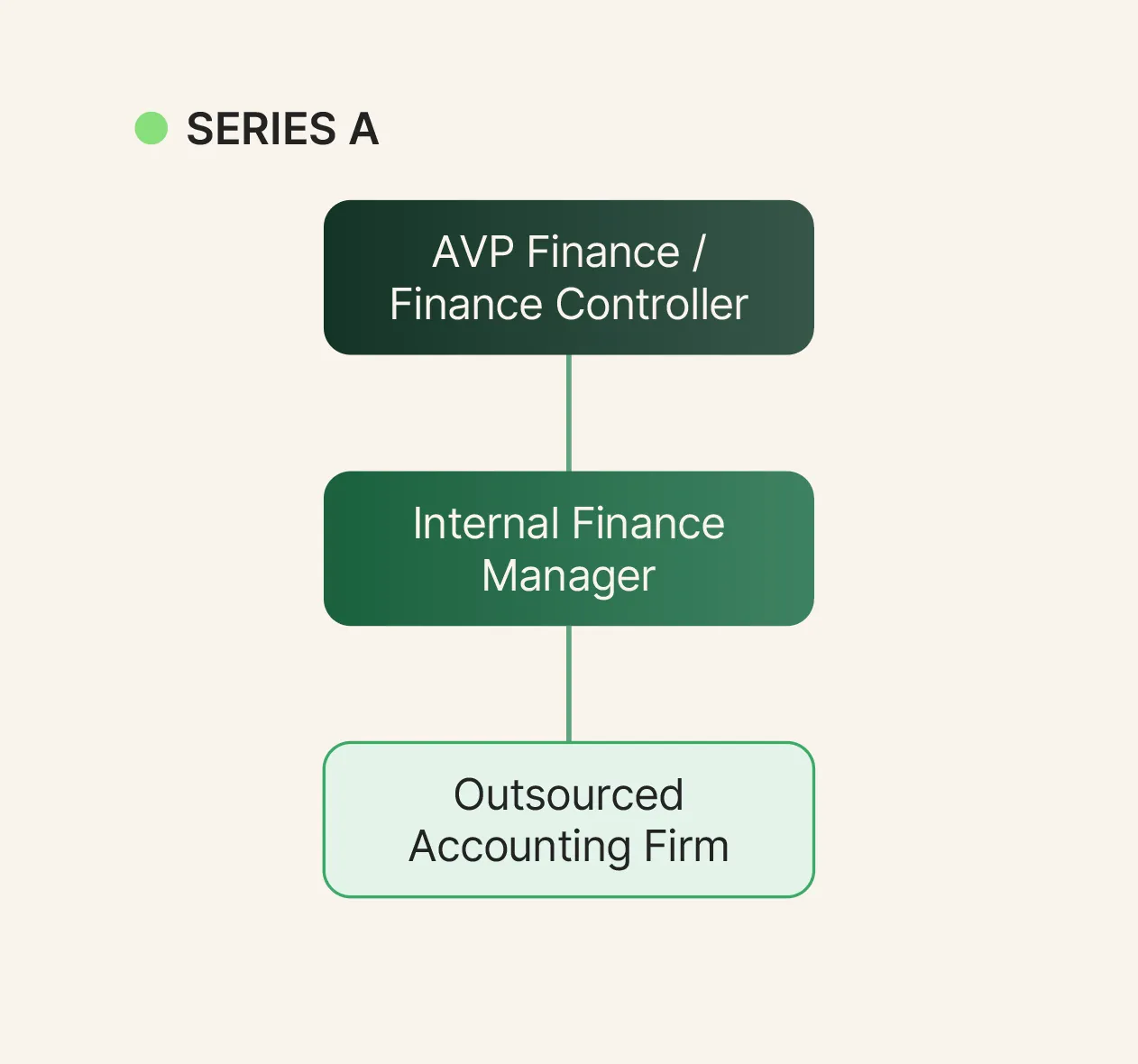
At the Series A stage, the finance function typically remains compact, with individuals overseeing multiple responsibilities. The structure is intentionally streamlined to reflect the company’s resource constraints and its primary focus on product development and initial market traction.
However, in certain sectors such as marketplaces, e-commerce, consumer products, retail, fintech, and segments of SaaS, business models often involve international operations and high volume, low value transactions that demand robust financial operations processes. In such cases, appointing a hands-on Financial Controller or an AVP/Director of Finance may be necessary to ensure effective oversight and scalability.
Series B
.webp)
Following a Series B fundraising round, startups typically enter a phase of operational scaling that necessitates a more structured finance team to support growth and attract additional investment. At this stage, the team enhances financial planning and analysis, delivers detailed reporting to both leadership and investors, and provides visibility through data-driven insights, scenario planning, and modeling.
The complexity of the finance team structure depends on factors such as the industry, revenue model, founders’ expertise, upcoming milestones, and available budget. Assessing both current and anticipated requirements over the next 12 months is essential to building a finance function capable of scaling with the business rather than merely meeting immediate needs.
In this stage, the CFO or VP of Finance oversees the company’s strategic financial direction and overall health, supported by a Financial Controller, who manages operational financial processes and specific functional areas and a Head of FP&A. Hiring a FinOps Head might also be a consideration depending on the scale of operations.
Series C
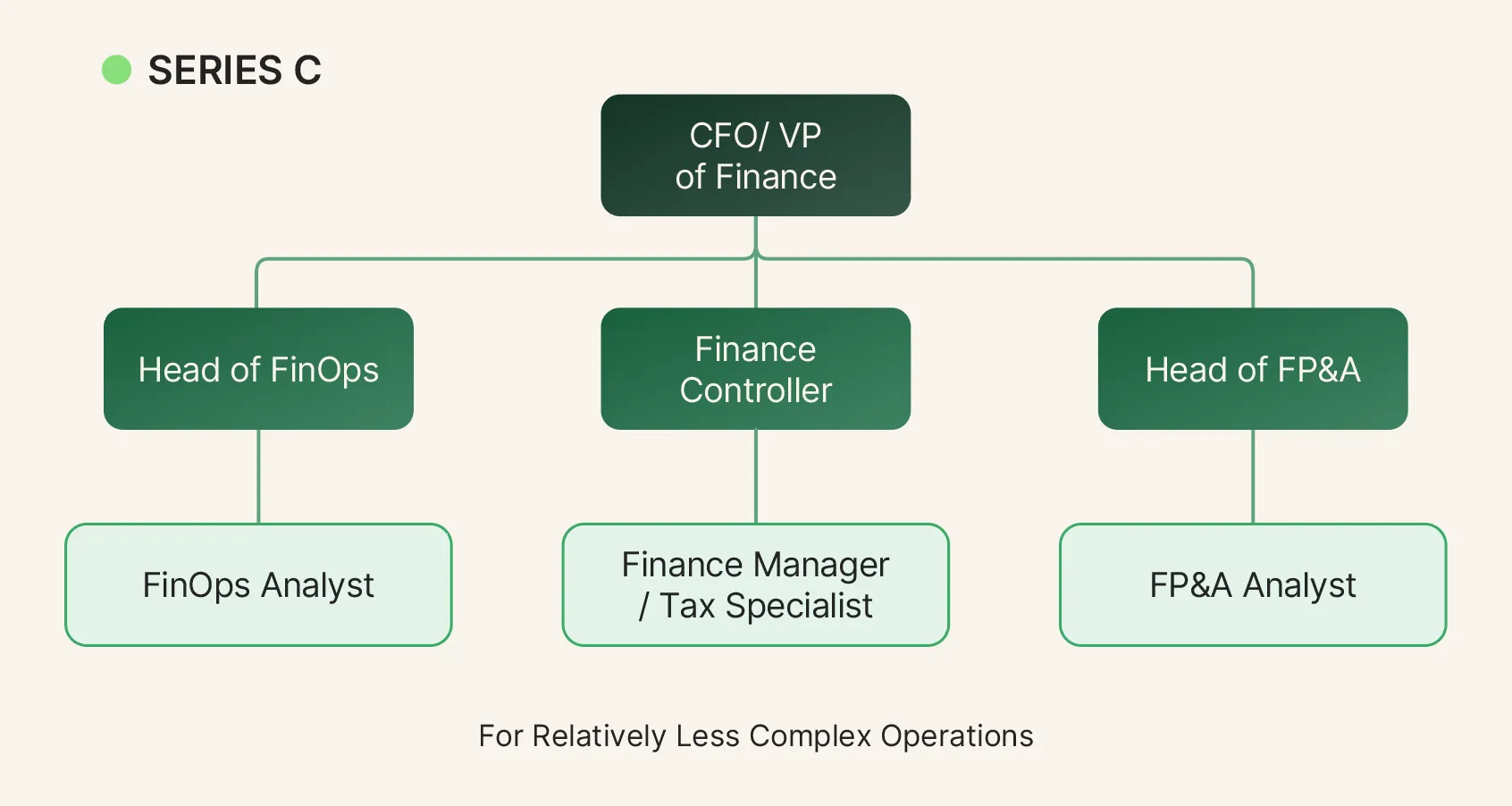
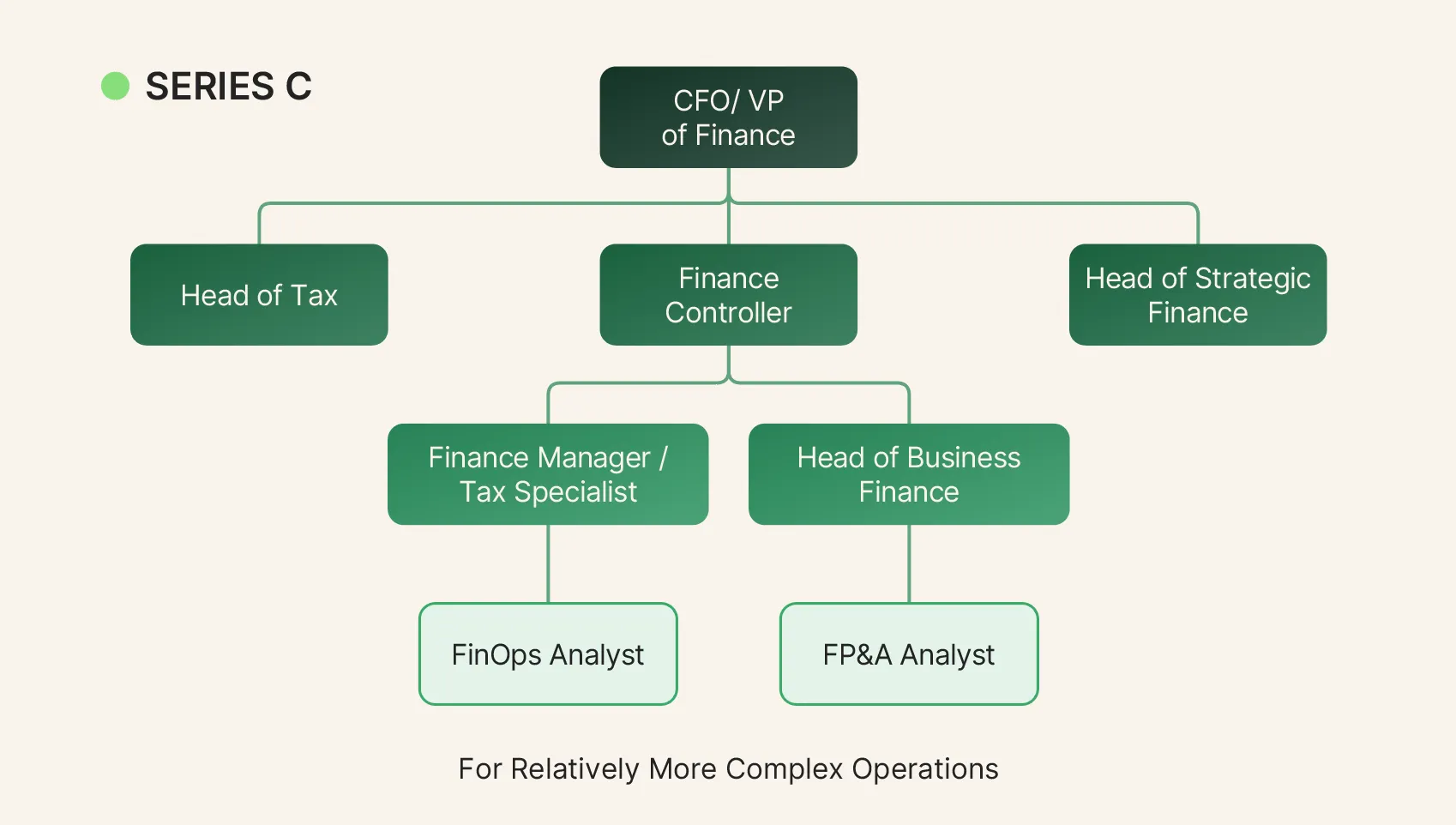
By the Series C stage, startups typically experience substantial growth, necessitating a more specialised and segmented finance team. Each function within the department is typically divided into sub-functions, each overseen by dedicated leaders. The role of a strong CFO or VP of Finance becomes increasingly critical, given the growing volume of internal reports and executive responsibilities.
At this stage, the finance function is expected to deliver advanced financial planning, strategic partnerships, detailed analysis and reporting, and support for large-scale operations and potential public offerings. Accordingly, specialists in areas such as tax, financial reporting, strategic finance, and business intelligence are often appointed, with a Finance Director reporting directly to the CFO to ensure cohesion and effective management of the department.
Series C+
.webp)
Beyond the Series C stage, companies are typically well-established, necessitating a highly focused and layered finance team to manage the increased complexity and scale of operations. The finance department is organised into multiple sub-functions, each led by dedicated managers, and is ultimately overseen by an experienced CFO responsible for managing extensive internal reporting, executive responsibilities, and strategic financial decision-making.
Conclusion
The structure and evolution of a startup’s finance team play a pivotal role in its ability to scale sustainably and attract investor confidence. From the lean, cash-conscious setups of the Seed stage to the specialised, multi-layered functions of Series C+ companies, finance transforms from a transactional back-office role into a strategic partner that drives decision-making, governance, and long-term value creation.
A well-structured finance team ensures accurate accounting, effective cash flow management, robust reporting and analysis, and compliance with regulatory requirements. It enables founders to focus on growth while providing investors and stakeholders with transparent, credible insights. By carefully aligning team structure with business model, stage of growth, technology stack, and the balance between outsourcing and in-house capabilities, startups can build a finance function that meets current operational demands and scales seamlessly with the company’s ambitions.
Ultimately, thoughtful investment in a capable finance team is a strategic advantage that positions startups for resilience, profitability, and sustainable success in today’s competitive funding environment.
For suggestions/queries on selecting ERPs, revenue reconciliation tools, outsourced third party accounting providers, or engaging a fractional CFO, please feel free to contact us. At 3one4, we maintain a vetted network of expert financial consultants and products that we have successfully worked with.
DISCLAIMER
The views expressed herein are those of the author as of the publication date and are subject to change without notice. Neither the author nor any of the entities under the 3one4 Capital Group have any obligation to update the content. This publications are for informational and educational purposes only and should not be construed as providing any advisory service (including financial, regulatory, or legal). It does not constitute an offer to sell or a solicitation to buy any securities or related financial instruments in any jurisdiction. Readers should perform their own due diligence and consult with relevant advisors before taking any decisions. Any reliance on the information herein is at the reader's own risk, and 3one4 Capital Group assumes no liability for any such reliance.Certain information is based on third-party sources believed to be reliable, but neither the author nor 3one4 Capital Group guarantees its accuracy, recency or completeness. There has been no independent verification of such information or the assumptions on which such information is based, unless expressly mentioned otherwise. References to specific companies, securities, or investment strategies are not endorsements. Unauthorized reproduction, distribution, or use of this document, in whole or in part, is prohibited without prior written consent from the author and/or the 3one4 Capital Group.


.jpg)


