Translating Intelligence into Action. 3one4 Capital and AWS Host the Physical AI Builder Session.
Moving Beyond the Screen. The Transition to Physical Artificial Intelligence
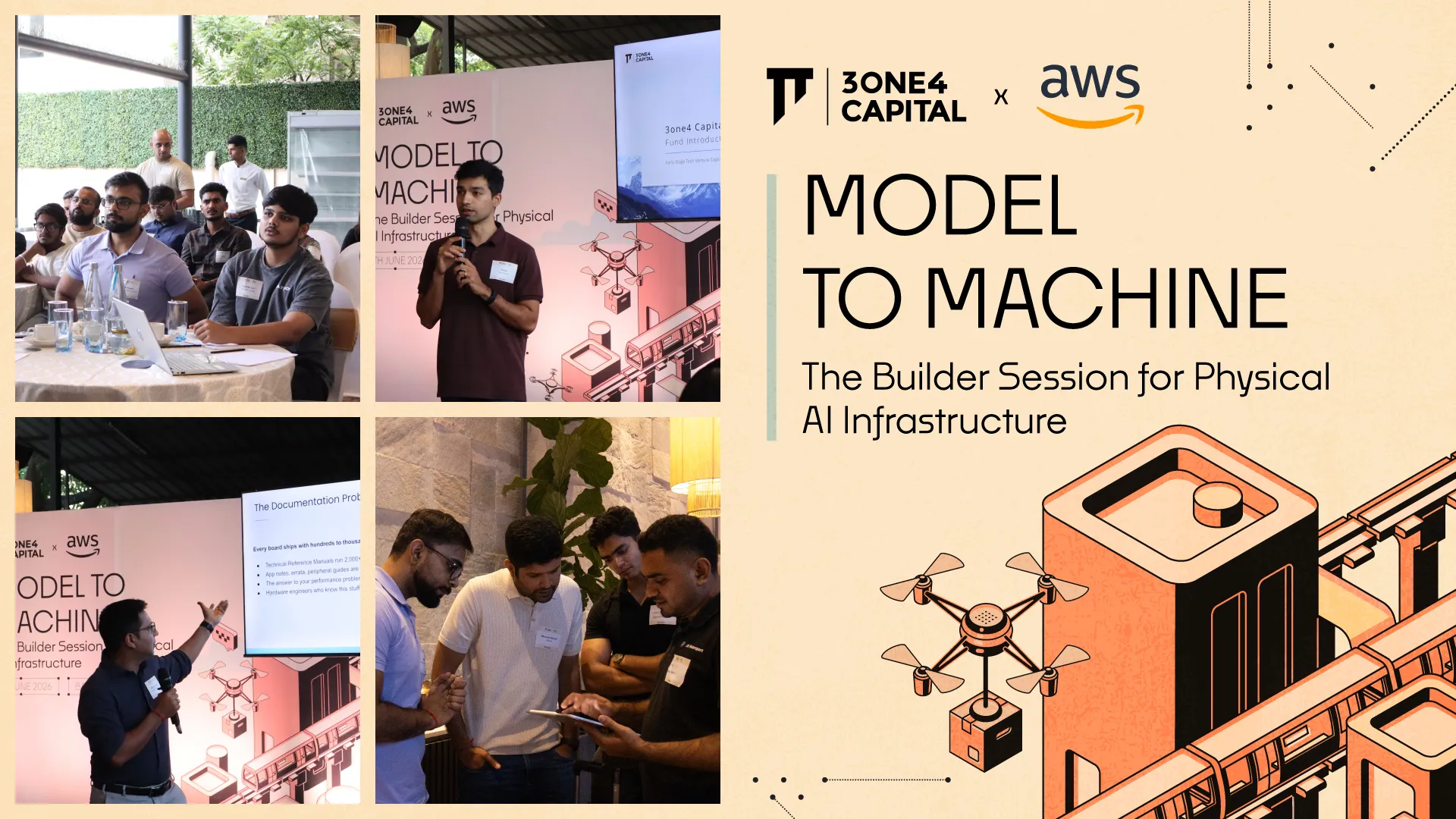
Transformers succeeded by tokenising digital data to predict sequences, the physical world resists simple tokenisation. Deploying intelligent systems in industrial environments presents complex engineering challenges. 3one4 Capital partnered with Amazon Web Services to host the The Model to Machine: A Builder Session on Physical AI in Bengaluru. The recent closed-door gathering convened founders, engineers, and researchers to examine the practical realities of scaling physical artificial intelligence from research to production.
The Intelligence of Embodiment. Compressing Physical Reality
Sonal Saldanha, Principal at 3one4 Capital, opened the forum by detailing the firm's thesis on physical artificial intelligence. A foundational thesis on physical AI suggests that while models successfully compress digital representations of the world into mathematical weights, achieving similar compression for physical reality remains the primary engineering challenge for the next generation of technology. Moravec’s Paradox dictates that physical tasks that are simple for humans remain exceptionally difficult for machines. Physical environments contain infinite variations in dimension, material, and weight. Generalising intelligence requires systems capable of mapping observation to policy decisions and subsequent physical action.
Early evidence indicates that scaling laws are beginning to emerge in physical artificial intelligence. Embodiment accelerates learning rapidly. Deploying robotics in real-world settings creates a continuous data feedback loop to refine foundational models. Vertical applications will establish the foundation for broader horizontal platforms.
The Infrastructure Builders Translating Research to Industrial Scale
The session featured live demonstrations from four organisations building the foundational infrastructure for physical artificial intelligence.
Unbox Robotics replaces rigid warehouse conveyor systems with autonomous swarm intelligence, utilising proprietary motor control drivers and battery management systems to maintain total architectural control. Their presentation showcased a 160-robot deployment executing real-time path planning and vertical sorting for global logistics providers, demonstrating how building in-house hardware, such as reducing specific component costs from 1.5 lakh rupees to 26,000 rupees is essential for commercial viability. By controlling the entire hardware and software stack, the company utilises vertical sorting robots to significantly compress warehouse footprints and optimise logistics routing, ultimately allowing them to sell guaranteed sorting throughput rather than just individual units.
Next, H2LooP AI demonstrated Hydron, a hardware-aware coding agent designed for mission-critical deployments. The presentation highlighted how generic artificial intelligence copilots hallucinate hardware constraints and crash deployment pipelines. Hydron ingested exact system-on-chip data sheets to optimise a vision model deployment. The agent instantly pushed processing speeds from four frames per second to over twenty frames per second on legacy hardware. Grounding code generation in exact hardware documentation delivers mathematically verified software for demanding industrial environments.
Other founders at the event also spoke about accelerating the broader physical infrastructure stack. One demonstration featured an agentic suite automating the perception layer and firmware generation. The platform allows developers to output compiled vision pipelines directly deployable to edge devices. Another presentation addressed the scaling bottleneck founders face when moving from early prototypes to mass manufacturing.
An Enduring Conviction to Engineer an Autonomous Future
The transition to physical artificial intelligence demands rigorous execution and deep technical mastery. Founders must solve complex edge cases across hardware, software, and real-world deployment simultaneously. Significant engineering depth exists to build foundational infrastructure for global industrial automation. Technical founders remain capable of translating advanced research into resilient commercial outcomes.
DISCLAIMER
The views expressed herein are those of the author as of the publication date and are subject to change without notice. Neither the author nor any of the entities under the 3one4 Capital Group have any obligation to update the content. This publications are for informational and educational purposes only and should not be construed as providing any advisory service (including financial, regulatory, or legal). It does not constitute an offer to sell or a solicitation to buy any securities or related financial instruments in any jurisdiction. Readers should perform their own due diligence and consult with relevant advisors before taking any decisions. Any reliance on the information herein is at the reader's own risk, and 3one4 Capital Group assumes no liability for any such reliance.Certain information is based on third-party sources believed to be reliable, but neither the author nor 3one4 Capital Group guarantees its accuracy, recency or completeness. There has been no independent verification of such information or the assumptions on which such information is based, unless expressly mentioned otherwise. References to specific companies, securities, or investment strategies are not endorsements. Unauthorized reproduction, distribution, or use of this document, in whole or in part, is prohibited without prior written consent from the author and/or the 3one4 Capital Group.
.jpg)