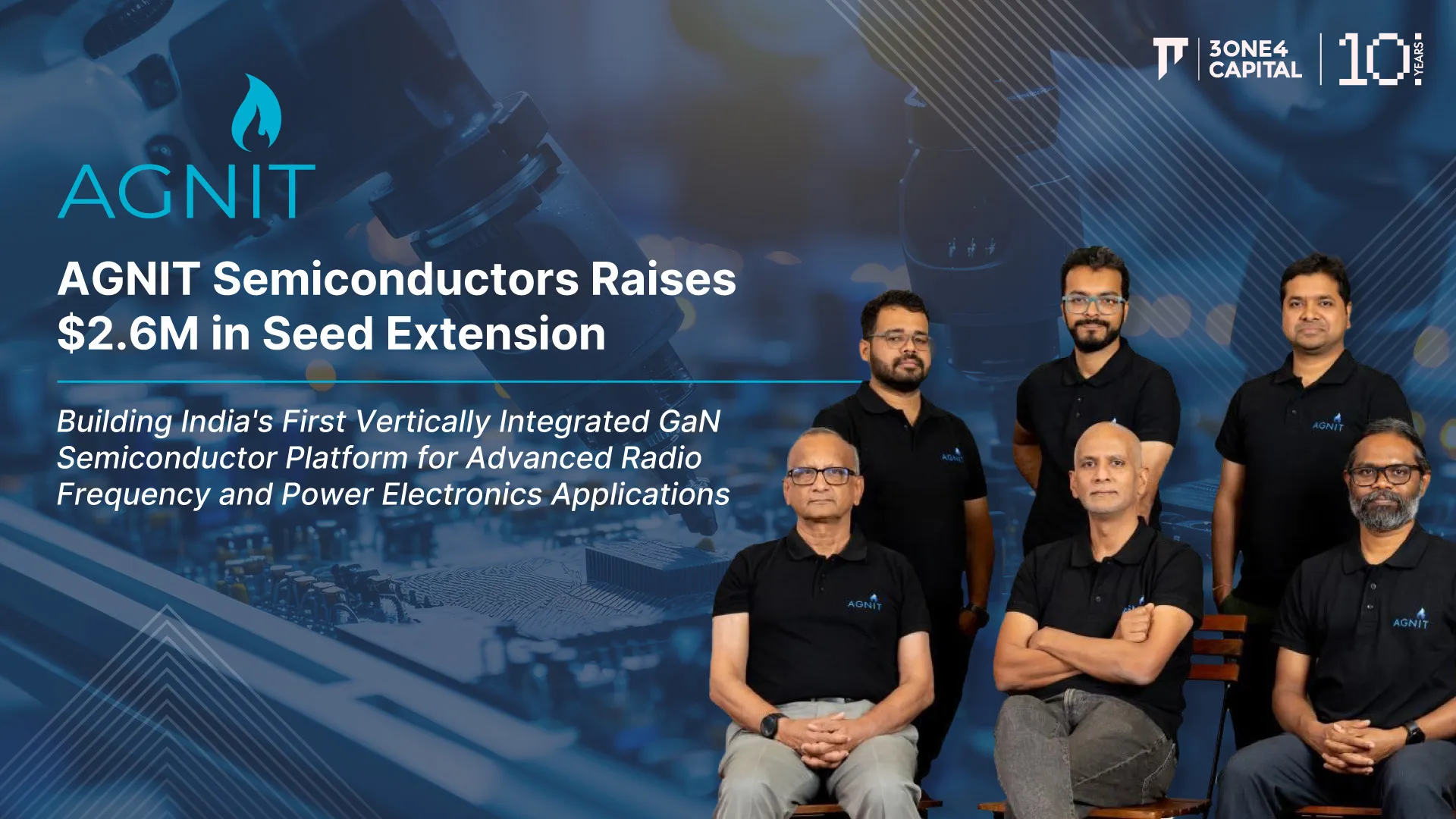
AGNIT Semiconductors Raises $2.6M in Seed Extension: Building India's First Vertically Integrated GaN Semiconductor Platform for Advanced Radio Frequency and Power Electronics Applications
At 3one4 Capital, we've long believed that the most defensible technology companies are built on accumulated scientific knowledge that takes years to develop and cannot be replicated by capital alone. The depth of the foundation determines the durability of the moat.
We backed AGNIT Semiconductors in 2024, recognising a founding team that had spent more than 18 years at the Indian Institute of Science developing GaN semiconductor technology from the substrate up. Our decision to invest at the seed stage was driven by a core question around what it would take for India to meet a meaningful share of its GaN demand by 2030.
When we first met, AGNIT had already grown wafers, developed devices, proven performance, and patented technology, epitaxy processes, and device architectures. Since then, the team has expanded its wafer portfolio, completed first international exports, launched commercial RF devices, and deployed pilots on Indian strategic platforms.
Today, we're proud to continue backing the team as AGNIT announces a $2.6 million seed extension from 3one4 Capital alongside Shastra VC, with continued participation from Zephyr Peacock India.
Why This Matters
For decades, the global semiconductor industry operated on a division of labour that seemed permanent. Chips were designed in one country, fabricated in another, and shipped everywhere else. That arrangement is now being deliberately unwound.
Governments across the United States, Europe, Japan, and India are committing serious capital to build domestic semiconductor capability. Concentrated dependence on a small number of geographies for critical technology has proven to be a structural vulnerability that nations are no longer willing to accept.
India has spent decades importing semiconductors. The government's intent to fund domestic semiconductor capability reflects an acknowledgement that this must change. We believe the most consequential place to begin that effort is in the materials and devices that power strategic electronics and next‑generation wireless infrastructure, where performance requirements have already outgrown what silicon can reliably deliver.
The global GaN semiconductor market is valued at $32 billion and growing at 6% annually. The serviceable market in RF and power electronics is $9.2 billion, growing at 23%. Within India, the obtainable market across strategic, telecom and power conversion is $950 million, growing at 40%. GaN accounts for 10 to 15% of total radar system cost and 30 to 40% of a 5G radio unit's bill of materials, making it a primary cost and performance driver in the systems that matter most.
AGNIT is building this capability from India.
Building GaN From the Ground Up
Gallium Nitride is a wide-bandgap semiconductor that outperforms silicon in exactly the operating conditions demanded by modern strategic and telecom systems. Its advantages enable higher efficiency, higher frequency operation, lower latency, smaller form factors, and superior power performance. GaN devices sustain higher electric fields, operate efficiently at higher frequencies, and handle thermal loads that degrade silicon devices.
In radar systems, a GaN power amplifier delivers more output power from a smaller chip, with better efficiency and longer operational life. In 5G base stations, GaN transmitters consume less energy and occupy less physical space. In electronic warfare applications, GaN enables wider frequency coverage at higher power levels than any silicon transistor can achieve.
The challenge has always been manufacturing and performance. A finished GaN device’s performance is largely determined by the quality of the epitaxial material grown at the start of the process. Achieving consistency and yield at that stage requires years of accumulated process knowledge.
Most GaN companies buy epitaxial wafers from external foundries and design devices on top of purchased material. Contrary to this, AGNIT grows its own wafers, processes its own devices, handles packaging and qualification, and supports customers through system integration. This end-to-end capability is what separates a serious semiconductor company from another assembly operation.
AGNIT's manufacturing process spans the full value chain. It begins with epitaxy, where crystalline semiconductor layers are grown on substrates using MOCVD (Metal-Organic Chemical Vapour Deposition) equipment on Silicon, Silicon Carbide, and Sapphire substrates. From there, the wafer moves through device processing, where photolithography and etching define the transistor geometry, then through packaging, reliability and qualification, evaluation kits and documentation, measurements, and application engineering, ensuring every device is validated against real-world operating conditions before it reaches a customer's system.
Their RF devices are GaN HEMTs covering frequencies from VHF through UHF, L-band, S-band, C-band, and X-band, addressing the full range of frequencies used in radar, electronic warfare, and communications systems. Devices are available as bare die or in matched and unmatched packages. Evaluation boards covering narrowband and wideband configurations let customers characterise and validate device performance before committing to a system design. AGNIT's captive fabrication facility at IISc compresses production cycles from the typical six months at external foundries down to approximately 45 days.
Commercial Traction and Deployment
AGNIT’s RF devices are currently deployed across drone jammers, radio handsets, drone communication systems, and radar platforms. Radio handsets and drone communication systems are ramping up to volume production. Drone jammers are in user evaluation, and radars have a customer pipeline in place.
The outcomes from their current deployments are tangible:
- RF devices are deployed across drone jammers, radio handsets, drone communication systems, and radars, with radio handsets and drone communication systems already ramping to volume production, drone jammers in user evaluation, and radars with a customer pipeline in place.
- 2 pilots on track to transition to volume production within six to nine months
- First international exports completed, with customers outside India purchasing AGNIT wafers on the basis of material quality
- 5 wafer SKUs across three substrate types, covering RF, power, and optoelectronic applications
The external validation is equally strong:
- IEEE Bangalore Section Technology Startup Award 2025 recipient
A single radar deployment requires around 10,000 GaN chips, which means two production contracts in a year generate 20,000 units, validating the manufacturing process at an operational scale.
AGNIT plans to scale production to 1 lakh GaN components, launch telecom RF chip pilots, and validate high-performance power devices over the next 24 months, with commercial shipments beginning from mid-2027.
Backing India's GaN Capability for the Next Decade
Our journey with AGNIT has been deeply rewarding. What began as a shared conviction around vertically integrated GaN built out of India has evolved into a commercially deployed platform with pilots running on live strategic systems and customers purchasing material from outside the country.
Hareesh Chandrasekar, Digbijoy Neelim Nath, Srinivasan Raghavan, Madhusudan Atre, Prof. Mayank Shrivastava, Shankar Kumar Selvaraja, Muralidharan Rangarajan, and the entire AGNIT team demonstrate what becomes possible when a world-class research institution produces founders who choose to build, not just publish. They are establishing that India can develop, manufacture, and commercially deploy advanced semiconductor technology in a domain where the performance standard is set by strategic and telecom customers who accept nothing less than excellence.
This is how India's semiconductor story gets written: deep scientific foundations meeting serious commercial discipline, competing on technology quality, and winning on merit.
At 3one4 Capital, we've backed deep-tech practitioners from the beginning. The semiconductor opportunity for India extends beyond supply‑chain resilience and the founders who will define it are those who convert macro tailwinds into execution.
We are proud to continue backing AGNIT Semiconductors as it builds India's first vertically integrated GaN semiconductor platform and takes it to the world.
DISCLAIMER
The views expressed herein are those of the author as of the publication date and are subject to change without notice. Neither the author nor any of the entities under the 3one4 Capital Group have any obligation to update the content. This publications are for informational and educational purposes only and should not be construed as providing any advisory service (including financial, regulatory, or legal). It does not constitute an offer to sell or a solicitation to buy any securities or related financial instruments in any jurisdiction. Readers should perform their own due diligence and consult with relevant advisors before taking any decisions. Any reliance on the information herein is at the reader's own risk, and 3one4 Capital Group assumes no liability for any such reliance.Certain information is based on third-party sources believed to be reliable, but neither the author nor 3one4 Capital Group guarantees its accuracy, recency or completeness. There has been no independent verification of such information or the assumptions on which such information is based, unless expressly mentioned otherwise. References to specific companies, securities, or investment strategies are not endorsements. Unauthorized reproduction, distribution, or use of this document, in whole or in part, is prohibited without prior written consent from the author and/or the 3one4 Capital Group.