D2C’s Next Wave Will Be Won on Merchandising, Measurement, and Memory
India's first wave of D2C brands emerged when digital commerce itself was still expanding rapidly. Customer acquisition was relatively efficient, marketplaces were accelerating online adoption across categories, and consumers were becoming more comfortable transacting with new brands online. In that environment, growth rewarded a clear set of capabilities, which encompassed building a differentiated product, identifying the right audience, and deploying performance marketing capital efficiently enough to scale awareness and demand.
Over the last few years, however, the operating environment for consumer brands has changed materially. Customer acquisition costs have risen sharply, quick commerce has compressed expectations around convenience and delivery speed, and consumers now benchmark every digital storefront against the best purchase experiences they encounter anywhere online rather than against direct category peers alone.
For most brands today, the core challenge is no longer discovery. Consumers are reaching the website, browsing products, and engaging with the catalogue. The bigger issue is that too much demand is being lost inside the funnel itself. Product pages fail to build conviction, merchandising lacks coherence, delivery expectations are not communicated clearly, and the post-purchase experience is often too transactional to create meaningful repeat behaviour. Brands are spending aggressively to generate traffic without paying sufficient attention to whether the purchase journey is converting that intent efficiently.
The next phase of D2C growth is therefore unlikely to be driven by acquisition alone. It will be shaped by how effectively brands convert intent, measure customer behaviour, and create reasons for customers to return. Such a strategic pivot changes where operational advantage sits inside the business, and it will accrue to brands that invest seriously in three capabilities most consumer businesses still underinvest in, namely, merchandising, measurement, and post-purchase experience.
Slowing Growth Is a Merchandising Problem
Treating slowing growth as a top-of-funnel problem is one of the most consequential mistakes in D2C. When conversion weakens, brands often respond by increasing acquisition spend, widening targeting, or scaling campaigns more aggressively. In practice, such actions compound inefficiency rather than resolving it. Performance marketing determines how many consumers reach a storefront, but what happens afterward is a merchandising problem. For many brands, the issue is not discovery but intent leakage after discovery.
Customers evaluate digital storefronts within seconds, forming opinions on product quality and brand credibility almost immediately. Product pages therefore need to communicate far more than specifications alone. Imagery must feel trustworthy, use cases must be instantly understandable, pricing must feel justified, and operational details such as delivery timelines, returns, and warranties must reduce hesitation. If the purchase environment fails to build confidence quickly enough, customers drop off regardless of how efficiently they were acquired.
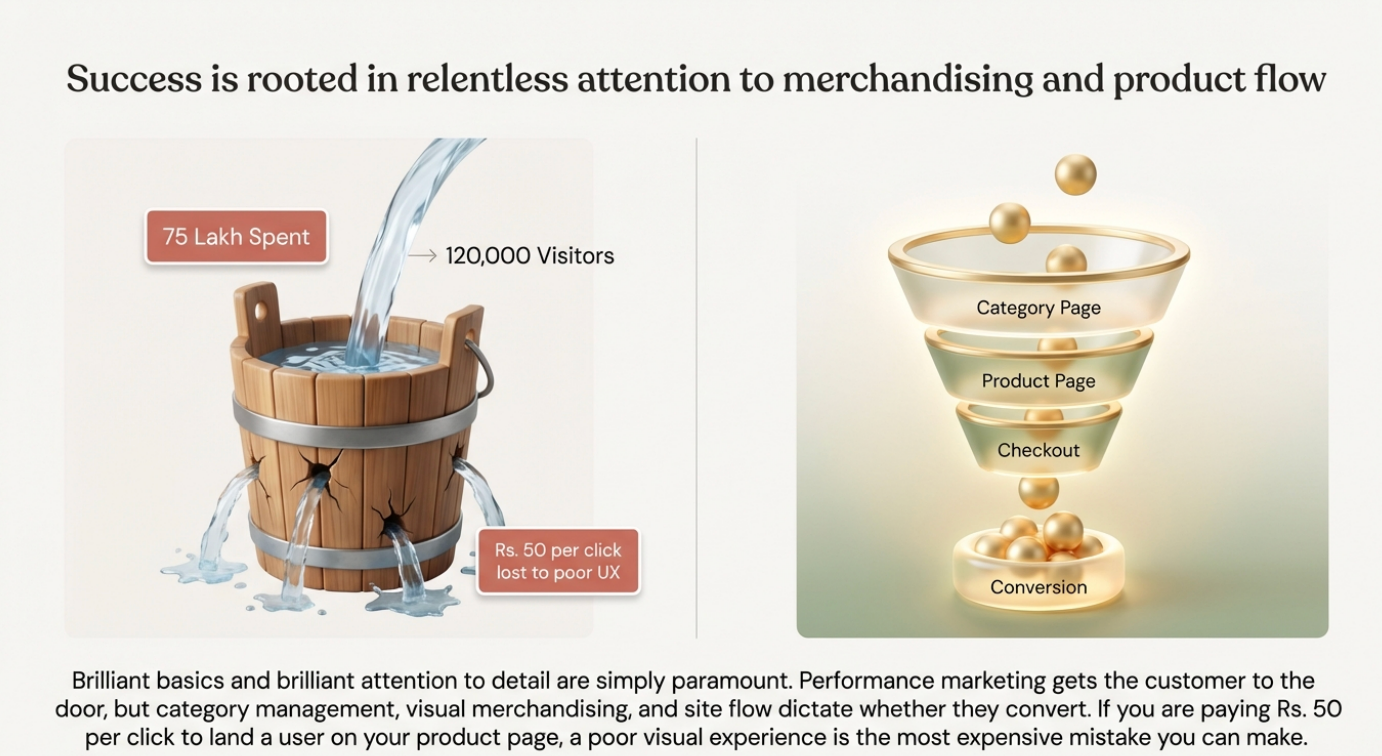
Brands that convert efficiently measure conversion in far greater detail across the customer journey, tracking banner CTRs, category conversion, add-to-cart ratios, repeat purchase behaviour, and page-level drop-offs separately rather than treating conversion as a single aggregate metric. Granular measurement of this depth helps identify where intent weakens and where intervention is required.
A banner generating strong click-through rates but weak downstream conversion, for instance, often reflects a mismatch between the promise of the creative and the destination page experience. Similarly, homepage banners, navigation hierarchy, category sequencing, and merchandising placement shape customer attention and determine which products receive visibility. As digital commerce becomes more competitive, these surfaces demand the same discipline that physical retailers apply to shelf placement and in-store merchandising.
Strong Merchandising Is Conversion Infrastructure
In physical retail, customers can touch products, assess quality directly, compare finishes, and ask questions before making a purchase. In digital commerce, the product page has to perform all of those functions simultaneously. Merchandising is therefore no longer a surface-level branding exercise; it directly influences conversion quality.
The strongest D2C brands treat the product page as a complete purchase environment rather than a catalogue listing. Product titles, image hierarchy, contextual photography, copy quality, reviews, pricing presentation, delivery messaging, warranties, and return policies collectively shape whether customers feel confident enough to transact. Small execution gaps across these surfaces add up quickly, particularly in categories where customers require greater reassurance before purchase.
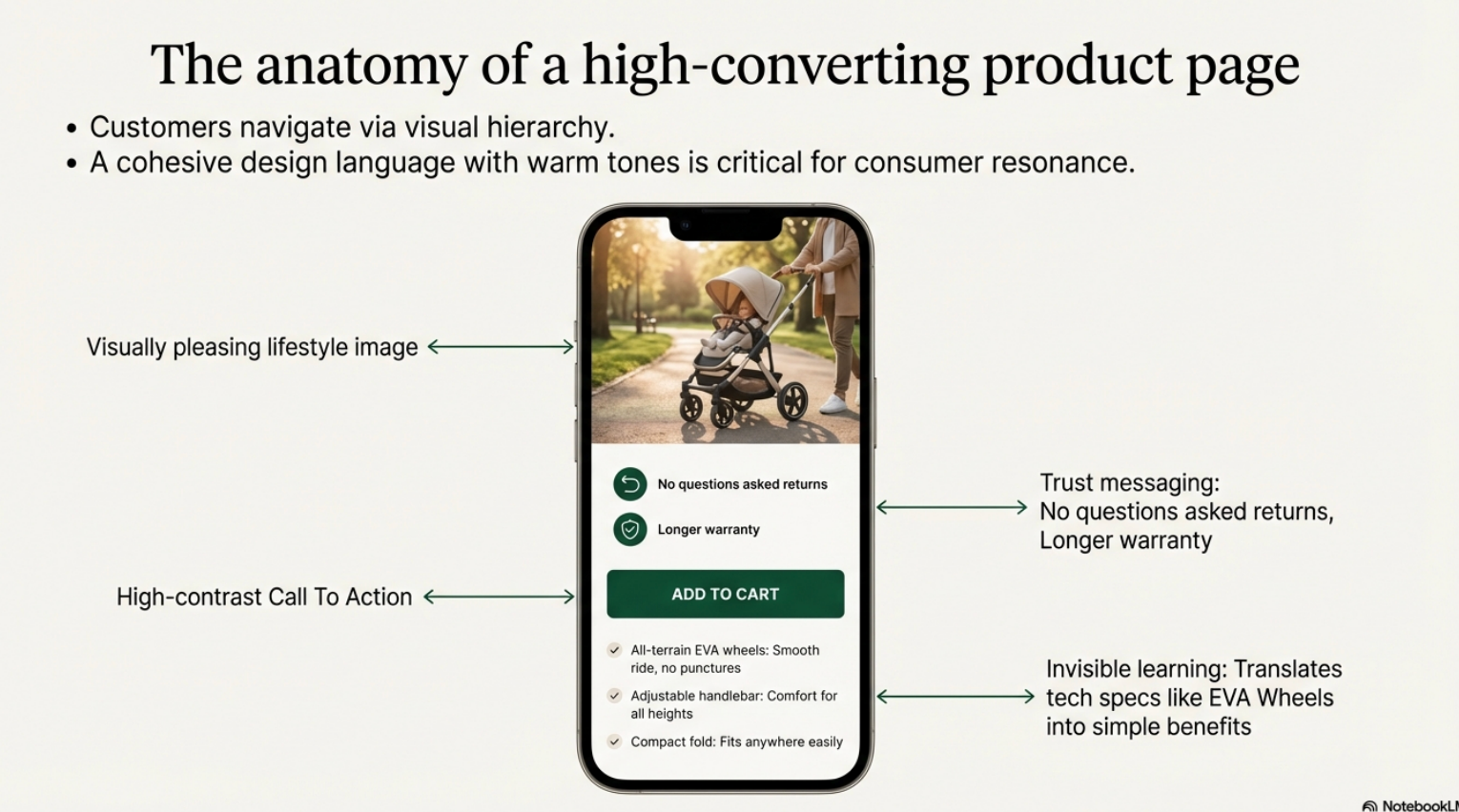
Contextual presentation is especially visible in higher-consideration categories such as baby care, furniture, home products, or wellness. A product photographed against a plain white background may communicate the item itself, but it often does little to help customers understand scale, fit, usability, or quality in a real-world setting. Contextual imagery, clearer visual depth, and more intuitive information hierarchy reduce uncertainty by helping customers visualise the product within their own lives before purchase.
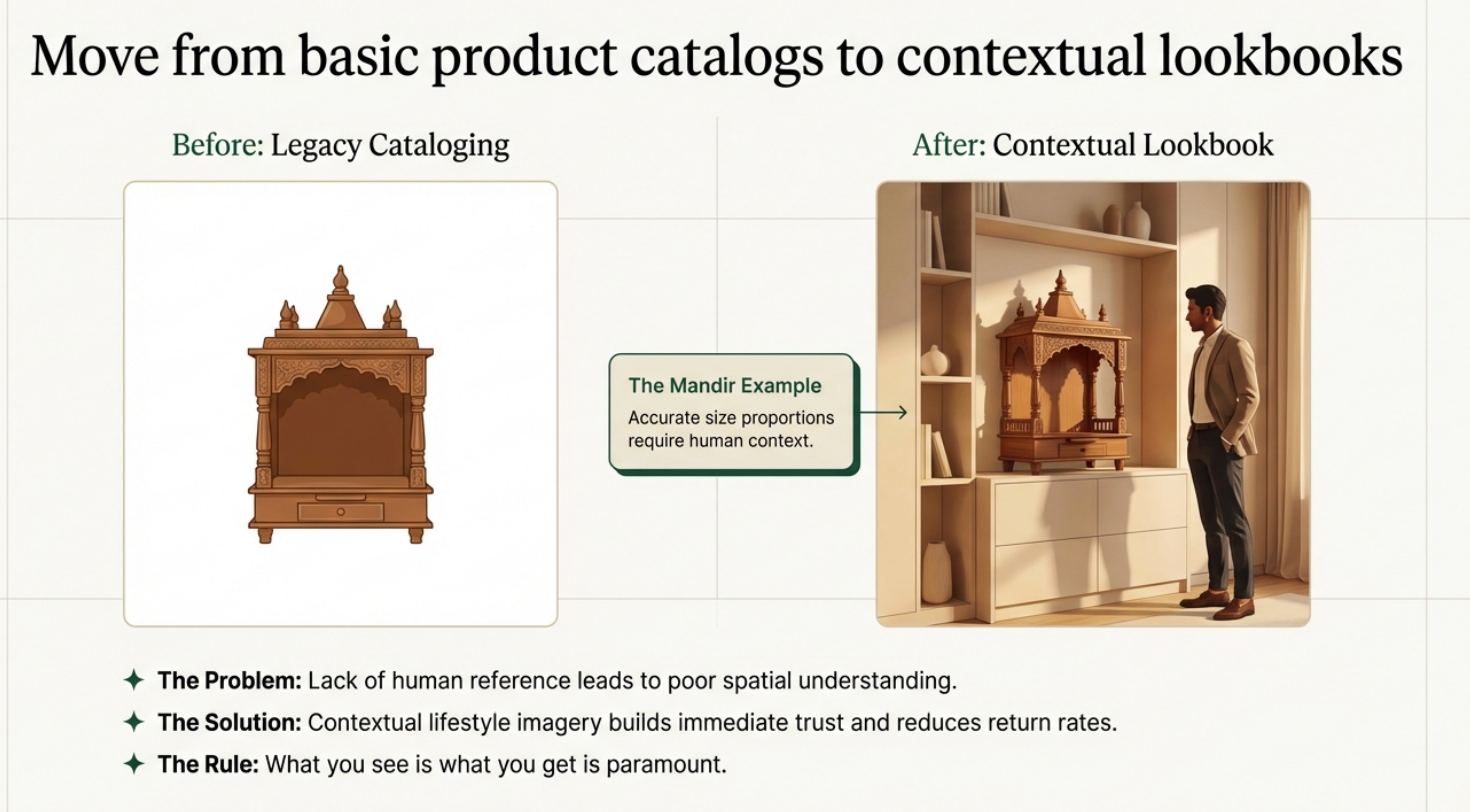
The underlying principle is simple, wherein strong merchandising reduces friction. Customers should not have to work hard to understand why a product is credible, who it is meant for, or what problem it solves. The highest-performing product pages succeed not because they contain more information, but because they organise it more effectively and build confidence more quickly.
For a long time, achieving high merchandising standards was constrained by production economics. Rich lifestyle photography, catalogue refreshes, and repeated creative iterations required expensive shoots, agency coordination, and significant operational effort, concentrating strong visual presentation among brands with the resources to sustain large creative budgets consistently.

AI-assisted tooling is changing that equation. Brands can now generate, test, and iterate on contextual product imagery far more efficiently, using a limited set of base assets to create significantly richer merchandising systems across catalogues. As production barriers fall, the advantage shifts toward brands that maintain a coherent visual identity, preserve product accuracy, and build consistent merchandising systems across categories and channels.
Direct Channel Must Compete on Relationship Depth as Q-Comm has Commoditised Convenience
Quick commerce has altered customer expectations around convenience. In many categories, rapid fulfilment is no longer perceived as a premium feature but as a baseline expectation. At the same time, heavily subsidised pricing and delivery infrastructure have made it difficult for standalone D2C brands to compete purely on speed or transaction economics.
If a brand website offers little beyond what marketplaces and quick commerce platforms already provide, customers have limited reason to transact directly. The better-run D2C businesses are therefore using their own channels not simply as checkout layers, but as environments where they can build greater trust, educate customers more effectively, present products with more context, and create stronger post-purchase engagement.
Focusing on customer experience explains why direct commerce is becoming less about convenience parity and more about relationship depth. Better merchandising, clearer warranties, stronger onboarding, more thoughtful bundling, improved packaging, and clearer delivery communication all become mechanisms through which brands justify the direct purchase journey. In effect, the direct channel works best when it creates a genuinely better brand experience rather than attempting to replicate the speed advantages of quick commerce players.
The strategic shift toward relationship depth is particularly important because the direct channel remains the one surface where brands retain complete control over customer experience, merchandising, and communication. As competition intensifies across digital commerce, maintaining control over the customer experience is becoming more valuable rather than less.
Cohorts Matter More Than Categories
Many consumer businesses still evaluate categories primarily through topline GMV or immediate margin contribution. While useful, top-level financial metrics often fail to capture the strategic role certain products play within the broader customer lifecycle. Lower-ticket or lower-margin categories may still be highly valuable if they drive customer acquisition, create purchase frequency, or establish enough trust for customers to migrate toward larger-ticket purchases.
The strategic importance of lifecycle tracking is where cohort analysis becomes significantly more important than static category reporting. The key imperative is to not only determine which products generate revenue, but also which products create long-term customers. A category contributing modest GMV today may still be strategically important if customers acquired through it demonstrate stronger repeat behaviour, higher retention, or greater cross-category expansion.
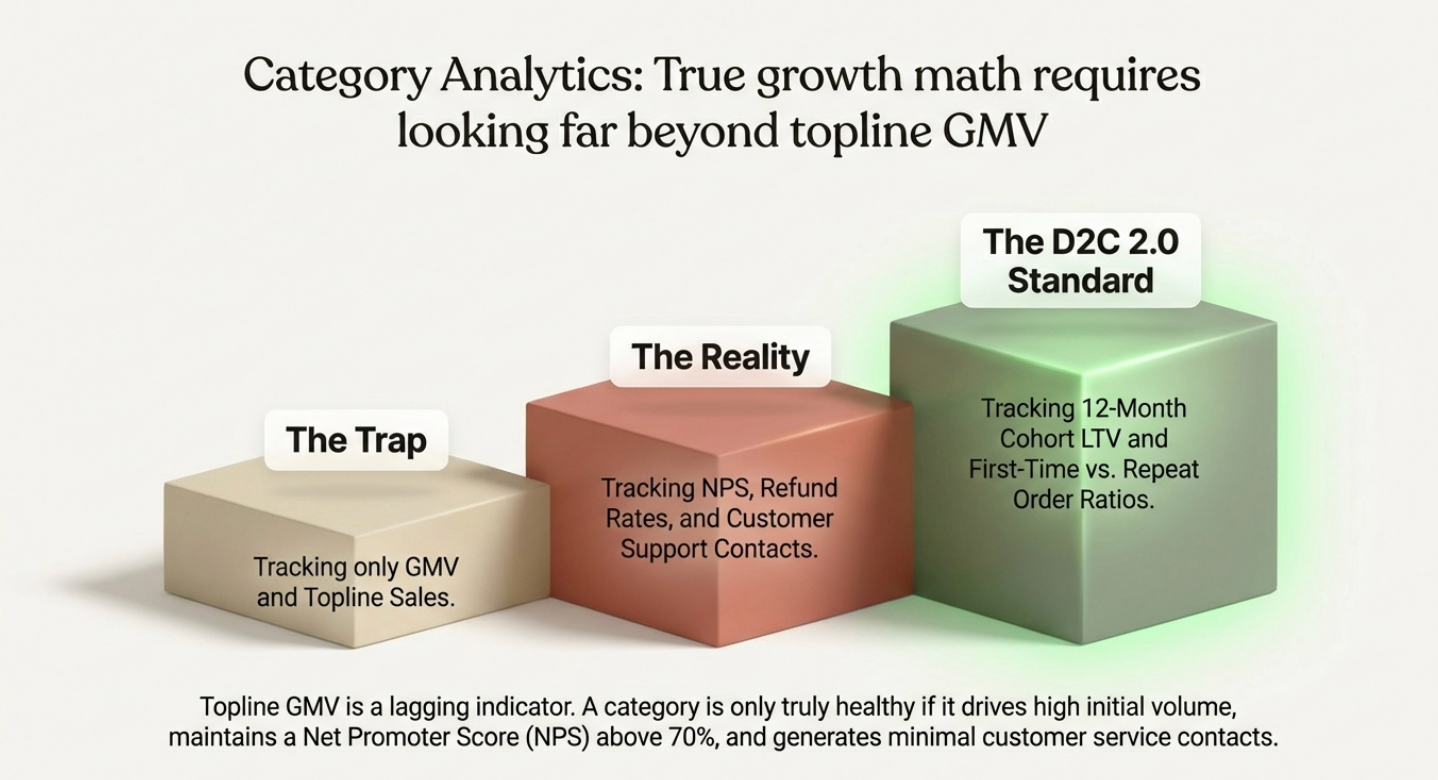
Operators who compound customer relationships evaluate performance through longer-term behavioural patterns rather than isolated first-order economics alone. Repeat purchase cohorts, cross-sell pathways, frequency curves, and customer lifetime value provide a much clearer picture of how categories actually contribute to durable growth. The first purchase frequently functions less as a profit event and more as a trust-building event that shapes future spending behaviour across the catalogue.
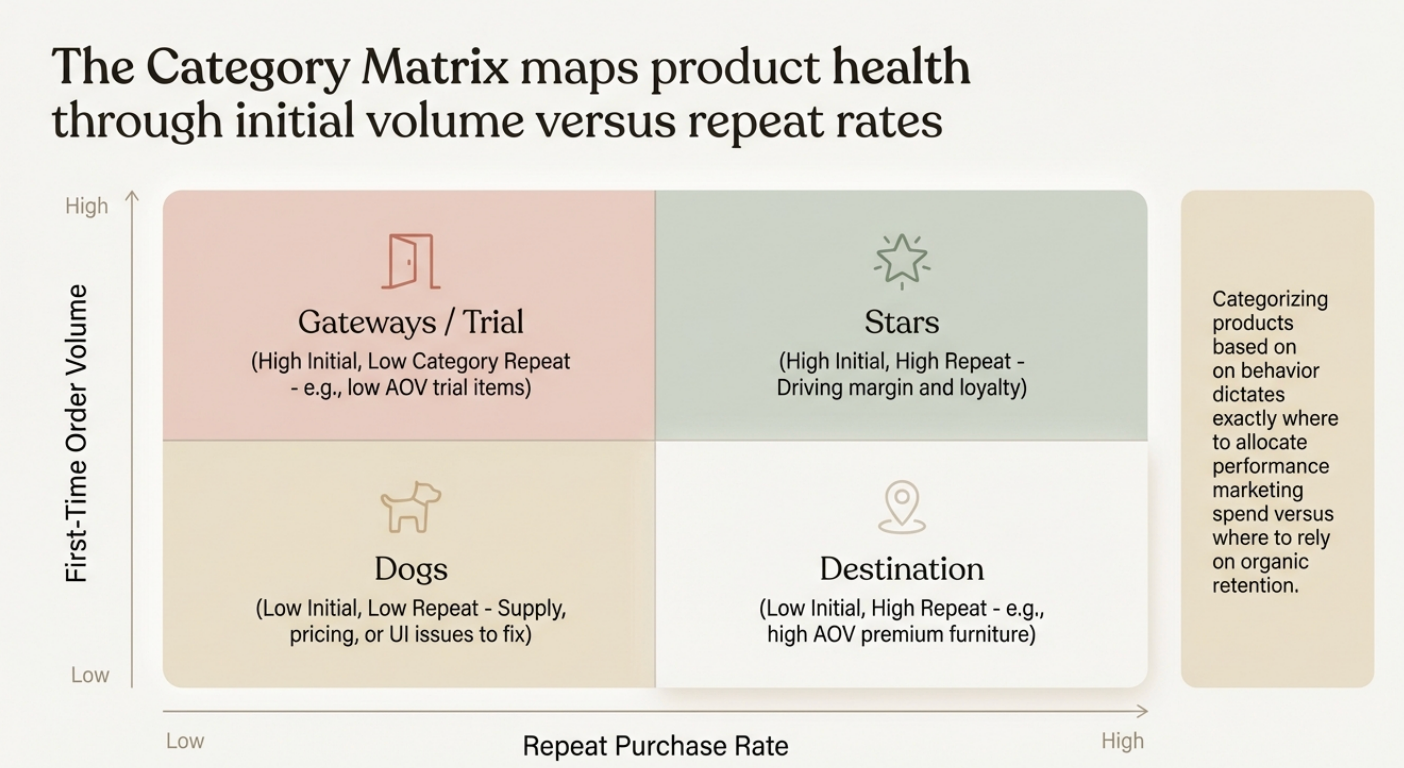
A focus on lifetime customer behaviour also changes how brands think about merchandising and category investment. Products that drive trial and engagement often require a different operating lens from products optimised purely for immediate profitability. As customer acquisition costs rise, understanding which categories genuinely compound customer relationships becomes central to how D2C businesses allocate capital and prioritise growth.
Measurement Is Becoming a Moat
Most consumer businesses still operate with limited visibility into how customers move through their funnel beyond topline revenue, ROAS, and blended acquisition metrics. Yet as digital commerce becomes more competitive, the brands that scale efficiently are the ones that understand their operational data at a much more granular level.
Banner click-through rates, category-level conversion, repeat purchase behaviour, delivery timelines, support queries, cohort retention, and cross-category movement patterns collectively provide a much clearer understanding of where friction exists inside the business. Granular tracking changes how decisions get made because it reduces reliance on intuition and allows teams to identify operational leaks much earlier.
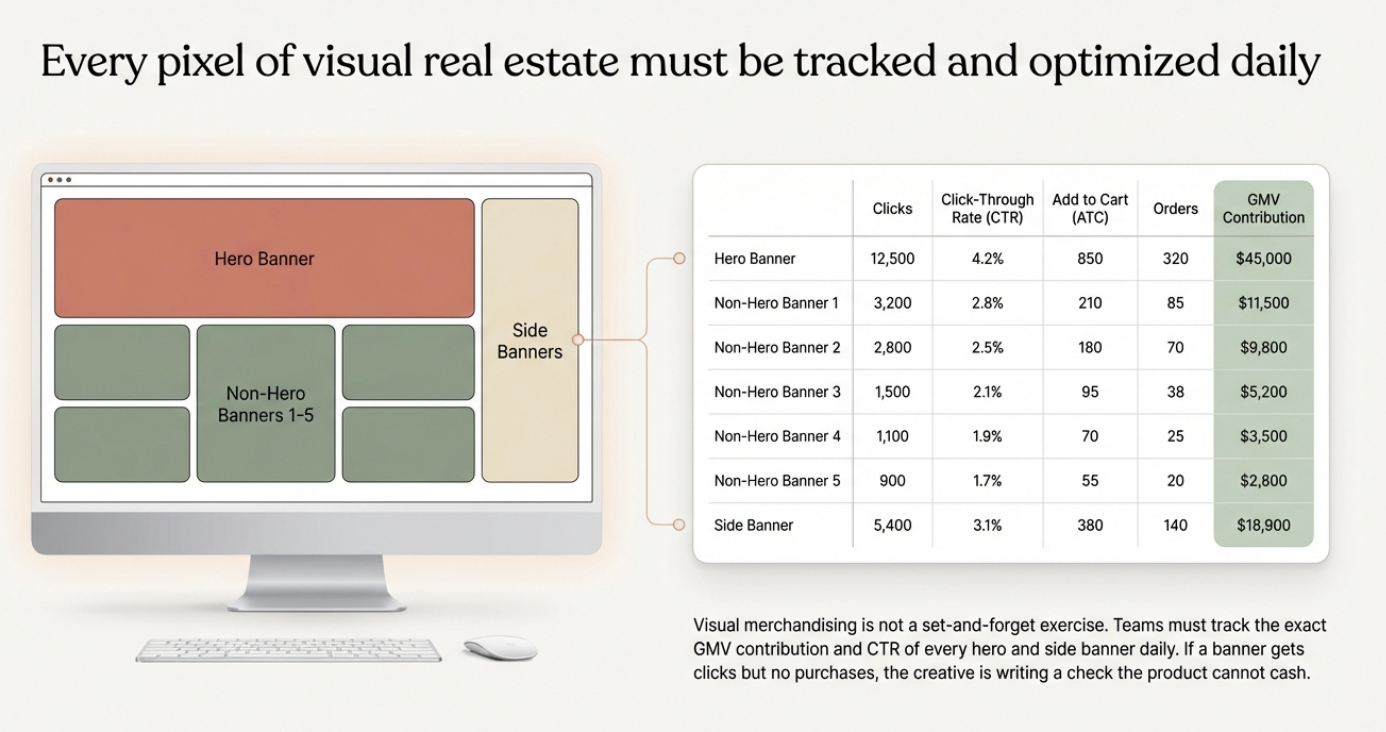
Measurement also becomes important because small inefficiencies accumulate quickly at scale. A weak product page, poor navigation structure, inconsistent delivery performance, or unclear merchandising hierarchy may appear manageable in isolation, but together they materially reduce conversion quality and customer retention. Businesses that measure these variables consistently are able to iterate faster across merchandising, pricing, inventory, retention, and customer experience.
The cumulative effect of rigorous data tracking is a meaningful operational advantage. As acquisition costs rise and categories become more crowded, the ability to learn faster from customer behaviour becomes decisive. Businesses that scale efficiently treat measurement not as reporting hygiene but as core operating infrastructure.
The Best Brands Build Memory, Not Just Transactions
A good number of D2C brands have come to rely on discounts and performance marketing as the primary levers for sustaining growth. While these levers can drive transactions, they rarely build durable customer affinity on their own. Excessive dependence on discounts weakens differentiation rather than strengthening it, particularly in categories where consumers already have multiple interchangeable options.
What customers remember are experiences that reduce friction, build trust, or create small moments of delight beyond the transaction itself. Clear delivery communication, intuitive returns, thoughtful packaging, contextual onboarding, relevant post-purchase engagement, and small but intentional customer touches collectively influence whether a brand feels transactional or considered. Small operational details may appear minor in isolation, but together they shape whether customers return organically or only through repeated promotional incentives.

Post-purchase experience is the primary mechanism through which brands build brand recall. Clear delivery communication, transparent tracking, thoughtful packaging, and contextual onboarding collectively shape whether a customer remembers a brand as considered or transactional. Furthermore, operational touchpoints represent surfaces that quick commerce platforms, by design, cannot replicate.
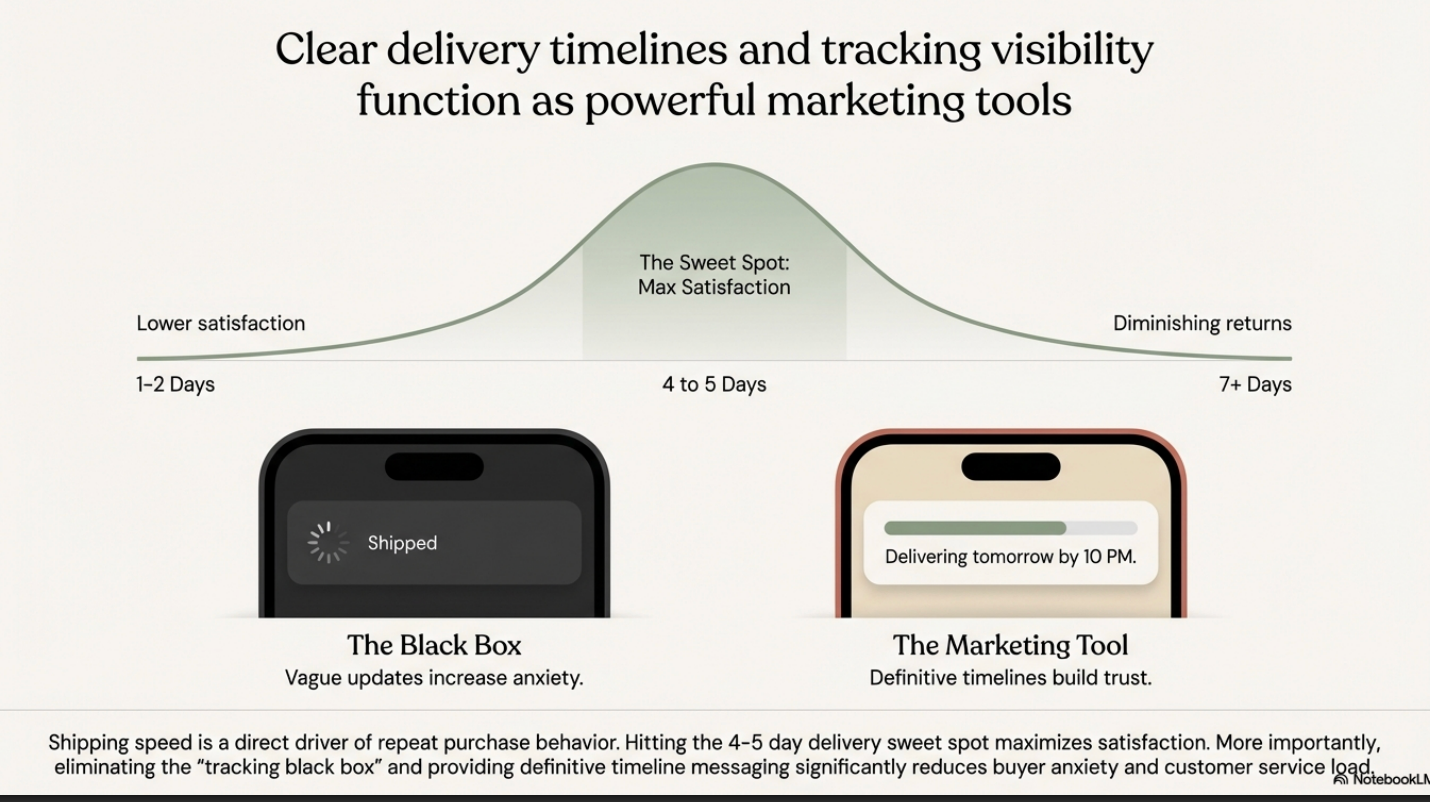
Building lasting customer memories is what separates durable consumer brands from efficient transaction engines. Transactions can often be bought through discounts and advertising spend. Brand memory compounds differently; it is built through consistency, clarity, and experiences that make customers more willing to return without needing to be reacquired repeatedly.
Conclusion
The economics of D2C are shifting in a direction that acquisition spend alone cannot address. Traffic is getting more expensive, convenience is no longer a differentiator, and customers have more options than they did five years ago.
What that leaves is execution. Brands that understand their funnel in granular detail, build product pages that actually convert, and give customers a reason to return without a discount are in a materially different position from those that do not. The performance gap will widen as the market matures.
DISCLAIMER
Details of all the funds managed by 3one4 Capital can be found here: https://www.3one4capital.com/aif-registration-details
For informational purposes only. This content does not constitute an offer to sell or a solicitation of an offer to buy units of any fund. Investments in AIFs involve market risks.
The views expressed herein are those of the author as of the publication date and are subject to change without notice. Neither the author nor any of the entities under the 3one4 Capital Group have any obligation to update the content. This publications are for informational and educational purposes only and should not be construed as providing any advisory service (including financial, regulatory, or legal). It does not constitute an offer to sell or a solicitation to buy any securities or related financial instruments in any jurisdiction. Readers should perform their own due diligence and consult with relevant advisors before taking any decisions. Any reliance on the information herein is at the reader's own risk, and 3one4 Capital Group assumes no liability for any such reliance.Certain information is based on third-party sources believed to be reliable, but neither the author nor 3one4 Capital Group guarantees its accuracy, recency or completeness. There has been no independent verification of such information or the assumptions on which such information is based, unless expressly mentioned otherwise. References to specific companies, securities, or investment strategies are not endorsements. Unauthorized reproduction, distribution, or use of this document, in whole or in part, is prohibited without prior written consent from the author and/or the 3one4 Capital Group.