

H2LooP Raises $2 Million in Seed: Accelerating System Software Development Through AI-Native Infrastructure Powered by Hardware Aware Coding Models
Embedded software is one of those domains where the AI wave has mostly washed past. GitHub Copilot and Cursor are transforming how web applications get built, but the engineers writing safety-critical firmware for automotive ECUs and avionics systems are still working the way they did a decade ago.
H2LooP is changing that. Founded by Sairanjan Mishra and Pulkit Agrawal, thecompany has raised $2 million in seed funding from 3one4 Capital and Speciale Invest to build AI infrastructure purpose-built for embedded and system software engineering.
The Bottleneck Is The Software, And Is Now An AI-Native Problem To Solve
Hardware is moving fast. Software-defined vehicles are replacing fixed-function ECUs with centralised compute. Semiconductor companies are shipping AI accelerators into edge devices that need real-time, safety-critical firmware. Aerospace programs are deploying avionics with more lines of embedded code per platform than any previous generation.
The software layer that makes all of this work has not kept pace. Embedded teams still run on manual code reviews, hand-written compliance documentation, and porting processes that eat months of senior engineering time per platform migration. The gap between what hardware can do and what its software stack can reliably deliver is widening with every product cycle.
General-purpose AI coding tools are not closing this gap. They do not understand MISRA rules, AUTOSAR architecture patterns, ISO 26262 functional safety requirements, or DO-178C certification constraints. They cannot reason about how a register configuration in a datasheet maps to a driver implementation, or why a particular memory access pattern violates a safety standard. In embedded systems, code that compiles and runs is not the same as code that is correct. Violations carry legal and safety consequences, as well as severe financial implications from product recalls. This domain needs AI built from the ground up for it.
Domain-Specific Models On a Hardware-Aware Semantic Layer
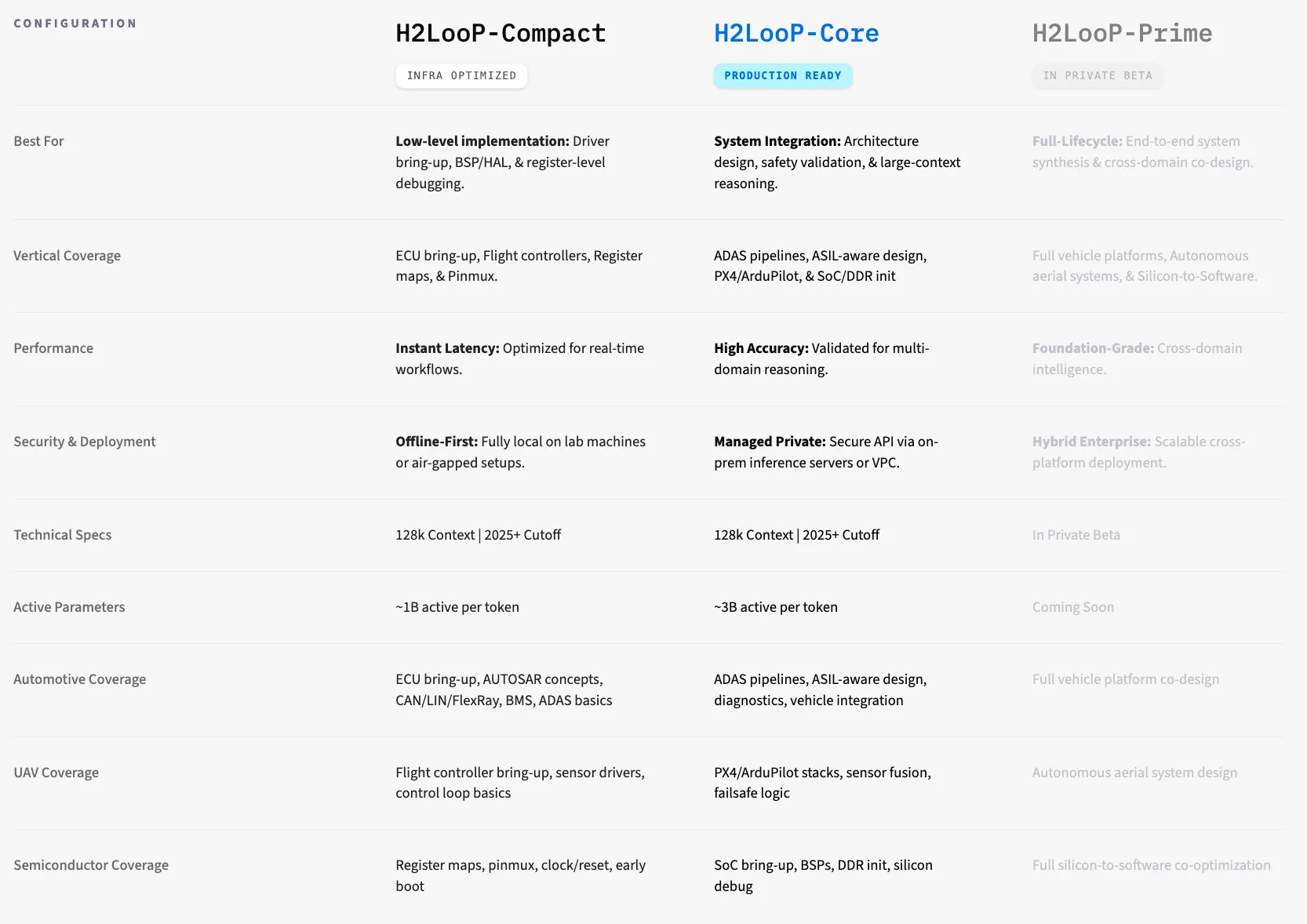
H2LooP's architecture pairs two things that do not exist elsewhere in combination. The first is a set of small language models trained exclusively on embedded systems code. The second is a proprietary Knowledge Graph, a semantic layer that connects hardware specifications, software standards, design patterns, and a customer's own codebase into a unified representation that every model draws on when generating output.
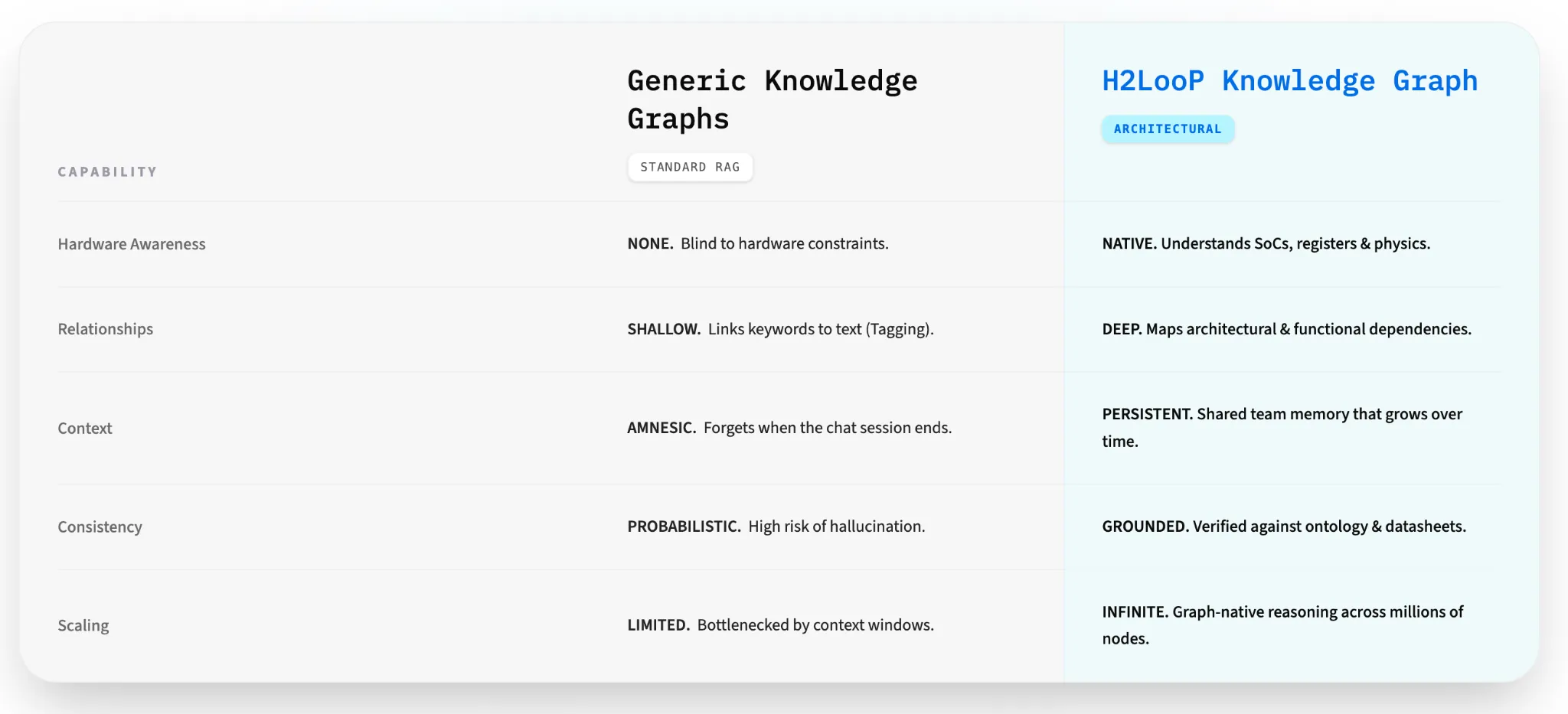
The pairing matters because in embedded engineering, code generation without hardware context is useless. An AI that writes a peripheral driver without understanding the target SoC's register map, timing constraints, and bus architecture will produce code that looks plausible and fails in integration. The Knowledge Graph provides models with the context to reason about system-level relationships, not just syntax. The result is compliant code generation that rivals frontier models, delivering production-grade reliability and significantly higher accuracy than general-purpose AI.
The early deployments show what this looks like when it works. At a German semiconductor company managing AUTOSAR compliance and legacy code conversion, H2LooP significantly reduced design diagram update time, streamlined document audit cycles, and dramatically accelerated test case generation with 90 to 95 percent accuracy across validation cycles. Across deployments, engineering teams are reporting a 200% improvement in velocity. Customers are reporting measurable, high-multiple returns on investment and immediate value in modernising engineering workflows.
Why This Compounds
Every deployment feeds the platform. Customer codebases, hardware specifications, and validation outcomes expand the Knowledge Graph. An engineering pattern learned from one AUTOSAR deployment improves the model's reasoning on the next. Each cycle makes the next one more accurate. In a domain where proprietary engineering knowledge is the scarcest resource, this flywheel is the moat.
The platform runs entirely on-premise. In embedded engineering, source code and hardware specifications are among a company's most sensitive assets. On-premise deployment means the flywheel operates within the customer's environment. Their proprietary knowledge stays theirs while still improving the platform's performance on their specific stack.
The Team And What Comes Next
Sairanjan and Pulkit bring more than 50 years of combined experience in embedded systems and deeptech engineering. They are building from Bengaluru, and the platform is already live with semiconductor companies and automotive teams across India and Europe, with plans to scale enterprise deployments globally. H2LooP has been selected for the Infineon Global Startup Program and recognised by the India Electronics and Semiconductor Association in the Startup IP category.
"In system engineering, writing code is not the hardest problem. Understanding it, reasoning about hardware interactions, and proving correctness is where teams lose months," said Sairanjan. "We are building the infrastructure that ensures software is not just generated, but fully understood, validated, and trusted before it reaches production."
The embedded software market is large, growing, and underserved by current AI tooling. As hardware absorbs more software complexity and regulatory requirements tighten, the teams building this software need infrastructure that understands their domain from the silicon up. H2LooP is building it, and it gets better with every deployment.
DISCLAIMER
The views expressed herein are those of the author as of the publication date and are subject to change without notice. Neither the author nor any of the entities under the 3one4 Capital Group have any obligation to update the content. This publications are for informational and educational purposes only and should not be construed as providing any advisory service (including financial, regulatory, or legal). It does not constitute an offer to sell or a solicitation to buy any securities or related financial instruments in any jurisdiction. Readers should perform their own due diligence and consult with relevant advisors before taking any decisions. Any reliance on the information herein is at the reader's own risk, and 3one4 Capital Group assumes no liability for any such reliance.Certain information is based on third-party sources believed to be reliable, but neither the author nor 3one4 Capital Group guarantees its accuracy, recency or completeness. There has been no independent verification of such information or the assumptions on which such information is based, unless expressly mentioned otherwise. References to specific companies, securities, or investment strategies are not endorsements. Unauthorized reproduction, distribution, or use of this document, in whole or in part, is prohibited without prior written consent from the author and/or the 3one4 Capital Group.


.jpg)


