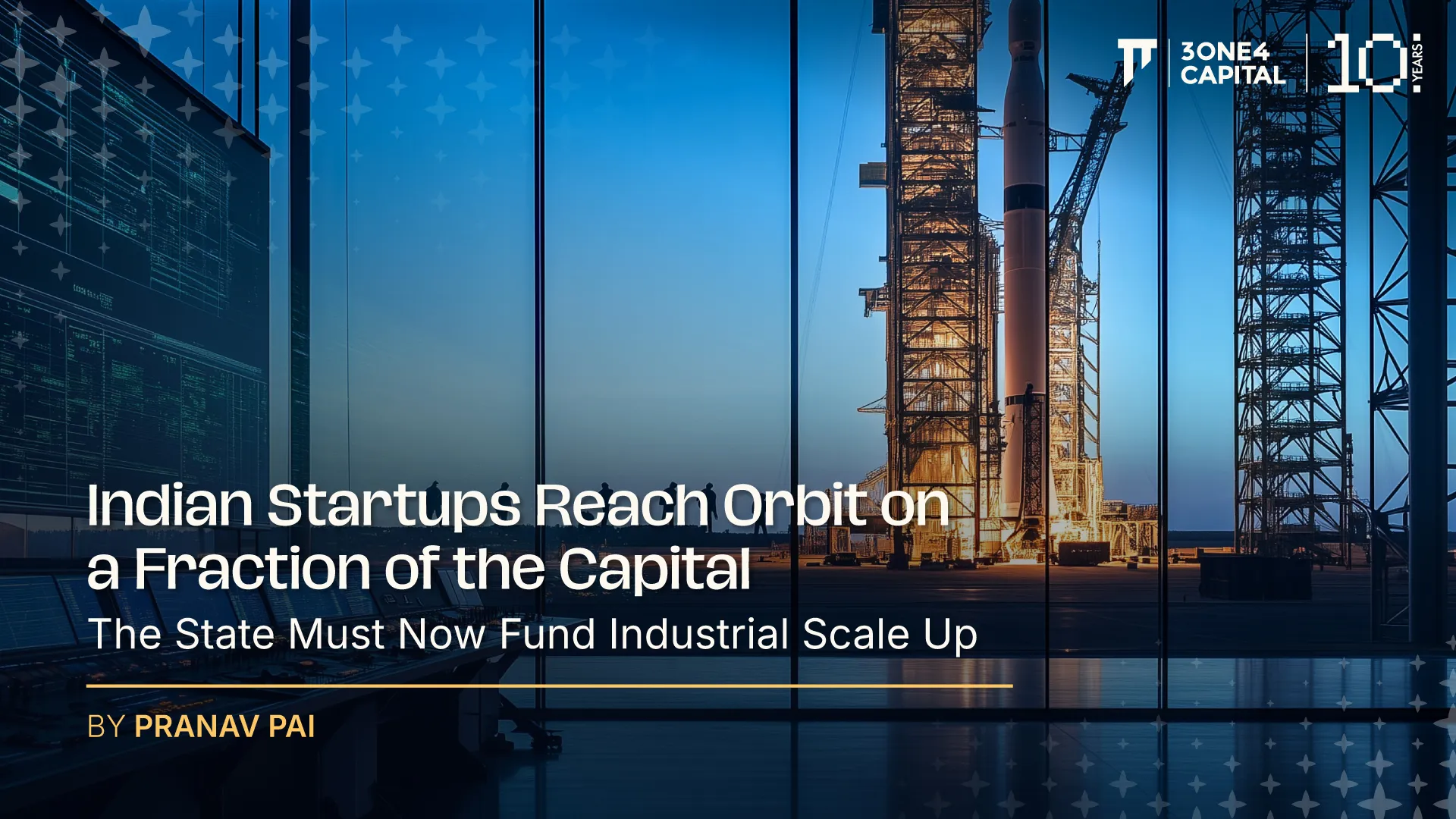
Indian Startups Reach Orbit on a Fraction of the Capital. The State Must Now Fund Industrial Scale Up.
India has proven it can build world-class launch systems at unbeatable costs. Turning that frugal brilliance into an industry now depends on the state committing a multi-year, predictable order book.
Vikram-1 reached orbit on 18 July on its very first attempt, having raised roughly $150 million across its entire life as a company. That number, not the launch itself, is a strategic headline. It means India can now manufacture orbital launch capability at a cost structure no other country has managed to match, and it points policymakers straight to where public money now earns its highest return.
Measured against its global peers, that figure looks extraordinarily efficient. Rocket Lab, the closest analogue in the small-satellite launch market, had raised around $150 million by the time it began its orbital campaign, and its first attempt in 2017 still fell short of orbit. Virgin Orbit burned through more than $1 billion, reached orbit four times, then filed for bankruptcy in 2023 with its assets eventually sold for about $36 million. Falcon 9, a far larger and more capable vehicle, cost SpaceX roughly $400 million to bring to flight. Vikram-1 cleared orbit on the first attempt, on a fraction of any of these budgets, and made India the third country, after the United States and China, with a private company able to place payloads in space.
This efficiency is inherited rather than accidental, and it is the most under-priced asset in India’s space programme. ISRO reached Mars orbit with Mangalyaan in 2014 for $74 million, on the first attempt, and landed Chandrayaan-3 near the lunar south pole in 2023 for about ₹615 crore, close to $75 million.
Six decades of doing more with less have produced an engineering culture that treats cost as a design constraint rather than an afterthought. Frugality of this kind is not merely thrift. In a domain where resilience now depends on fielding many satellites rather than a few exquisite ones, a low cost base is a strategic multiplier. It lets a nation build redundancy, iterate through failure cheaply, and reconstitute assets at a tempo that expensive programmes cannot afford.
A Single Launch Proves the Technology, a Viable Industry Needs Cadence
One flight validates a rocket. It does not build a sector, and it does not yet secure a country. A commercially viable and strategically useful launch industry needs dozens of flights a year.
Cadence amortises development costs, and it turns launch from a symbolic capability into a dependable and routine one. Responsive launch, the ability to replace a downed satellite within weeks, is itself a form of deterrence, because it strips value from any attack on a constellation that can be rebuilt quickly.
Indian space tech startups are already building for this future. Skyroot’s Infinity Campus in Hyderabad is designed to roll out one orbital rocket a month. The manufacturing capacity exists. The firm order book that would keep that line running does not.
The State Has Started Funding the Sector
The Government of India has moved from spectator to participant faster than most expected. The space budget has nearly tripled in a decade, from ₹5,615 crore in 2013-14 to ₹13,416 crore in 2025-26. IN-SPACe has operationalised a ₹1,000 crore venture capital fund, managed by SIDBI Venture Capital and cleared by SEBI in late 2025, writing cheques of ₹10 crore to ₹60 crore into about 40 startups. A separate ₹500 crore Technology Adoption Fund now co-funds indigenous R&D. Private capital has continued its support, with funding into Indian space tech more than doubling in 2025 to around $170 million. The direction is right.
Supply-Side Capital De-Risks the Prototype, Guaranteed Demand De-Risks the Scale Up
The government can do more, and the highest-return action is not just a larger equity cheque. Public venture capital and public procurement work on different parts of the risk curve. Equity funding helps a founder build and prove a prototype. A committed order book is what justifies the factory, the second production line, and the decade-long allocation to cost compression.
India has funded the first and left the second largely to hope. The ₹1,000 crore venture fund deploys perhaps ₹150 crore to ₹250 crore a year across the whole sector, less than Skyroot raised in a single round on its own. Only the state can supply a multi-year, predictable stream of orders, and only that stream lets a young company plan at industrial scale. As I argued in the first part of this series, reliable procurement rather than subsidy is what built SpaceX into a category leader.
The demand already exists, and it is sovereign. According to reports, India’s armed forces today rely on roughly 15-20 military and dual-use satellites for intelligence, surveillance, and reconnaissance, set against a Chinese fleet that now exceeds 900 satellites and includes well over 100 built for surveillance and reconnaissance. The Space-Based Surveillance Phase 3 programme will field 52 dedicated military satellites, 31 of them built by private firms, and the armed forces have committed to a proliferated low-earth-orbit architecture that depends precisely on cheap, mass-manufacturable satellites and frequent, affordable launches.
That architecture now runs on the private sector’s cost structure. Turning that programme from an exception into a standing, multi-year procurement line, with indigenisation milestones and intellectual property written into the contracts, is the most powerful lever available. Because Indian firms are so capital-efficient, the fiscal cost of anchoring a national champion here is a fraction of what the same outcome cost the leading economies.
Frugality Is a Foundation, Global Competitiveness Needs Forward Investment
Frugality must also not harden into a permanent expectation. India’s firms compete against rivals who pair capability with sheer scale, backed by billions in private capital and sustained state sponsorship. SpaceX has drawn more than $22 billion in United States government contracts, its early growth underwritten by NASA, and China funds its launch and constellation programmes as instruments of national power.
A cost advantage buys India entry, but it does not on its own buy the frontier. The country’s space agencies must now budget for capability and not only for savings, because a programme optimised purely for cost will always trail one optimised to win. Forward capital, deployed ahead of proven demand, is what moves a technology frontier, and only the state can direct patient investment on that horizon. The right modality is dual. Grants must fund the hard, pre-commercial research in propulsion, advanced materials, and sensors, while anchor-customer contracts guarantee the revenue to scale what that research produces. Grants push the frontier outward, and procurement pulls it into an industry.
Vikram-1 should not stay an outlier. It should become the template. Indian startups have demonstrated that its founders can build world-class launch and satellite systems at admirable costs, and that advantage is rare, durable, and compounding. It also changes the arithmetic for the exchequer, because every rupee of committed demand now buys more capability here than it would anywhere else.
India has already supplied the frugal brilliance. The task that remains belongs to the state, and it is to supply the demand at the scale and tenure that turns a breakthrough into an industry.
DISCLAIMER
The views expressed herein are those of the author as of the publication date and are subject to change without notice. Neither the author nor any of the entities under the 3one4 Capital Group have any obligation to update the content. This publications are for informational and educational purposes only and should not be construed as providing any advisory service (including financial, regulatory, or legal). It does not constitute an offer to sell or a solicitation to buy any securities or related financial instruments in any jurisdiction. Readers should perform their own due diligence and consult with relevant advisors before taking any decisions. Any reliance on the information herein is at the reader's own risk, and 3one4 Capital Group assumes no liability for any such reliance.Certain information is based on third-party sources believed to be reliable, but neither the author nor 3one4 Capital Group guarantees its accuracy, recency or completeness. There has been no independent verification of such information or the assumptions on which such information is based, unless expressly mentioned otherwise. References to specific companies, securities, or investment strategies are not endorsements. Unauthorized reproduction, distribution, or use of this document, in whole or in part, is prohibited without prior written consent from the author and/or the 3one4 Capital Group.