

India's deposit insurer, DICGC, is still overcharging commercial banks
DICGC has introduced risk-based premiums. However, commercial banks still pay far more than their claims share justifies. Further premium cuts are needed.
The Deposit Insurance and Credit Guarantee Corporation (DICGC), a wholly owned subsidiary of the RBI, was set up 63 years ago to insure deposits across the banking system. As of March 2025, DICGC insured 1,982 banks, including commercial and cooperative banks, according to its latest annual report. In FY25, DICGC collected gross premiums of ₹26,764 crore, with investment income at ₹15,802 crore and revenue surplus after tax at ₹30,907 crore.
As an insurance company, it has an actuarial valuation of its liability as of 31 March 2025 of only ₹17,567 crore. However, the surplus collection to date beyond actuarial liability totalled a significant ₹2,11,366 crore. The total funds available with the Deposit Insurance Fund were ₹2,28,933 crore, equivalent to 2.29% of the total insured amount.
With these impressive surpluses, the key issue is whether DICGC is overcharging banks for premiums to build up a surplus, and whether the premiums adequately reflect the risk profiles of the insured banks. Effective 1 April 2026, DICGC has taken a meaningful step in this direction by moving from a flat premium to a risk-based structure. The question now is whether that reform goes far enough, particularly for commercial banks.
Commercial Banks Face Lower Risk
Commercial banks have vastly lower risk profiles than cooperatives.
Insurance premiums increased from 5 paise per ₹100 insured in 1962 to 10 paise in 2005 and 12 paise in April 2020. Insurance coverage was capped at ₹1,500 in 1962, increased to ₹1,00,000 in May 1993 and revised to ₹5,00,000 in February 2020.
Until March 2026, DICGC collected insurance premiums at a flat rate of 12 paise per ₹100 insured for all deposits up to ₹5 lakh per person, applied uniformly irrespective of whether the bank was commercial or cooperative, despite the vastly differing risk risk profiles, credit ratings and management structures.
Of the 1,982 insured banks, 139 are commercial and 1,843 are cooperative banks. Insured deposits totalled ₹1,00,04,919 crore, of which a significant ₹92,34,540 crore was deposited with the 139 commercial banks and the balance ₹7,70,379 crore with the 1,843 cooperative banks.
Within commercial banks, public sector banks alone held ₹59,53,830 crore (59.5% of total insured deposits), while private sector banks held ₹25,70,617 crore (25.7% of total insured deposits), together accounting for 85.2% of everything insured in the system.
Accordingly, of the total premiums collected in FY25 of ₹26,764 crore, ₹25,352 crore came from commercial banks and ₹1,412 crore from cooperative banks.
However, the claims profile is reversed, with cooperative banks accounting for more than 98% of total claims to date. Since the inception of deposit insurance in 1962, gross claims of ₹295.85 crore have been filed against 27 commercial banks. Against cumulative recoveries of ₹160.70 crore, net claims for commercial banks total ₹135.15 crore.
On the other hand, ₹16,644.84 crore has been filed in gross claims against 453 cooperative banks. Against cumulative recoveries of ₹6,809.45 crore, net claims for cooperative banks stood at ₹9,835.39 crore.
DICGC collects 94.72% of premiums from commercial banks, which account for a mere 1.36% of net claims. Cooperative banks contribute only 5.28% of premiums while accounting for 98.64% of net net claims.
The skew in premiums relative to net claims distorts the sector because well-managed banks are being made to pay for the significant defaults prevalent in cooperative banks. It imposes high costs on good management, running contrary to the risk evaluation theory of insurance.
The Move Towards Risk-Based Premiums
Effective 1 April 2026, DICGC replaced the flat 12-paise premium with a risk-based premium structure. Banks are now rated into one of four categories, A to D, based on an internal DICGC risk model, and pay a differentiated rate. The 12-paise rate is retained as a ceiling, or card rate, rather than the rate every bank pays.
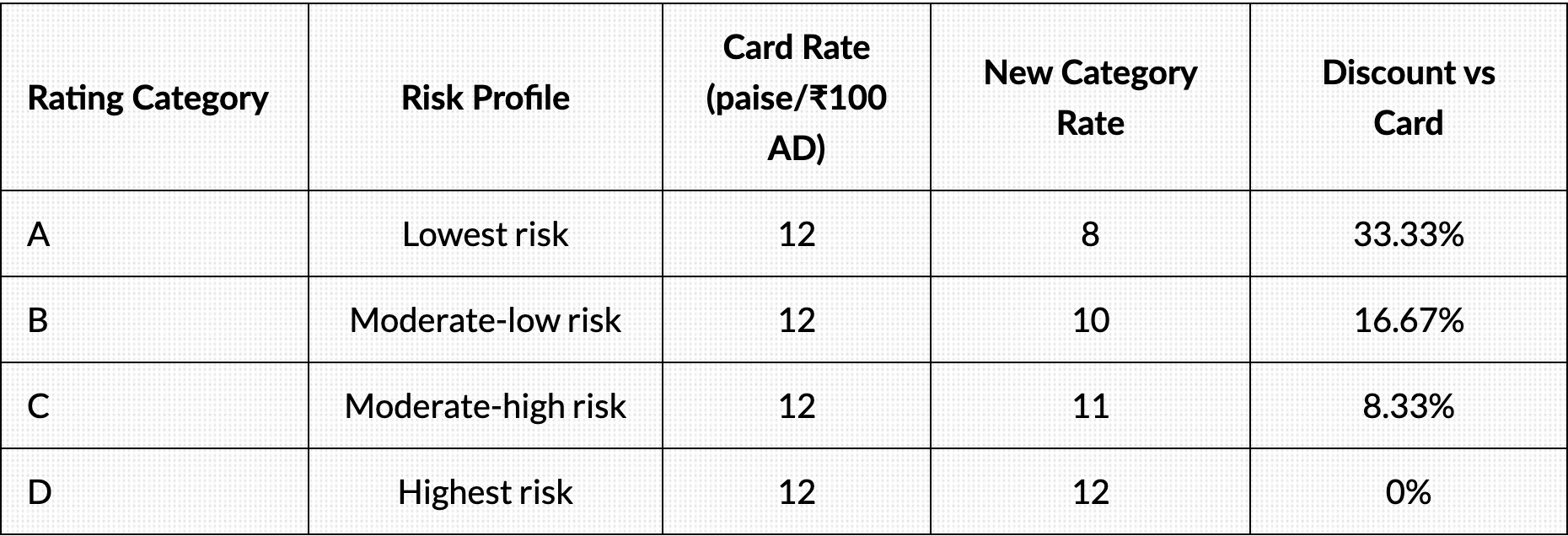
A vintage incentive stacks on top of the category rate, granting a 1% discount for every completed year a bank has existed without any record of restructuring or major distress, capped at 25% for banks with 25 or more years of clean history.
The effective rate is the category rate multiplied by (1 minus the vintage discount). A Category B bank with 25 years of clean vintage, therefore, pays 10 × (1 − 25%) = 7.5 paise per annum.
Cooperative banks under RBI's supervisory, prompt corrective action or all-inclusive-directions frameworks continue to pay the full 12-paise card rate until they exit, while newly registered banks pay the card rate until sufficient data exists to rate them.
This reform is welcome and moves in the right direction. It concedes the central principle that premiums should reflect risk rather than be applied uniformly. The carve-out keeping distressed cooperatives at the full 12 paise also correctly loads more of the cost on to the higher-risk segment.
Why The Reform May Not Go Far Enough
While the direction is right, the extent of the relief falls well short of what the claims experience justifies for commercial banks.
A well-run commercial bank rated Category A pays 8 paise, and with the full vintage incentive, an effective 6 paise. On the ₹25,352 crore that commercial banks paid in FY25 at the flat 12-paise rate, a Category A rate of 8 paise would reduce their premium to approximately ₹16,900 crore, and an effective 6 paise with the full vintage incentive to approximately ₹12,700 crore — roughly half the current bill.
Commercial banks, given their negligible share of net claims, will overwhelmingly fall into the lower-risk categories, where the effective rate settles between 6 and 8 paise once vintage incentives are applied. Yet even at that level, the charge is disproportionate.
Commercial banks account for only 1.36% of net claims while contributing 94.72% of premiums. On that basis, a net premium of around 3 paise, or roughly ₹6,300 crore, would more accurately reflect their risk contribution.
Under the most generous reading of the new structure — Category A with the full vintage incentive — they would still pay close to double what their claims experience warrants. The reform narrows the overcharge; it does not remove it, and an overcharge of the order of ₹6,000 crore persists.
Re-evaluating The Premium Structure
DICGC does not need to carry these significant excess surpluses on its balance sheet. It invests its surplus funds in government securities, which are stable investments. Additionally, as a wholly owned subsidiary of the RBI, it has, in principle, access to liquidity support from the RBI in case of need.
In FY25, revenue surpluses after tax totalled ₹30,907 crore. FY26, which falls entirely under the old flat premium, should deliver a comparable surplus of at least ₹33,000 crore.
From FY27, the first year under risk-based pricing, premium income will moderate as safer banks move to lower category rates. But, on any reasonable estimate, the surplus will remain substantial and the fund will keep climbing towards the oversized 2.5% target DICGC has set for itself.
That the fund continues to accumulate at this pace even as premiums begin to fall is the clearest sign that the rates remain calibrated well above what the system's actual claims experience requires.
DICGC and the RBI must go further. Bringing commercial banks to a rate that reflects their actual claims contribution, say at 3 paise rather than settling at the 6-to-8-paise range the new categories allow, would return roughly ₹19,000 crore to the sector against the FY25 base, while still leaving DICGC with substantial premium and investment income.
The premium for the highest-risk cooperative banks can remain at 12 paise or be raised to 15 paise, the maximum allowed under law.
Reducing Costs Across The Banking System
Alternatively, banks that have paid premiums for more than 25 years, such as SBI, should not be charged any premium, as their accumulated payments within that overall ₹2,28,933 crore fund would be substantial and would constitute a pool of capital to take care of any calamity.
More broadly, PSU deposits constitute 59.5% of total insured deposits. Therefore, at least 59.5% of the ₹2,28,933 crore fund — an estimated ₹1,36,215 crore — is attributable to PSU banks alone.
Given that the probability of a PSU bank requiring a payout is remote, this pool sits largely idle. Further reforms are required to prevent overcharging. Such excessive overcharging is a burden on both depositors, who receive less interest, and borrowers, who pay more interest.
Reducing premiums for low-risk banks further would send a clear message to the economy that premiums must be based on the risk profile of the insured entity, and that larger, well-managed banks do not have to subsidise the claims of cooperative banks.
In the case of bank failure, the RBI has demonstrated alacrity in working out a safety net, as seen in the case of Yes Bank. The probability of public sector banks such as SBI requiring bailouts is almost nil, as the Government of India owns them.
The likelihood of private sector banks requiring bailouts is also relatively low, as evidenced by the data. If a private sector bank is in trouble, the RBI has enough tools to ensure the bank is safely reset. High insurance premiums are not required here.
For smooth economic growth, excessive regulation and compliance costs across the banking sector must be reduced to improve systemic efficiency. The RBI and the Government of India have already done exceptionally well in developing tools to manage bank failures. They must ensure that commercial banks do not bear high compliance costs, which are ultimately passed on to depositors and good borrowers and drag down the economy.
This article was first published on Moneycontrol.
DISCLAIMER
Details of all the funds managed by 3one4 Capital can be found here: https://www.3one4capital.com/aif-registration-details
For informational purposes only. This content does not constitute an offer to sell or a solicitation of an offer to buy units of any fund. Investments in AIFs involve market risks.
The views expressed herein are those of the author as of the publication date and are subject to change without notice. Neither the author nor any of the entities under the 3one4 Capital Group have any obligation to update the content. This publications are for informational and educational purposes only and should not be construed as providing any advisory service (including financial, regulatory, or legal). It does not constitute an offer to sell or a solicitation to buy any securities or related financial instruments in any jurisdiction. Readers should perform their own due diligence and consult with relevant advisors before taking any decisions. Any reliance on the information herein is at the reader's own risk, and 3one4 Capital Group assumes no liability for any such reliance.Certain information is based on third-party sources believed to be reliable, but neither the author nor 3one4 Capital Group guarantees its accuracy, recency or completeness. There has been no independent verification of such information or the assumptions on which such information is based, unless expressly mentioned otherwise. References to specific companies, securities, or investment strategies are not endorsements. Unauthorized reproduction, distribution, or use of this document, in whole or in part, is prohibited without prior written consent from the author and/or the 3one4 Capital Group.


