.webp)
India’s Trillion-Dollar Materials Decade Has Begun: India Imported Its Molecules, It Will Now Make Them.
A global shift in where chemicals and materials get made has opened one of the largest industrial opportunities of the decade, and India has finally arranged its policy to capture the hard middle of the value chain. India is moving from buyer to builder, and a generation of founders is moving with it.
The most contested layer of industrial power is no longer the barrel of crude or the finished device. It is the molecule in between, and the chemistry that turns a raw input into something the rest of the world cannot easily reproduce. Close to 90% of the world’s rare earths are processed in a single country, and that leverage was never about the rocks. It was about the separation chemistry, the patient and difficult work of pulling apart seventeen near-identical elements at scale and at acceptable cost.
That distinction is now reshaping global supply chains, and it is the lens through which we at 3one4 Capital are reading the emerging materials and chemicals opportunity.
In a previous Signals piece, we set out how India's industrial policy is evolving into an operating system, and how that shift is creating the conditions for founders to build the winners suited to an emerging geometry of market conditions. Here, we turn the same lens on materials, the mother industry beneath several downstream multi-trillion-dollar TAMs, and share our research on the opportunities now opening across its segments.
The global map of where chemicals and materials get made is being redrawn in real time. India is one of very few countries arranging its industrial policy, its talent, and its capital in the right order to absorb that shift at scale. This is our view of how the shift is unfolding, why India is positioned to capture a meaningful portion of it, and where the durable companies are being built.
The Shape of the Market
Chemical and Materials Production is Changing Address
The global chemical industry is rebalancing across geographies, and it helps to read this as a redistribution of roles rather than a story of decline. Europe remains a centre of innovation and high-end specialties, and it is a net exporter of high-value chemistry. Its share of global sales has settled near 13%, while Asia has become the centre of gravity for volume, with China alone accounting for close to 46% of global chemical sales.
Unlike Europe, which exports the majority of its high-value chemistry output, India's chemicals industry remains largely domestic-demand-led, with roughly 70% of production consumed at home. But within that base, it already holds genuine net-exporter positions in specific high-value categories — India is the world's second-largest exporter of dyes and pigments and the fourth-largest producer of agrochemicals, manufacturing more than half the world's technical-grade pesticides. The specialty chemicals segment, growing at close to 9% CAGR, is where this exporter position is expected to broaden, as global buyers increasingly value India's quality certifications and supply reliability alongside its cost base.
The longer arc is a steady rebalancing rather than a collapse, with the United States moving from around 22% to 12% of global production and the European Union from 27% to 13% over two decades, as CEFIC data shows. Production did not vanish. It moved to where cost, scale, and policy aligned, and it is still moving.
The industry is also working through a long capital cycle, which matters for timing. Global petrochemical operating rates have run near 70% against a pre-2020 norm closer to 80%, and total shareholder returns for the sector have been subdued since late 2022, according to McKinsey’s chemicals analysis.
Periods like this tend to precede a re-sorting of who leads next, because when margins compress everywhere, the producers with the best cost base, the cleanest feedstock access, and the strongest policy support take share from those without.
The last comparable structural migration, China’s rise through the 2000s, rewarded exactly those advantages. The current shift is set up to reward processing capability, because the overcapacity sits in commodity materials while complexity and specialty hold their margins.
The Value in The Chain is Migrating to the Chemistry
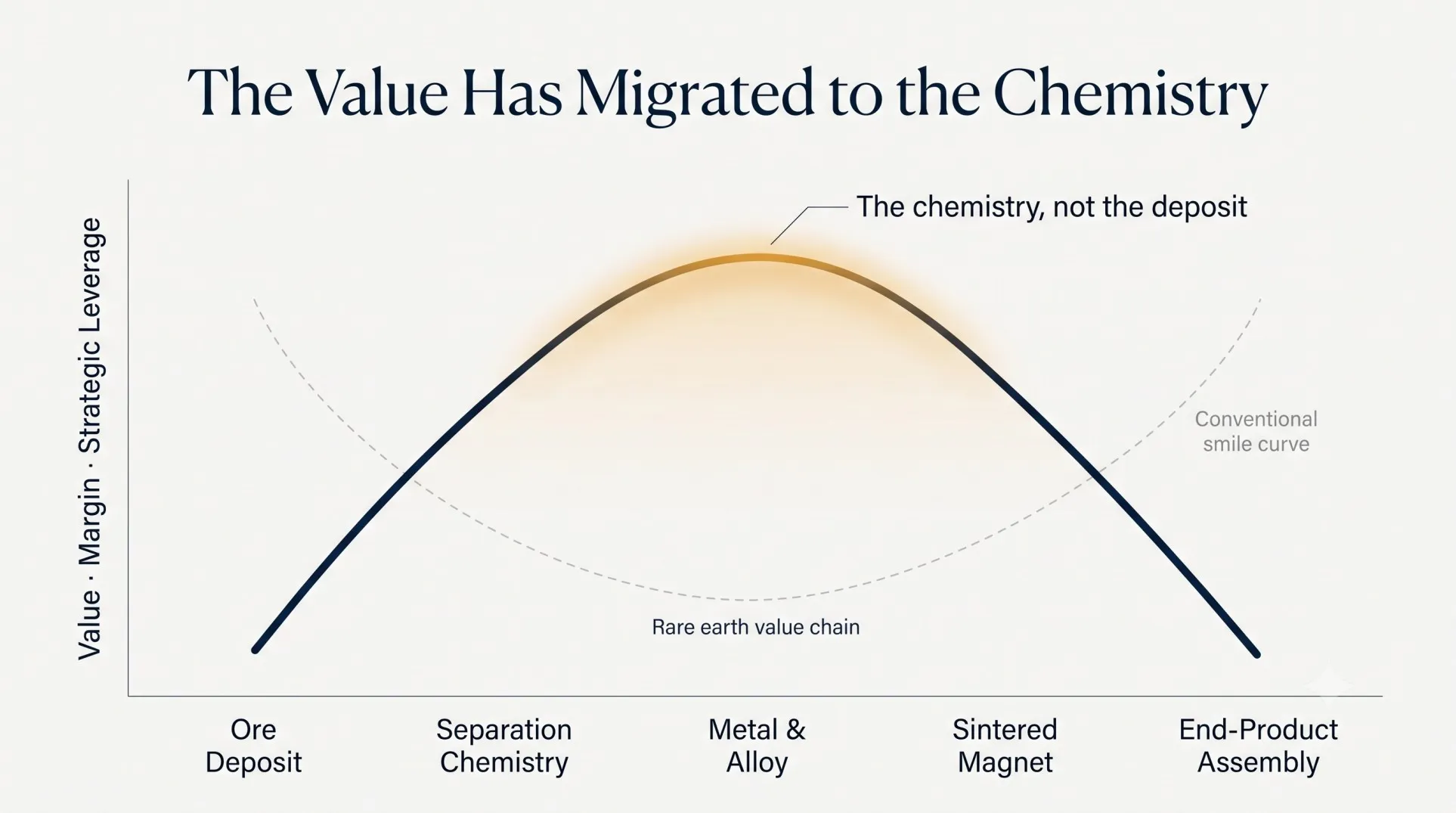
The durable advantage in materials sits in the middle of the value chain, in separation, synthesis, and processing, rather than at either end. Rare earths illustrate this with unusual clarity. Turning oxide into metal, metal into alloy, and alloy into a finished sintered magnet is the part of the chain that is genuinely hard to build, and it is the part that captures the margin and the strategic leverage.
There are only a handful of places on earth that can turn rare earth oxide into a finished magnet outside China, which is precisely why a country that masters that processing step owns something far scarcer than a mine.
Mineral extraction itself sits at the start of this chain as a necessary input, but on this same logic it is not where the value or the defensibility lives — a country that controls the mine without controlling the chemistry still depends on others for the margin and the strategic leverage. Extraction is best understood as the feedstock precondition for the chemistry layer, not a substitute for it; India's own policy design reflects this, sequencing assured domestic feedstock access ahead of, and in support of, the processing capability it is funding.
This is the smile curve that strategy teams have described for years, where value concentrates at research and at high-complexity processing while simple assembly earns the least. India spent decades at the lower end of that curve. The opportunity now is to climb into the parts that are difficult to copy.
Supply Diversification has Become Ordinary Commercial Sense
Global buyers are diversifying their sourcing for reasons that are practical rather than dramatic. Cost structures have shifted, geopolitics has realigned, and concentration in any single country now reads as a risk to be managed rather than a saving to be banked.
More than 135 multinationals already source specialty chemicals from India under the broad heading of China-plus-one, and United States chemical sourcing has been diversifying toward Indian suppliers even as flows from China have softened. Resilience has become the new currency in supply chains, and the shift in India’s favour is no longer only about price. It is also about capability.
This international dimension is also widening beyond bilateral arrangements. Quad partners have set up the Quad Investors Network, with a working group focused specifically on clean energy and critical minerals — a multilateral channel that complements the bilateral critical minerals framework India signed with the United States, discussed below under policy sequencing.
A decade of supplying regulated markets in pharmaceuticals and agrochemicals has built credibility in quality systems, intellectual property discipline, and the ability to run complex multi-step chemistry. India is increasingly chosen as a strategic manufacturing partner, not merely a lower-cost alternative, and that is a more durable position to hold.
The Shape of the Market in India
India Enters This Shift as a Global-Scale Producer with Room to Grow Toward $1T
India is already a top-tier producer, not an aspirant. It is the sixth-largest chemical producer in the world and the third-largest in Asia, and the sector contributes around 7% of national GDP, according to industry data compiled by IBEF. We size the full domestic chemicals and materials opportunity, combining current production with the large pool of demand that India currently meets through imports, at roughly $350 billion (₹31 lakh crore) today. That figure blends a domestic production base of about $250 billion (₹22 lakh crore) with $80 billion to $100 billion (₹7 lakh crore to ₹9 lakh crore) of demand presently met by imports.
On the trajectory we see, that opportunity compounds at close to 10% a year and reaches about $1 trillion (₹95 lakh crore) by 2037, at pace with nominal GDP. This is the trillion-dollar materials decade in summary.
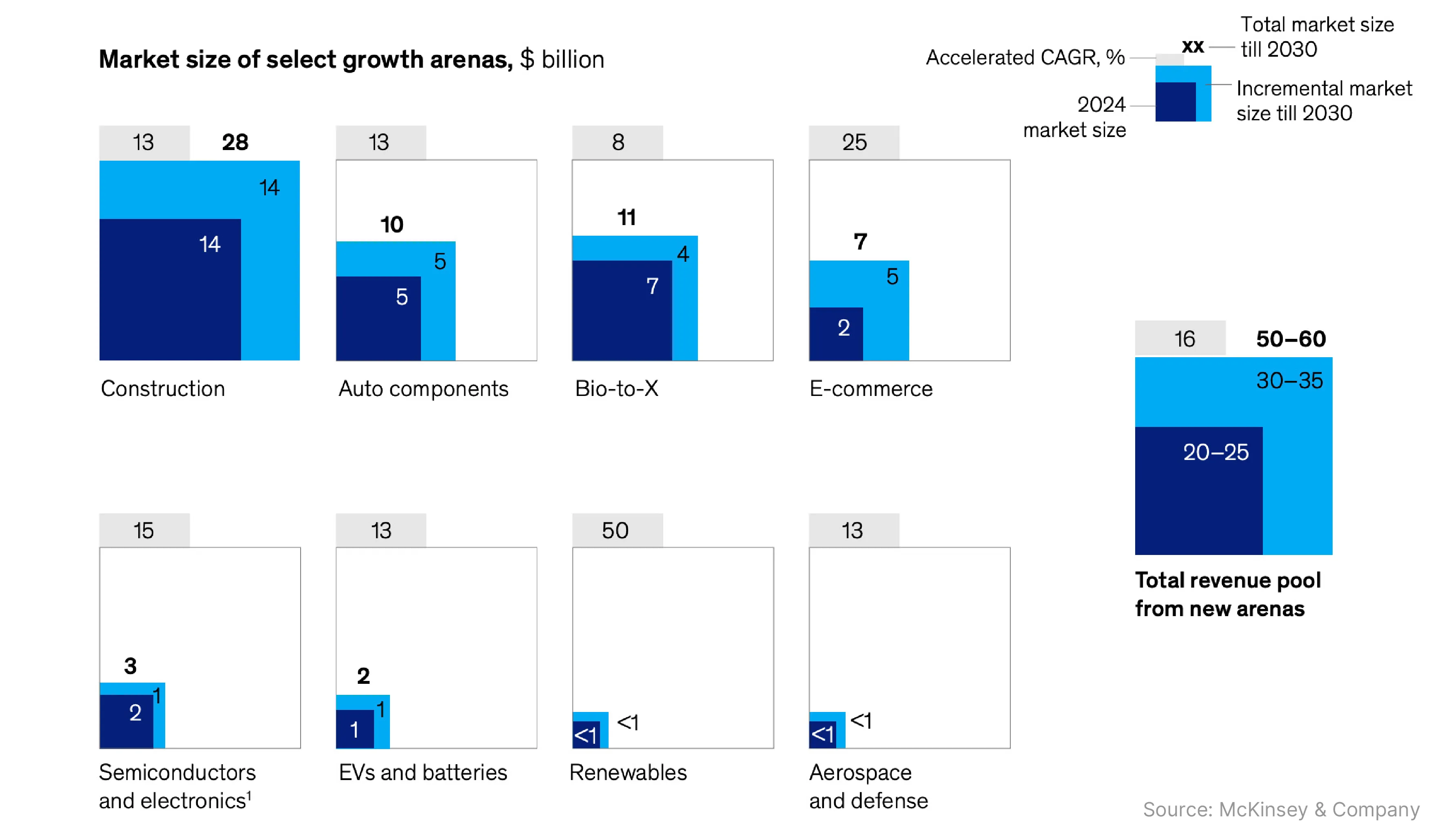
The trajectory holds up against independent markers. India’s specialty chemicals segment is compounding at 9% and moving from roughly $62-$64 billion (₹5.5 lakh crore) toward about $95 billion (₹8.4 lakh crore) by the end of the decade. McKinsey identifies eight chemical-intensive arenas, spanning semiconductors, EVs and batteries, renewables, construction, aerospace and defence, auto components, bio-to-X (bio-manufacturing), and e-commerce, that could add $30-$35 billion (₹2.6-₹3.1 lakh crore) in chemical revenues by 2030 as downstream capacity localises.
The market performance of Indian producers has already been exceptional. Listed Indian chemical companies have delivered total shareholder returns near 17% a year over the past decade, two to three times most global peers, on McKinsey’s reckoning.
The important nuance for an investor is that this growth will not lift every producer equally. The same analysis shows value creation splitting sharply, with a limited set of winners combining double-digit growth with margin expansion while the broad cohort stays flat, and with utilisation across specialty chemicals running at only 60% to 75% and new lines lower still. The opportunity is therefore not to own the average. It is to back the small number of capability-led companies that pull away from it.
India is Learning to Make the Complex Molecules it Has Been Buying
India’s most important materials gap is also its clearest opportunity. The country runs a chemical trade deficit of about $31 billion (₹2.7 lakh crore), and the deficit is concentrated in exactly the complex inputs that capability creation would address.
Roughly 70% of active pharmaceutical ingredients are sourced from China. Permanent magnet imports ran at dependence levels as high as 90% by quantity in recent years. In fertilisers, India imports the entirety of its potash and close to two-thirds of its diammonium phosphate nutrient requirement, a dependence laid bare when China halted fertiliser exports to India in mid-2025 and triggered an acute domestic shortage.
These dependence figures are, at root, an extraction and early-stage processing shortfall rather than a downstream manufacturing one. India has the chemistry talent and regulatory credibility to run complex synthesis, but lacks secured upstream feedstock and the refining capacity that sits just after it. Closing that gap is therefore as much about exploration and processing infrastructure as it is about final-stage manufacturing capability.
We read this deficit not as a weakness to apologise for but as a precise map. It shows where domestic capability would earn the highest strategic and commercial return, molecule by molecule. This is the heart of what we call whole-chain sovereignty, the principle that a country gains real security and real margin only when it controls the difficult middle of a value chain, not just the assembly at the end.
Policy Has Been Sequenced To Fund the Hard Middle of the Chain
India’s recent industrial policy is notable for funding the difficult steps rather than the convenient ones. The clearest example is the scheme to promote sintered rare earth permanent magnet manufacturing, with an outlay of ₹7,200 crore ($850 million) to build 6,000 tonnes a year of capacity across up to five producers.
The design matters more than the headline number. The scheme deliberately pays for the entire chain, from rare earth oxide to finished magnet, rather than subsidising one easy link and importing the hard ones. It pairs a capital subsidy of ₹750 crore with ₹6,450 crore of sales-linked incentives over a seven-year horizon, and it sits inside a wider architecture that includes the National Critical Minerals Mission and the reformed mining law that opened critical minerals to private participation.
This wider architecture is more substantial on the ground than the magnet scheme alone suggests. The National Critical Minerals Mission carries a seven-year outlay in the range of ₹16,300 crore to ₹34,300 crore depending on scope, and sets concrete operational targets: 1,200 domestic exploration projects by 2030-31, domestic production of at least 15 critical minerals such as graphite, lithium, potash, and rare earth elements, and a goal for Indian companies to acquire 50 mining assets worldwide. On the ground, the Geological Survey of India took up 195 exploration projects in the 2024-25 field season alone, including 35 in Rajasthan, and more than 100 critical mineral blocks are set to be auctioned, with exploration now expanding into offshore polymetallic nodule fields rich in cobalt, rare earths, nickel, and manganese.
The mission also carries an innovation target of 1,000 patents across the critical minerals value chain by FY 2030-31, supported by a dedicated Centre of Excellence on Critical Minerals cleared in April 2025. The regulatory foundation was reinforced by the Mines and Minerals (Development and Regulation) Act amendment in 2025, which gives the Central Government exclusive authority to auction mining leases for 24 critical minerals, marking a shift from reactive to proactive industrial planning.
Two parts of this architecture are worth flagging as genuinely structural strengths.
- First, geological promise is increasingly well-evidenced rather than speculative: Rajasthan has been formally identified as holding major reserves consistent with significant lithium and rare earth prospectivity, and the Department of Atomic Energy has already identified roughly 1,11,845 tonnes of in-situ rare earth oxide in Balotra, Rajasthan.
- Second, India is treating mineral recovery broadly rather than narrowly — a dedicated ₹100 crore has been set aside for pilot projects recovering critical minerals from unconventional sources such as mining overburden, tailings, fly ash, and red mud, using emerging hydrometallurgical and bioleaching techniques. This is a faster, lower-capex path to incremental supply than fresh extraction, and is consistent with the broader recycling and circularity opportunity flagged later in this note.
What is striking is the order of the moves. India locked its domestic incentive structure, opened the magnet capacity to competitive bidding with assured state feedstock for early movers, and then signed a critical minerals framework with the United States, with the bid window and the signature falling within days of each other. The framework is the international cover wrapped around an industrial policy India had already committed to, not the engine of it. The keystone was dropped into an arch that was already being built.
The same instinct runs through the bioeconomy, where the BioE3 policy backs bio-manufacturing as a strategic capability. India’s bioeconomy has grown from about $10 billion (₹88,000 crore) in 2014 to $165.7 billion (₹14.6 lakh crore) in 2024, with a stated target of $300 billion (₹26.4 lakh crore) by 2030, according to government figures. India is building this capability to supply the world, not only to replace its own imports.
Another area where policy execution is still catching up to ambition, and worth tracking closely, is advanced cell and component manufacturing. The Advanced Chemistry Cell PLI scheme set out to build 50 GWh of battery cell capacity by 2025 with an outlay of ₹18,100 crore; as of October 2025, roughly 1.4 GWh — about 2.8% of the target — had been commissioned, entirely by one beneficiary. The shortfall traces to genuinely hard, fixable constraints: stringent domestic value addition requirements, an aggressive two-year installation timeline, and bottlenecks in bringing in specialised technical expertise for equipment installation.
The underlying lesson is a useful one for the materials thesis broadly — capacity built at the final-assembly end of a chain is most effective when the precursor and component layers immediately upstream of it are also in place, and India's next phase of policy is increasingly oriented toward closing exactly that gap, including through circularity mechanisms under the Battery Waste Management Rules that can feed recovered lithium, nickel, cobalt, and graphite directly into domestic cell lines.
That is our Great Rebalancing thesis applied at the molecular layer, and it is the foundation of an India-for-the-world position as India on-shores more of its India-for-India supply chains in materials.
The Opportunity
The Prize is Owning the Complex Middle, Not Undercutting the Price-Sensitive End
The investable opportunity in Indian materials is capability creation, not price arbitrage. Import substitution captures a price and little else. Whole-chain capability captures a margin, a defensible position, and a strategic role that the world cannot easily reproduce.
We see four vectors where India can build that kind of capability.
- The first is full-stack specialty chemicals, where research connects directly to commercial manufacturing.
- The second is synthetic biology and bio-manufacturing, where molecules are grown rather than cracked from petroleum or extracted from animals and plants.
- The third is sustainable materials that replace petrochemical incumbents on performance and price.
- The fourth is advanced materials for electrical and electronics, including compound semiconductors, where the material itself is the product’s differentiation.
These four vectors map onto archetypes of companies that tend to win structural shifts, and our portfolio is built to maximise the opportunities from these shifts.
The Geometry of Performance: Our Thesis in Action

Our materials and chemicals portfolio operates on two layers. The first is the set of companies that make the molecules and the materials. The second is the company that makes the materials chain itself run to plan. Together they describe how we believe value is captured across this opportunity, by capability, by intellectual property, and by the size of the market each company addresses.
Scimplify Is a Full-Stack Challenger.
Scimplify is a science-first, asset-light innovator that spans research, process development, and commercial-scale manufacturing across more than 6,000 products and a network of over 500 partner manufacturing facilities. Its core contribution is to close the gap that breaks conventional outsourcing, where a process that works in the laboratory fails at scale. By integrating scientific expertise, process development, pilot validation, and commercial production into one operating model, it gives global buyers an integrated partner in place of a fragmented supply chain. Its product reach now extends from agrochemicals, pharmaceuticals, and flavours and fragrances into critical metals and advanced materials, which places it directly on the rare earth and whole-chain opportunity rather than beside it. It sits in the path of an India specialty chemicals market moving from roughly $62 billion to $64 billion (₹5.5 lakh crore) toward about $95 billion (₹8.4 lakh crore) by 2030, and in the path of the China-plus-one demand already drawing more than 135 multinationals toward Indian supply.
Fermbox Bio Is a Category Creator.
Fermbox Bio builds fermentation-based bio-manufacturing processes that grow alternative lipids, colours, flavours, proteins, and green-chemistry inputs. Its intellectual property lies in making those fermentation routes scalable, efficient, and cost-competitive, which is the step that decides whether a bio-based product can displace its animal, plant, or petrochemical equivalent. Precision fermentation is how a country moves from extracting molecules to programming them, and it converts agricultural biomass and local feedstock into high-value materials without a petrochemical cracker in sight. The company is building inside a national bioeconomy that the government is targeting at $300 billion (₹26.4 lakh crore) by 2030, backed by the BioE3 policy and its planned biomanufacturing and bio-foundry hubs. This is category creation in the most literal sense, producing materials that did not previously exist at viable scale in India.
ZeroCircle Is a 10x Better Product.
ZeroCircle makes seaweed-based, fully natural coatings and packaging materials, with material intellectual property that replaces petrochemical plastics. The decisive feature is that it does so at close to price parity, because a sustainable material only wins at scale when a procurement head does not have to choose between cost and conscience. The materials target high-volume categories where incumbent plastics face performance, recyclability, or regulatory limits, including foodservice and quick-service packaging, coated paper and board, hot and cold cups, grease-resistant wraps, and biopolymer pellets. The seaweed packaging market is moving from about $669 million (₹5,900 crore) in 2024 toward $1.3 billion (₹11,400 crore) by 2034, and that figure sits inside a far larger global opportunity to substitute plastic across packaging. ZeroCircle stands among the small set of global category leaders in this material, which makes it an India-for-the-world company by construction, building material infrastructure for a genuinely circular economy.
AGNIT Semiconductors Is a Territorial Superpower.
AGNIT is India’s first vertically integrated gallium nitride platform, controlling the chain from wafer to system. It is built on roughly 17 years of research originating at the Indian Institute of Science and on more than 15 patents across materials, processes, and devices. Its captive fabrication line compresses production cycles to about 45 days against the six months typical of external foundries, it has already completed its first international exports, and it is moving toward commercial shipments from the middle of 2027. Gallium nitride is a beyond-silicon material that outperforms silicon in exactly the conditions modern radar, 5G, electric vehicles, and power electronics demand, and the global market is headed past $9 billion (₹79,000 crore) by 2030. The strategic logic is sharp. A credible gallium nitride line can be built for a fraction of the cost of a leading-edge silicon fab, which makes compound semiconductors the most realistic route to genuine semiconductor sovereignty for India, with defence and telecom demand, including an engagement with the Ministry of Defence under the iDEX programme, anchoring early volume. Agnit is the purest expression of whole-chain sovereignty in our portfolio, a company that owns the material, the process, and the device.
Aereo Is a Materials Enabler.
Aereo is India’s pioneer in integrated drone solutions and aerial intelligence, built on proprietary survey-grade drones and the Aereo Cloud analytics platform. In materials and mining, the capability that pays is closing the gap between the mine plan and actual production, because in mining a deviation has a direct and immediate cost in tonnes not moved and grades off target. Aereo’s core use case is short-term production reconciliation, spotting early where output is drifting from plan and feeding that reality back into planning and into ERP and mine-scheduling workflows. The frontier the whole industry is now competing on is the gap between spotting a problem and acting on it, and the market has moved from admiring pilots to scaling closed-loop decisions across the enterprise. The pull is concrete and Indian. Tata Steel runs its full mine portfolio on Aereo Cloud after starting with a single three-month pilot. UltraTech Cement manages compliance across more than 37 mines on the platform. Hindustan Zinc has publicly committed to roughly ₹2,000 crore ($230 million) of value from artificial intelligence across its mines, smelters, and manufacturing, run as a portfolio of funded initiatives held to a stated return hurdle. Aereo is the layer that turns India’s expanding materials base into measured, plan-held output, and it shows that capability creation in materials spans both the molecule and the intelligence that governs it.
The Whitespaces: What We’re Looking For
The Next Layer of Capability Is Still Open, and We Are Looking for the Founders Building It
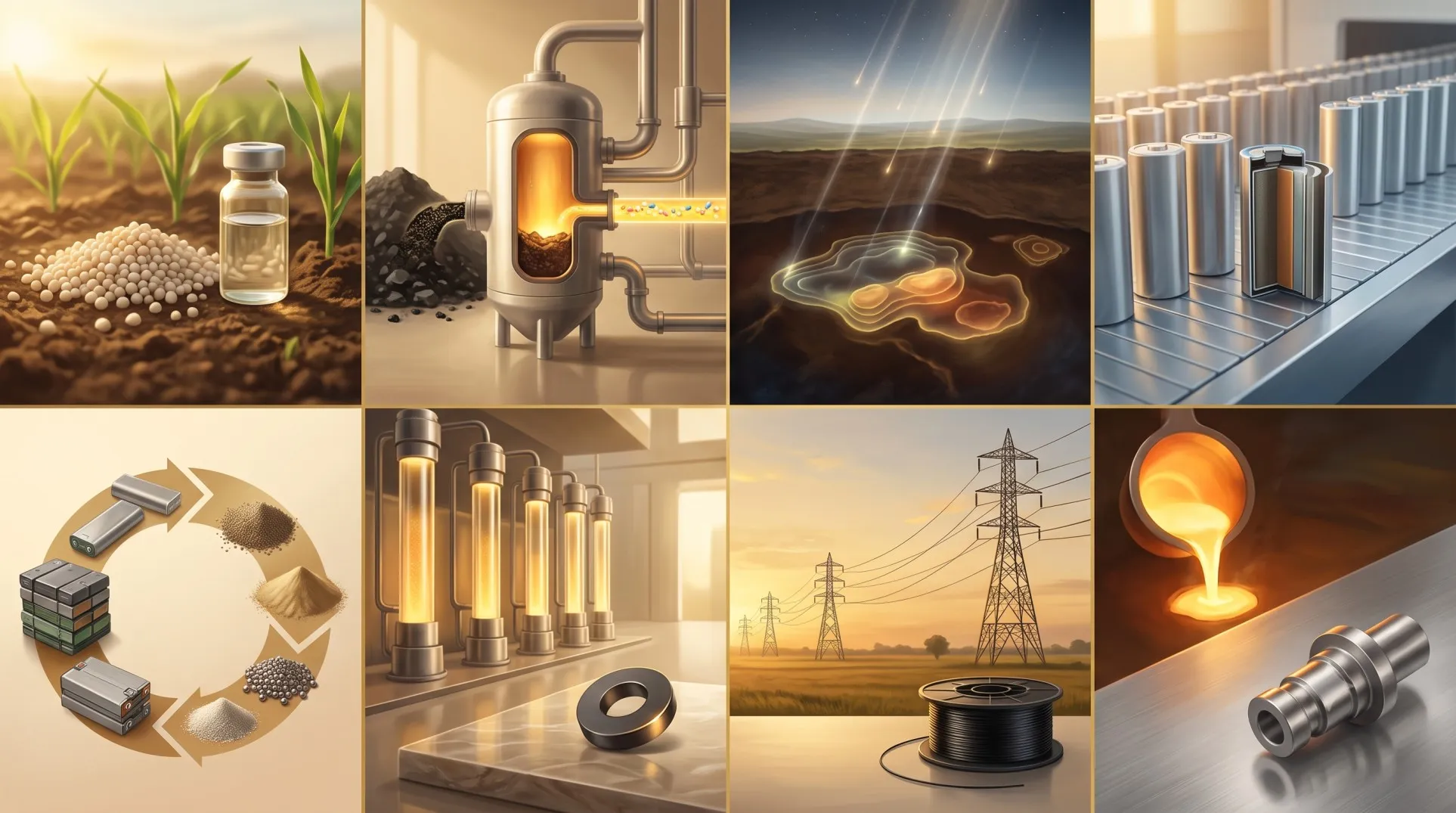
The materials whole chain still has large gaps, and each gap is an invitation. We are actively looking to back founders building deep intellectual property across the following areas, each tied to a specific dependency or a clear policy tailwind.
Alternative materials IP remains a priority. For instance, given that India imports the whole of its potash and the larger part of its phosphatic nutrient requirement against a fertiliser subsidy bill that has crossed ₹1.9 lakh crore, fertilisers remain a large target. New chemistries, nano-formulations, and alternative production routes that reduce that dependence would address one of the country’s largest and most persistent import lines.
Process-enablement IP such as coal gasification matters because it converts an abundant domestic resource into higher-value chemical feedstock, displacing imported precursors and deepening the early part of the chemical chain where India is currently thinnest.
Advanced subsurface imaging such as muon tomography is a step change for mining. By using naturally occurring cosmic-ray particles to build three-dimensional density maps, it can locate high-grade ore, map voids, and monitor asset integrity up to a kilometre below the surface, in effect a CT scan for the earth, improving both discovery and safety in ways conventional survey cannot match.
Advanced manufacturing of input materials and components for on-shoring supply chains is wide open, with battery cells and packs as the lead case. India has already added domestic capacity for about 200 million battery packs a year, close to 40% of national requirement, under the Electronics Manufacturing Cluster scheme. The cell, the active materials, and the upstream electrochemistry remain largely to be built. This is also where the ACC PLI scheme's early commissioning gap is most relevant — it points to where India's cell and component manufacturing base genuinely needs deepening before it can carry the weight of a fully domestic battery supply chain, and one independent estimate puts India at five to ten years from a robust, competitive cell manufacturing industry assuming execution stays on track. For investors, that lengthens the runway over which precursor materials, active materials, and component IP businesses have room to establish themselves before the assembly layer catches up.
Second-life and materials recovery is a fast-emerging layer. We are interested in battery lifecycle management, second-life energy storage, repurposed electric-vehicle packs, and recovery streams that include recovered carbon black, devulcanised rubber, and specialised base and precious-metal catalysts. These close the loop and create domestic supply from material already inside the country. Government policy is moving in step here too, with a dedicated outlay for recovering critical minerals from mining overburden, tailings, fly ash, and red mud, and with Extended Producer Responsibility provisions under the Battery Waste Management Rules creating a regulatory channel for recovered lithium, nickel, cobalt, and graphite to flow back into domestic manufacturing. Of the whitespace themes in this note, this is arguably the one with the shortest distance between today's infrastructure and a working domestic supply chain.
Rare earth materials IP and manufacturing is the separation, metal-making, and magnet capability that the national scheme is built to fund, in a category where import dependence ran as high as 90% by quantity. This is the clearest single example of value sitting in the chemistry rather than the deposit.
Carbon fibre materials IP and advanced components for the grid combine an advanced material with an urgent national need. India curtailed roughly 300 GWh of clean electricity in the first quarter of 2026 because generation outran the transmission to carry it, with around 25 major transmission projects delayed on right-of-way issues alone, according to data published by Ember. High temperature low sag conductors built around a carbon fibre composite core carry 1.5 to 2 times the power on the same towers with no new land, and one analysis estimated that deploying them across India’s planned greenfield lines would pay back the additional cost within four years through lower losses. Against a national plan to add over 191,000 circuit kilometres of transmission by 2032 and a transmission build estimated near ₹9 lakh crore ($102 billion), the carbon fibre core technology is patented and held by a small number of licensees, which makes this a supply-constrained, IP-gated materials opportunity of exactly the kind we want to back. The whole chain, from precursor to carbonisation to composite-core manufacturing, is open to a domestic builder.
Advanced metals and specialised component manufacturing remains an open wedge. We are looking for unique alloys and precision components for global supply chains and original equipment manufacturers across automotive, nuclear energy, electrical equipment such as transformers, and structural materials, spanning machining, castings, forgings, specialised fasteners, light-weight alloy frames, and assembly. This is the metallurgy-and-precision-manufacturing layer that lets India move from raw metal to qualified, OEM-grade parts, which is where the margin and the long-term customer relationships live.
Enabling Factors: The Foundations the Whole-Chain Thesis Depends On
The whitespace themes above sit inside the materials and chemicals value chain directly. A separate set of factors does not produce a molecule or a material itself, but determines how fast and how reliably the chain above can be built. These are worth tracking as a distinct category, because they are largely outside any single company's control and act as the binding constraints on the pace of the broader thesis.
Exploration Tenure and Financing Architecture
India's mineral wealth remains under-mapped relative to its geological promise, and the country currently lacks the high-resolution exploration datasets and the tenure system that let private capital take exploration risk efficiently. Leading jurisdictions such as Canada and Australia allow explorers to freely select ground, backed by secure, tradable exploration rights, which creates liquidity and draws private investment into early-stage exploration. Closing this gap would let India's exploration base scale through private capital markets rather than depending primarily on public-sector exploration capacity.
Ultra-specialised Domain Expertise
Constraints on specialised technical talent in separation chemistry, cell manufacturing, magnet metallurgy, and equipment installation expertise have shown up as a recurring bottleneck across early-stage schemes, including delays tied to bringing in specialised installation expertise for battery manufacturing facilities. The mission has already begun addressing this through plans to introduce specialised critical minerals modules into mining, metallurgy, and recycling degree programmes, but converting curriculum change into a working technical workforce is typically a multi-year process, and the timeline for this is worth watching closely alongside capacity build-out.
Power and Transmission Capacity
Energy-intensive processing — smelting, separation chemistry, and cell manufacturing — depends on reliable, sited grid capacity, and India's transmission build is currently the binding constraint in several regions, evidenced by clean electricity curtailment from generation outpacing transmission. As new processing clusters are sited, transmission readiness is likely to determine how quickly commissioned capacity can actually be brought online, independent of capital availability or policy support.
Cross-ministry Policy Execution and Continuity
Several of India's materials schemes, including the rare earth magnet programme, are designed around coordinated action across the Ministry of Mines, Ministry of Commerce, and Ministry of Industries operating in parallel rather than sequentially. This design can meaningfully compress timelines when it works, but it also introduces a sustained coordination requirement across electoral cycles. The more instructive test for programmes like the National Critical Mineral Mission is likely to be their fourth and fifth year of execution rather than their first.
Dedicated Financing and Refining Policy for the Middle of the Chain
India currently has well-developed policy at the two ends of the chain — exploration support through the National Critical Mineral Mission, and final-assembly incentives through PLI-style schemes — but a comparatively thinner policy framework for the refining and precursor-material layer in between. Since this is precisely the layer where this note's whole-chain sovereignty thesis identifies the greatest value and defensibility, the emergence of a more dedicated refining and component-financing policy is one of the more consequential developments to track over the next several years.
Conclusion
The State has begun acting as a coordinated catalyst, and the market geometry is shifting in response. As India climbs toward its $10 trillion GDP target, the task of the next decade is to start these flywheels of materials innovation now, while the policy tailwinds and the diversification of global supply chains are both in India's favour.
Founders have more room than ever to build full-stack National Champions, owning the whole arc from IP and design through manufacturing and global go-to-market.
The industrial winners of this decade will be decided in the chemistry, not the headline. India spent a generation buying its molecules. It is now learning to make them, across specialty chemicals, synthetic biology, sustainable materials, compound semiconductors, and the metals and components that hold the physical economy together.
We are backing the people building that capability from the ground up, and we are looking for many more. This is India for the world, written at the molecular layer.
DISCLAIMER
The views expressed herein are those of the author as of the publication date and are subject to change without notice. Neither the author nor any of the entities under the 3one4 Capital Group have any obligation to update the content. This publications are for informational and educational purposes only and should not be construed as providing any advisory service (including financial, regulatory, or legal). It does not constitute an offer to sell or a solicitation to buy any securities or related financial instruments in any jurisdiction. Readers should perform their own due diligence and consult with relevant advisors before taking any decisions. Any reliance on the information herein is at the reader's own risk, and 3one4 Capital Group assumes no liability for any such reliance.Certain information is based on third-party sources believed to be reliable, but neither the author nor 3one4 Capital Group guarantees its accuracy, recency or completeness. There has been no independent verification of such information or the assumptions on which such information is based, unless expressly mentioned otherwise. References to specific companies, securities, or investment strategies are not endorsements. Unauthorized reproduction, distribution, or use of this document, in whole or in part, is prohibited without prior written consent from the author and/or the 3one4 Capital Group.