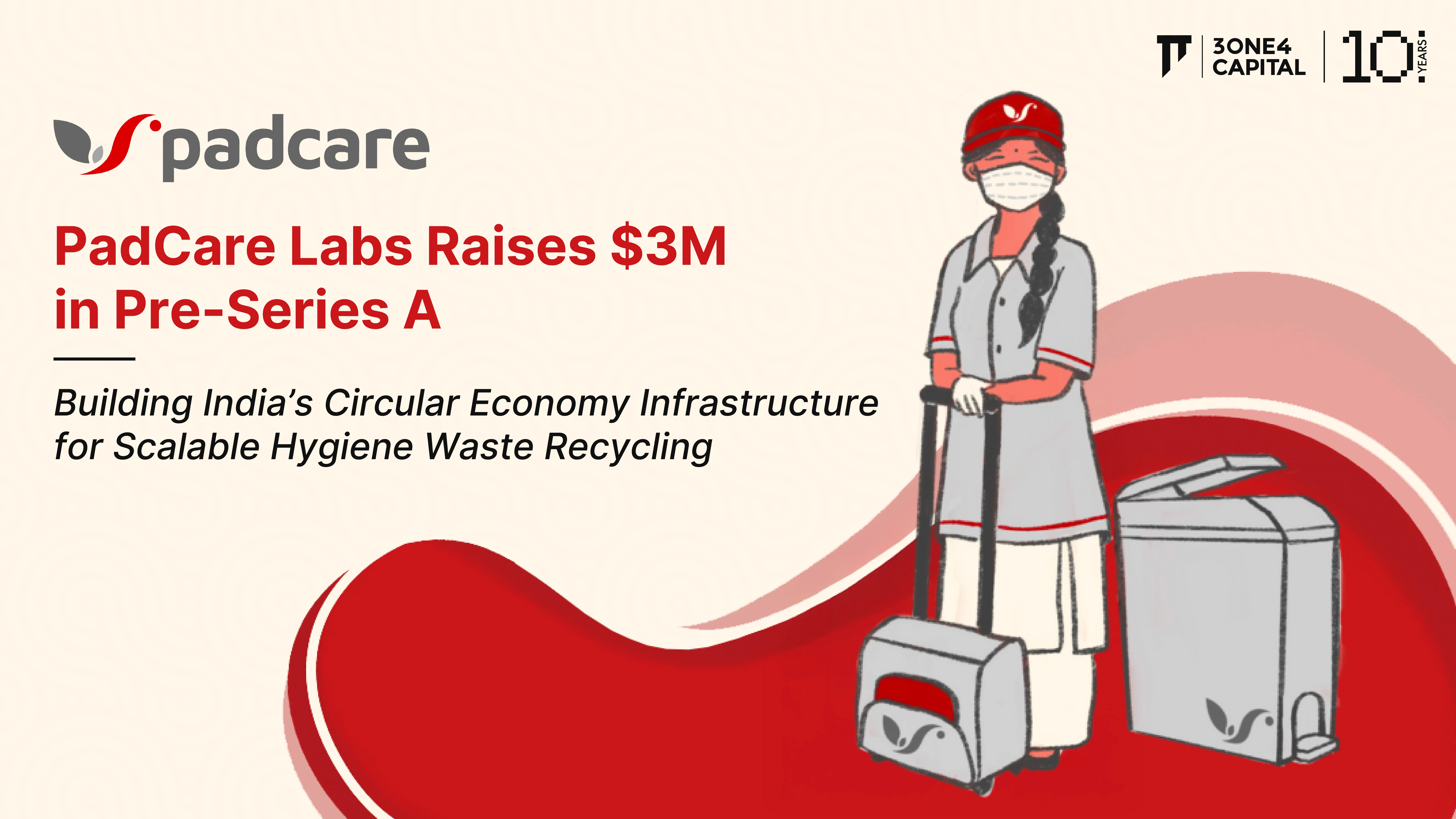
PadCare Labs Raises $3 Million in Pre-Series A: Building India’s Circular Economy Infrastructure for Scalable Hygiene Waste Recycling
We are delighted to back PadCare Labs' $3 million Pre-Series A, alongside Rainmatter by Zerodha, Brigade Group, PKRBCV Shroff Trust, and existing investors Lavni Ventures and 3i Partners. Founded by Ajinkya Dhariya, PadCare is building India's first integrated platform for sanitary waste collection, recycling, and EPR compliance, operating across 24 cities and serving 685 enterprises.
We partnered with PadCare because we believe India's sanitary waste sector is approaching the same structural shift that formalised biomedical and e-waste management over the past decade – a large, unorganised market where tightening regulation, absent infrastructure, and growing institutional demand create the conditions for a full-stack operator to define the category. No such operator exists yet at scale.
A Waste Stream That Formal Infrastructure Never Reached
India discards over 12 billion sanitary pads every year. Most are incinerated in makeshift community burners, mixed into municipal dry waste, or dumped in landfills where a single pad takes up to 800 years to decompose. The sanitation workers who handle this waste bear the greatest burden, sorting biologically contaminated material daily with no protective equipment and no formal processing system designed to manage it safely.
The gap persisted from genuine technical difficulty. Sanitary waste is moisture-heavy, biologically contaminated, and socially stigmatised, making it unlike any other waste stream. Building the sterilisation workflows, collection infrastructure, and material recovery systems to handle it compliantly at scale required a specialised effort that no existing waste management player had made. That is the gap PadCare is built to close.
From Collection to Circular Value
PadCare's recycling system uses a patented five-step process involving shredding, perforation-based separation, and advanced sterilisation to process soiled sanitary waste at industrial scale. The company operates at the highest technology readiness level, meaning the system is fully deployed and commercially validated across multiple cities.
What makes the model distinctive is that processing does not end at safe disposal. Used sanitary pads are separated into two recovered materials: a cellulose derivative with applications in paper, stationery, and advanced fibres, and an industrial-grade recycled polyethylene granulate used in moulded products. This positions PadCare as a supplier of sustainable raw materials to industrial buyers, adding a monetisation layer that grows with processing volume.
On the compliance side, IoT-enabled collection infrastructure and batch-level traceability generate verifiable EPR audit trails, making PadCare a directly deployable solution for FMCG brands facing post-consumer recovery obligations under the new regulatory framework.
Regulation Is Forcing the Market to Formalise
The Solid Waste Management Rules formally designate corporate offices, housing societies, hospitals, and transport infrastructure as bulk waste generators, requiring segregated disposal through authorised vendors. The Draft EPR Notification goes further, imposing binding post-consumer recovery targets on sanitary product manufacturers starting at 60% by FY27 and scaling to 100% by FY30. Producers can meet these obligations either through direct take-back systems or by purchasing EPR credits from authorised recyclers.
For FMCG companies producing sanitary products, these are hard financial and compliance obligations. Most currently have no credible, traceable recovery partner at any meaningful scale. Legacy waste management companies lack segment-specific sterilisation and traceability workflows. Regional operators cannot generate EPR credits. The demand for a verified, end-to-end processing partner is active and growing, and the supply side has not kept up.
A Category Being Built from the Ground Up
At the core of the business is PadCareX – the company's patented recycling machine. The output of PadCare's recycling process is not just waste disposal – it's material recovery. Used sanitary pads are broken down into two valuable derivatives: CellPure, an absorbent cellulose fraction with applications in copier paper, stationery, acoustic boards, and advanced fibres; and rPE35, an industrial-grade recycled polyethylene granulate used in plant pots, paver blocks, and other moulded products. This closed-loop model transforms what was once a liability into a source of circular value.
The Operating Edge
Ajinkya Dhariya founded PadCare as a university-incubated project and built it from a single-city pilot into a multi-city, IP-backed, profitable business without large external capital. A mechanical engineer who understood the processing problem at a technical level before building the commercial model around it, Ajinkya grounded the technology moat in IP.
The business today serves 685 enterprises across 2,000 sites in 24 cities, through partnerships with facility management companies including JLL, Sodexo, and CBRE. The sales team operates almost entirely on inbound demand, which speaks to how strongly the regulatory and ESG tailwinds are driving institutional procurement behaviour without active selling.
PadCare's Moment
No full-stack player has yet built the end-to-end infrastructure to serve both institutional compliance demand and post-consumer brand recovery obligations in sanitary waste simultaneously. PadCare's existing supply aggregation network, processing infrastructure, and regulatory approvals represent a head start that will take years to replicate in a category with long compliance timelines and high capital requirements.
As EPR mandates tighten and brands face hard recovery targets, the market will consolidate around operators who can offer verifiable, auditable, end-to-end processing. Looking ahead, PadCare aims to scale toward 2,000 MT of annual recycling capacity by March 2027, launch PadCare Orbit for housing societies, and begin expansion into APAC markets where the same structural gaps exist.
At 3one4 Capital, we are proud to back Ajinkya and the PadCare team as they set new standards for what responsible, circular sanitary waste management looks like – in India, and beyond.
DISCLAIMER
The views expressed herein are those of the author as of the publication date and are subject to change without notice. Neither the author nor any of the entities under the 3one4 Capital Group have any obligation to update the content. This publications are for informational and educational purposes only and should not be construed as providing any advisory service (including financial, regulatory, or legal). It does not constitute an offer to sell or a solicitation to buy any securities or related financial instruments in any jurisdiction. Readers should perform their own due diligence and consult with relevant advisors before taking any decisions. Any reliance on the information herein is at the reader's own risk, and 3one4 Capital Group assumes no liability for any such reliance.Certain information is based on third-party sources believed to be reliable, but neither the author nor 3one4 Capital Group guarantees its accuracy, recency or completeness. There has been no independent verification of such information or the assumptions on which such information is based, unless expressly mentioned otherwise. References to specific companies, securities, or investment strategies are not endorsements. Unauthorized reproduction, distribution, or use of this document, in whole or in part, is prohibited without prior written consent from the author and/or the 3one4 Capital Group.