Rise of the Indian Woman: At the Heart of Global AI Diffusion
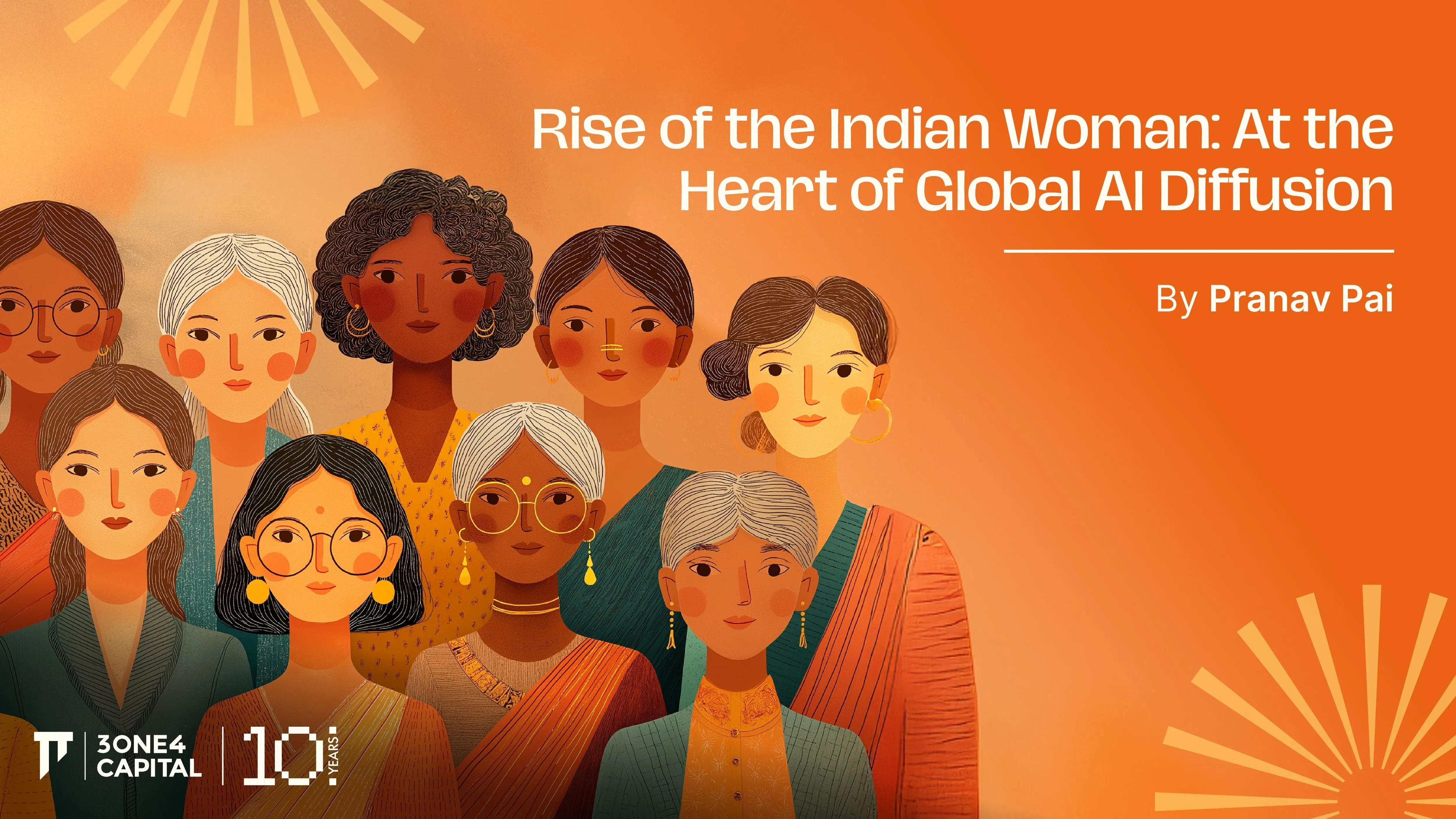
Indian women now rank first in the world in AI skill penetration. Not first among emerging economies. Not first in Asia. First globally, ahead of women in the United Kingdom, Germany, Israel, and every other country measured by Stanford University’s Institute for Human-Centred AI.
This sentence would have been unthinkable a generation ago. When India won its Independence, female literacy in India stood at 9% - a symptom of centuries of colonisation. Three generations later, the granddaughters and great-granddaughters of women who won Independence are building AI systems that serve the world. That arc, from 9% literacy to the global #1 in AI skill acquisition, is among the most remarkable human capital transformations in modern economic history.
Previously, I wrote about the rise of the Indian woman. A story of women’s literacy rates surging from 9% in 1950 to ~75% today, of women's enrolment in higher education institutions growing 5% YoY since 2011-12 and overtaking men's enrolment, of a quiet revolution of inclusive progress unfolding across scheduled tribes, minority communities, panchayats, and boardrooms. That story was about the groundwork being laid.
This year, the story has a new dimension: artificial intelligence. What the data now reveals is extraordinary. Indian women are not just participating in the global AI revolution; they are leading from the frontier of adoption. In doing so, they are powering India’s emergence as the world’s third-ranked AI ecosystem, behind only the United States and China.
A Different Kind of AI Capability
Stanford HAI’s Global AI Vibrancy Index (GVI) aggregates 42 indicators to rank countries on AI standing. In the 2024 edition, India ranks third behind only the United States and China, and ahead of South Korea, the United Kingdom, Singapore, Japan, Israel, and Germany. In 2017, when the index was first published, India ranked seventh. This is significant progress.
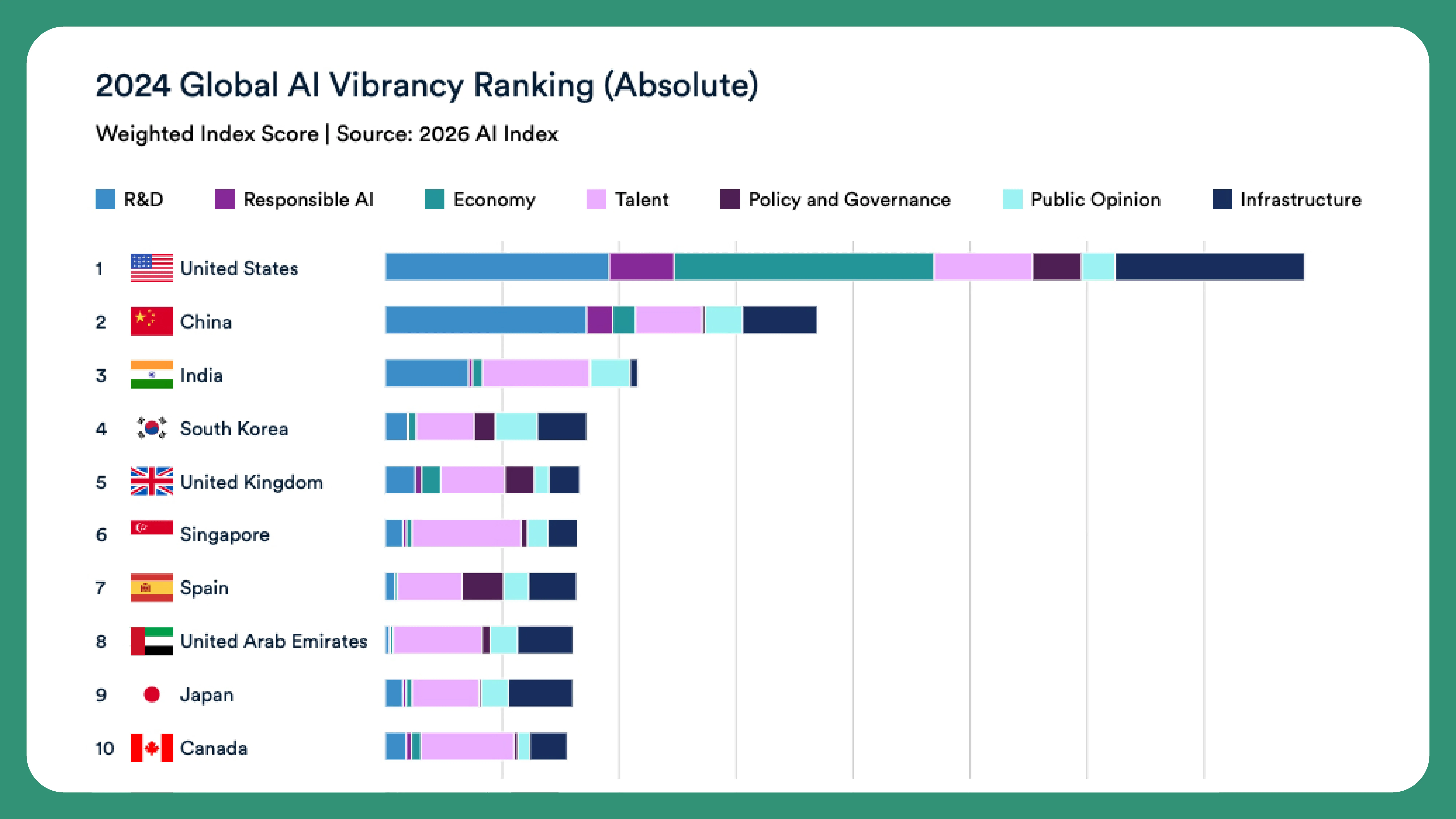
But what matters more than the rank is what is driving it. The United States leads through R&D dominance and infrastructure investments. China leads through the scale of investment and state-directed IP transfer. India’s ascent is talent-led and focused on the accelerated diffusion of AI throughout the economy. Within the Stanford HAI 2025 AI Index Report’s talent section, India overtakes even the United States in Relative AI Hiring Rate and Change in AI Talent Concentration. India also ranks second globally in AI-related GitHub projects, a measure of practical, democratised, community-driven development rather than top-down closed research.
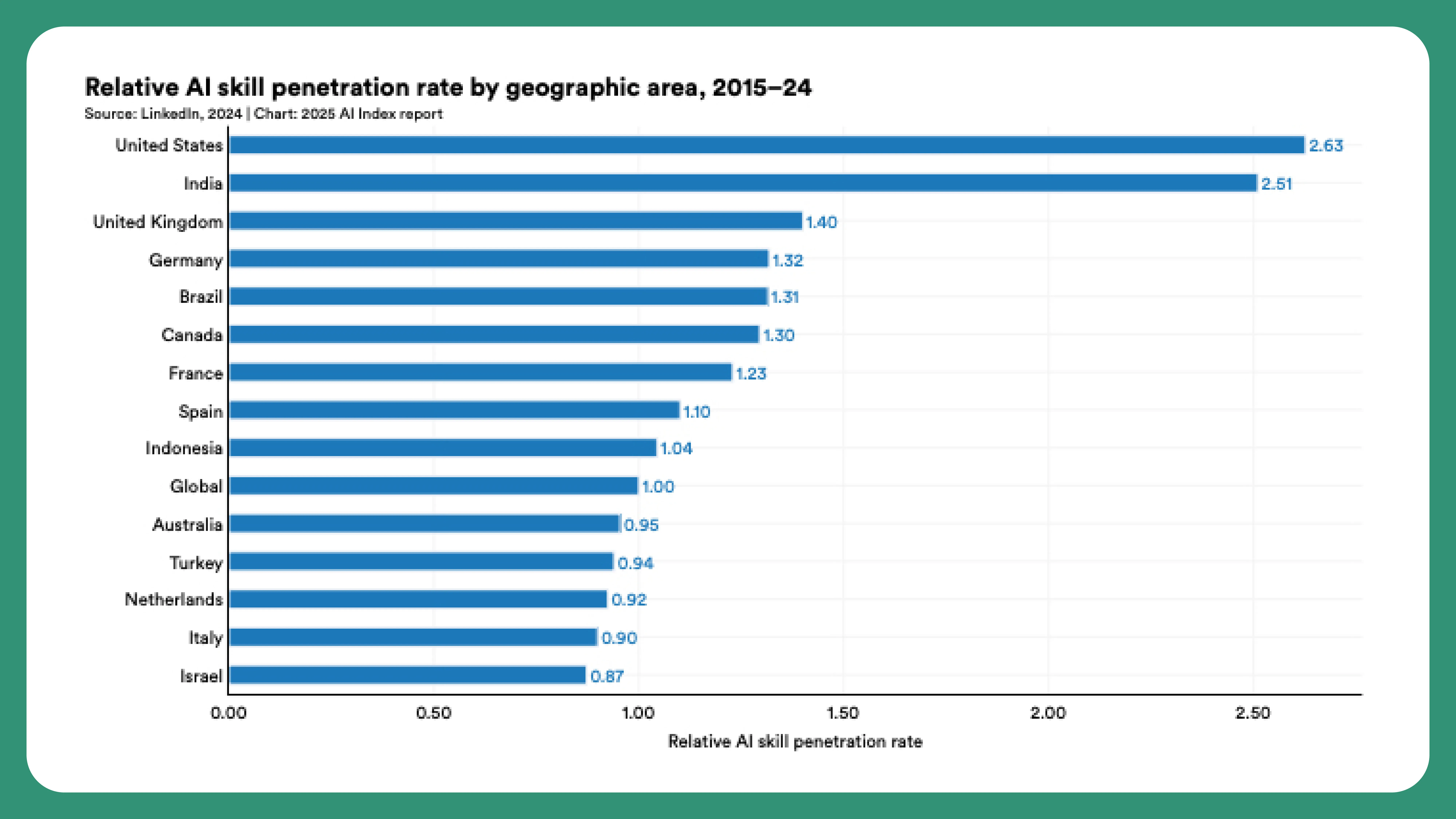
This is a fundamentally different kind of AI competence. It is not built solely by concentrated research labs or sovereign-wealth-funded compute clusters, though these remain essential. It is also built on the breadth of a talent base that is growing faster and more inclusively than any other, and is responsible for the diffusion of AI into the mainstream economy. The most striking evidence of this inclusivity is the rise of Indian women in tech.
India’s AI Gender Parity Is Ahead of Advanced Economies
The Stanford HAI 2025 AI Index Report, drawing on LinkedIn data across dozens of countries, reveals something that should reframe how the world thinks about India’s technology ecosystem: India has achieved near gender parity in AI talent concentration and AI skills penetration at a scale unmatched by any advanced economy.
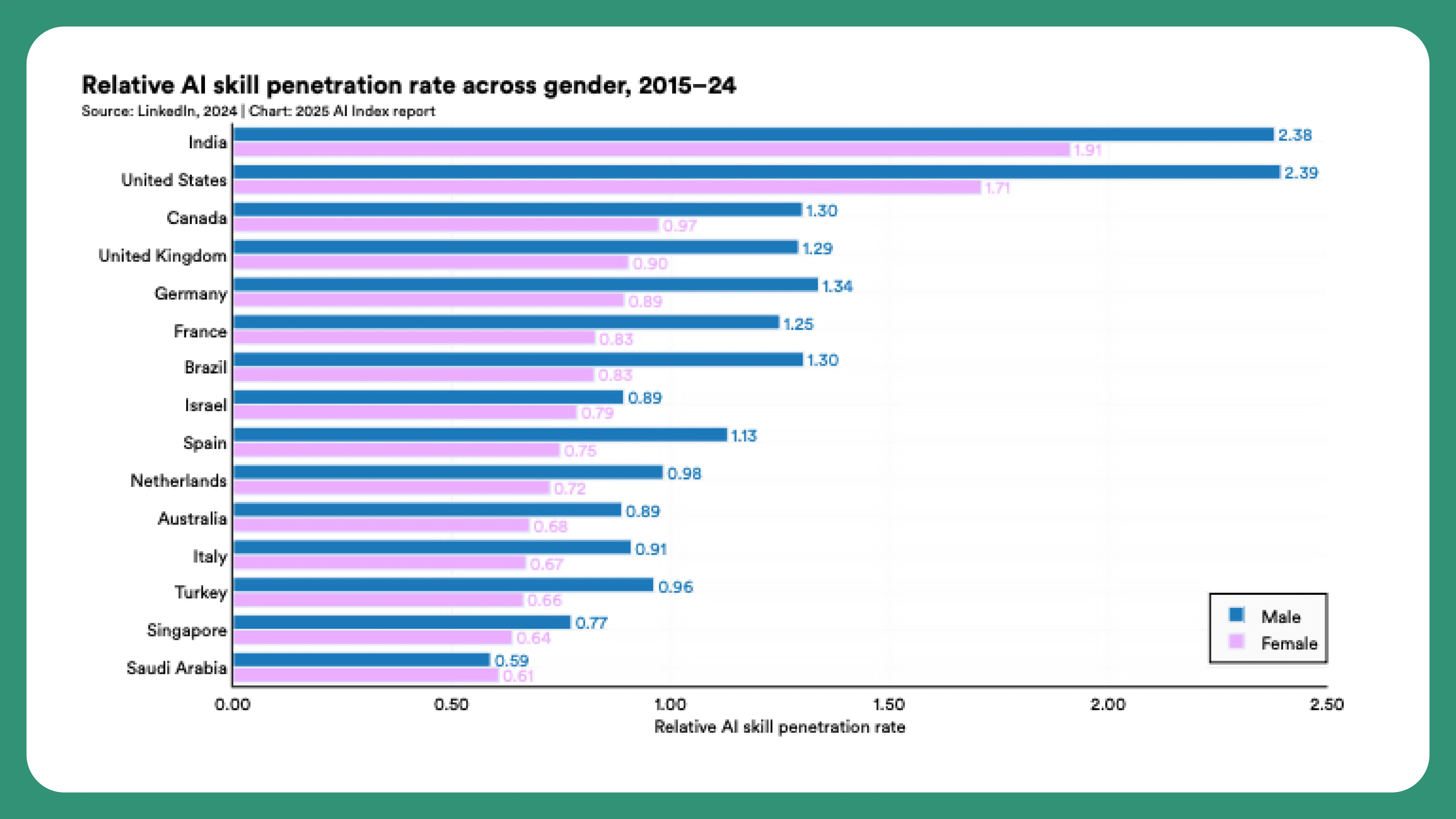
Start with the headline number. India’s female AI skill penetration rate stands at 1.91 — the highest of any country. The United States, the world’s overall AI leader, registers 1.71 for women. Germany, the strongest AI economy in Europe, manages just 0.89. These are not marginal differences. Indian women are acquiring AI skills at more than double the rate of their German counterparts.
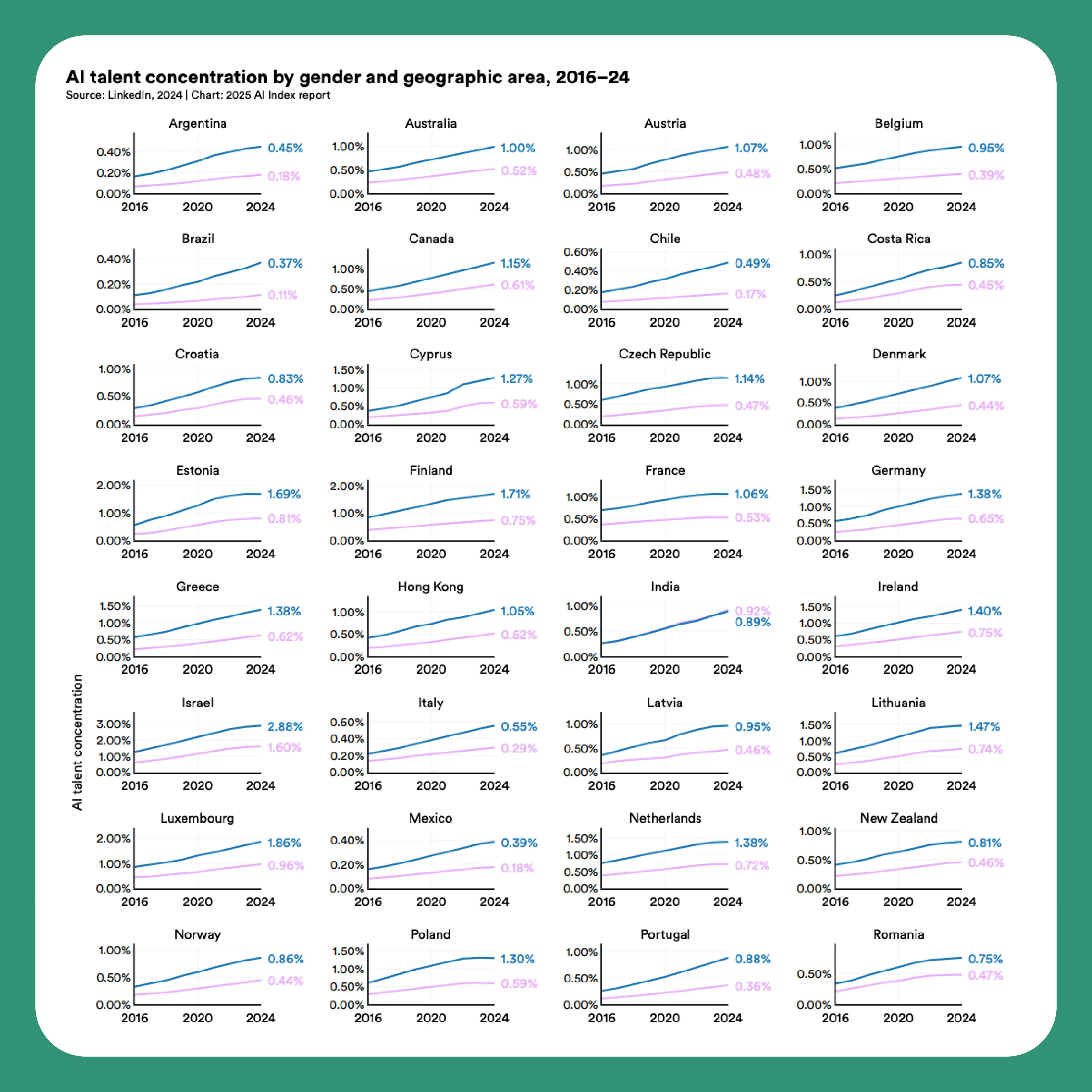
Now look at the gender gap within each country. In India, male AI talent concentration is 0.92%, and female is 0.89% — a difference of 0.03 percentage points. In Germany, that gap is 0.73 points. In France, 0.53. In Finland, nearly a full point. Across the advanced economies that pride themselves on gender equity in the workplace, the AI talent gender gap runs at 2x or more. In India, it is essentially level.
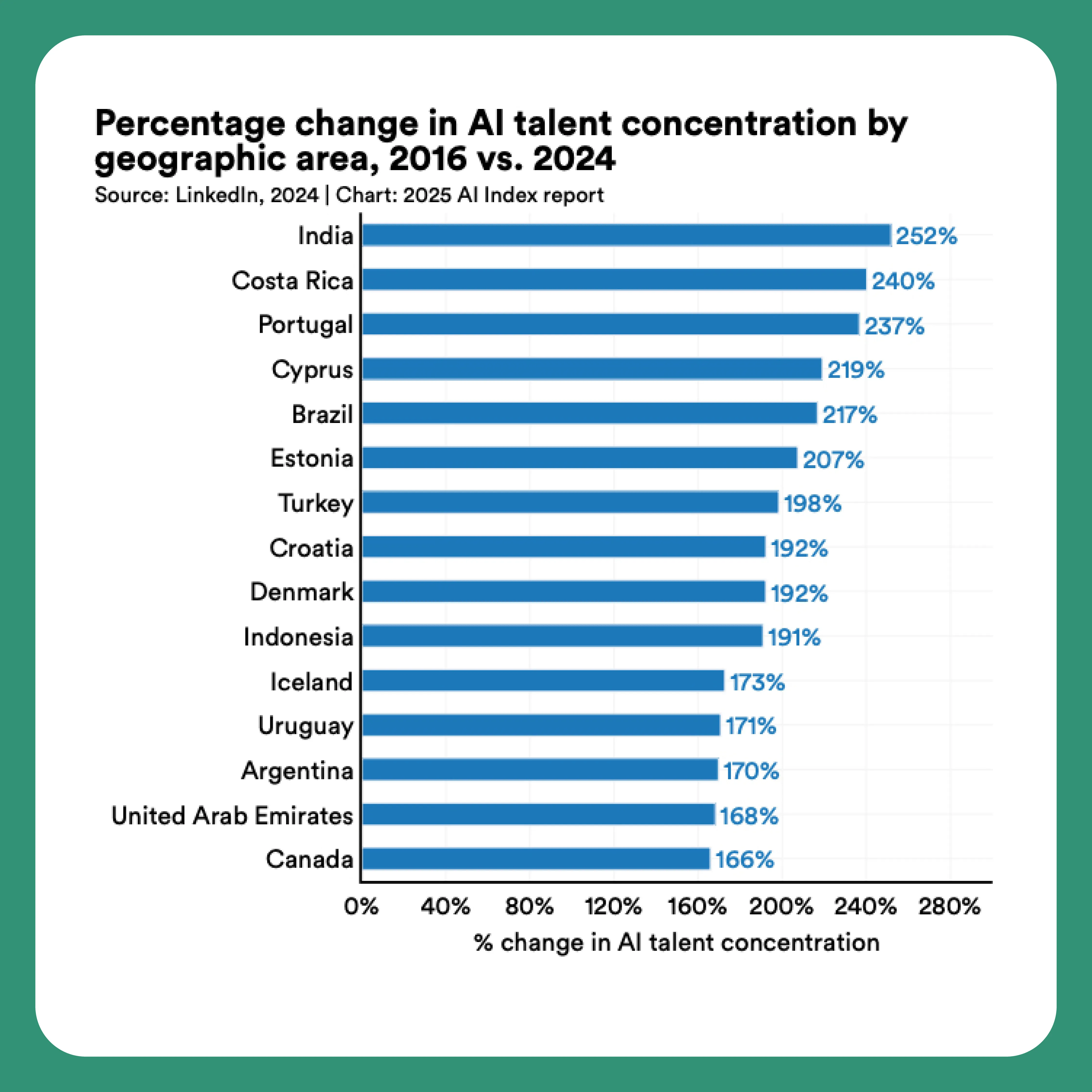
The pace of AI talent development in India is accelerating. Between 2016 and 2024, India’s overall AI talent concentration grew by 252% — the steepest growth among all countries measured, ahead of Japan, Israel, South Korea, Singapore, and every major economy. This is not a country catching up. This is a country competing to set standards in talent development and skills diffusion.
Why India Is Producing This
The natural question is: why? Wealthier countries with better-endowed universities and deeper AI research funding are producing wider gender gaps in AI talent. India, with a fraction of their R&D budgets, is achieving parity. The answer lies in three structural forces that are unique to India’s talent ecosystem.
- The first is the sheer scale of engineering education and its increasing female inclusion. As I wrote last year, women’s enrolment in higher education has grown 5% annually since 2011-12, outpacing men’s 3% rate. Women overtook men in gross enrolment ratio in FY19, and the gap has widened since. This pipeline feeds directly into the technology workforce and now, specifically, into AI roles.
- The second is the GCC hiring machine. India’s 1,800+ Global Capability Centres, contributing 28% of the global STEM workforce, have created a structured pathway from campus to AI deployment that operates at a scale no other country can match. GCCs recruit tens of thousands of engineers annually, train them in applied AI, and expose them to frontier production systems. This pipeline does not select for pedigree or connections; it selects for aptitude and competence, which is why it has been disproportionately effective in accelerating women's entry into the AI workforce.
- The third is India’s startups building on top of digital public infrastructure. The India Stack — Aadhaar, UPI, ONDC, DigiLocker — has created a massive surface area for applied AI across financial services, healthcare, agriculture, education, and governance. When AI is being deployed across everyday economic life by innovative young companies, the demand for an AI-skilled workforce broadens beyond elite institutions into the wider talent pool. Startups are always on the frontier of this shift, leading the charge by retraining existing talent and hiring recently graduated engineers to leapfrog and build the systems of tomorrow.
The result is a diffusion of AI capability across the economy rather than its concentration in a small number of institutions. This is how a country achieves AI talent breadth, and it is why India’s gender gap is narrower than in countries where AI remains concentrated in academic or corporate innovation enclaves.
The Talent-as-Infrastructure Advantage
Talent is still the upstream driver of everything in AI. When a country’s women are leading the world in AI skill acquisition, the talent pool is not narrow or fragile — it is resilient, adaptive, and becoming deeply embedded across its economy. This is the kind of foundation that sustains multi-decade competitive advantage, and it is a moat that can accelerate indigenous innovation in multiple directions.
At 3one4 Capital, we are seeing this translate into active deal flow and talent flow. Over the past 18 months, we have seen a measurable increase in AI-native startups with women in founding or technical leadership roles, particularly in fintech, edtech, consumer, and deep tech. The pattern is consistent with the Stanford data: expanding the talent base also expands the founder and operator base.
One of India’s greatest vulnerabilities is R&D intensity and the catch-up needed — still at 0.64% of GDP, compared with 2-3% in the US, China, and South Korea. The talent is there. The application surface is there. What is missing is the depth in grant programs, university integrations, and networked policy implementation that would turn a talent-led AI economy into a full-stack innovation engine. If India closes this gap while preserving the inclusivity of its talent ecosystem, it will have built something no other country has: a top-three AI economy where women are equal participants from the ground floor, not retrofitted into it a generation later.
The Horizon
The story of the rise of Indian women in tech is a hard, data-driven structural argument about the nature of India’s competitive position in the most consequential technology surge of the century. The countries that win in AI will be the ones that invest heavily in innovation, infrastructure, and IP. There is no shortcut here. They will also be the ones that mobilise the most competent talent, most broadly, most sustainably. On that measure, India is doing something special.
India’s tech sector has done the hardest part — building an AI talent base where gender is not a barrier. Now comes the question that will define whether this advantage compounds or erodes: will the country invest in the R&D infrastructure worthy of the talent it has produced? Will policy implementation move fast enough to expand the frontier of what we can do here? The women in tech have answered their part.
Source: Stanford HAI Global AI Vibrancy Index (2024); Stanford HAI 2025 AI Index Report; LinkedIn Economic Graph (2024); AISHE Higher Education Data.
DISCLAIMER
The views expressed herein are those of the author as of the publication date and are subject to change without notice. Neither the author nor any of the entities under the 3one4 Capital Group have any obligation to update the content. This publications are for informational and educational purposes only and should not be construed as providing any advisory service (including financial, regulatory, or legal). It does not constitute an offer to sell or a solicitation to buy any securities or related financial instruments in any jurisdiction. Readers should perform their own due diligence and consult with relevant advisors before taking any decisions. Any reliance on the information herein is at the reader's own risk, and 3one4 Capital Group assumes no liability for any such reliance.Certain information is based on third-party sources believed to be reliable, but neither the author nor 3one4 Capital Group guarantees its accuracy, recency or completeness. There has been no independent verification of such information or the assumptions on which such information is based, unless expressly mentioned otherwise. References to specific companies, securities, or investment strategies are not endorsements. Unauthorized reproduction, distribution, or use of this document, in whole or in part, is prohibited without prior written consent from the author and/or the 3one4 Capital Group.