

Why India Must Abolish Capital Gains Taxes for Foreign Investors
As India accelerates toward becoming the world’s third-largest economy, its policymakers are aggressively courting international capital to fund a multi-trillion-dollar infrastructure and technological buildout. Yet, while the government’s rhetoric champions foreign investment, its tax code remains anchored in an archaic philosophy that actively repels it. The core friction is not merely the rate at which foreign investors are taxed, but the fundamental, anomalous mechanism by which India claims the right to tax them at all.
To truly unlock the floodgates of global liquidity, India must confront a stark reality: its capital gains tax regime is a glaring global outlier. By clinging to a "source-based" taxation model for foreign investors, India is fighting gravity in a financial world predominantly governed by "resident-based" taxation. Eliminating capital gains taxes for foreign allocators is a necessary structural alignment with global financial standards.
The Global Standard of Resident-Based Taxation
To understand India’s isolation on this issue, one must examine the plumbing of international capital markets. The vast majority of developed nations, and the most successful financial hubs, operate on a resident-based capital gains framework for portfolio investments. Under this doctrine, the right to tax capital gains rests entirely with the jurisdiction where the investor resides, not where the asset is located.
Consider the United States, the deepest capital market on earth. If a British pension fund buys shares of Apple or Microsoft, holds them, and sells them for a massive profit, the U.S. Internal Revenue Service (IRS) does not levy a capital gains tax on that transaction. The U.S. recognizes that the investor is a resident of the U.K., and defers the taxing authority to the British government. The same principle applies across the U.K., much of the European Union, Singapore, and Hong Kong.
This global consensus is not an accident. Policymakers in these jurisdictions understand that taxing non-residents on capital gains introduces devastating friction. It deters investment, complicates compliance, and ultimately raises the cost of capital for domestic companies. By waving the right to tax foreign investors' capital gains, these nations prioritize market liquidity, robust corporate valuations, and seamless cross-border capital flows over a relatively small sliver of tax revenue.
India’s Outlier Status - The Burden of Source-Based Taxation
India, conversely, aggressively enforces a source-based capital gains regime. The Indian Income Tax Act dictates that because the underlying asset (the shares of an Indian company) is located in India, the income is deemed to "accrue or arise" in India. Therefore, the Indian government claims the primary right to tax the foreign investor's profit.
This source-based approach makes India deeply unique, and entirely uncompetitive. When a foreign endowment or sovereign wealth fund allocates capital to Indian equities, they are not simply taking on market risk; they are forced to become entangled in the Indian tax bureaucracy. They must obtain Indian tax registration (PAN), navigate complex withholding taxes, file annual tax returns in India, and expose themselves to the risk of protracted, often retrospective, assessments by local tax authorities.
Global investors investing in India take 3 different risks:
- Country Premium Risk. Despite its vast potential, India is still categorized by global sovereign and risk models as a high-risk jurisdiction, carrying an expected risk premium of roughly 4% to 4.5%. Investors demand this premium simply to offset the geopolitical and systemic uncertainties of operating within the region.
- Perpetual Foreign Currency Risk. Historical data is sobering for dollar-denominated allocators: from the liberalization of the Indian economy in 1991 to the present, the Rupee has depreciated by an average of 3.5% to 4% annually. This relentless slide structurally erodes dollar returns upon conversion, acting as a silent tax on every successful exit.
- Punitive Capital Gains Tax. The recently levied taxes on capital gains add a direct, unavoidable cost to investing, further diminishing the net yield. When combined, these three factors frequently turn what appears to be a stellar local-currency gain into a deeply mediocre dollar-adjusted return.
For a global asset manager sitting in New York or London, allocating across 50 different emerging and developed markets, India’s insistence on source-based taxation is a glaring, administrative nightmare. While tax treaties (such as the historical treaties with Mauritius and Singapore) once provided a workaround to mimic a resident-based system, India has systematically renegotiated these treaties over the past decade to close those avenues, forcing all foreign investors to face the full brunt of domestic taxation.
The Broken Promise of STT and Double Taxation
This heavy administrative burden is further compounded by a historical policy reversal that has deeply eroded investor trust. In 2004, India introduced the Securities Transaction Tax (STT) explicitly in lieu of long-term capital gains (LTCG) taxes. The macroeconomic logic was sound: STT was cleaner, easier to collect automatically at the exchange level, and completely eliminated tax evasion. For over a decade, foreign and domestic investors alike paid this transaction tax willingly, secure in the policy compact that their long-term capital gains were exempt.
Yet, in 2018, the government abruptly reintroduced the LTCG tax on equities, which was subsequently hiked to 12.5% in 2024. Crucially, the STT was never removed. Today, foreign investors suffer a punitive double-taxation regime: they are taxed upon executing a trade merely for participating in the market, and then taxed again upon exit via capital gains. This reneging on a fundamental policy promise creates a deeply unpredictable regulatory environment.
A Decade of Data: Indian Equities vs the US
When these friction points are quantified over the last ten years (June 2016 – June 2026), the investment thesis for India becomes incredibly strained. The following table illustrates the step-by-step erosion of foreign investor returns compared to the U.S. market:
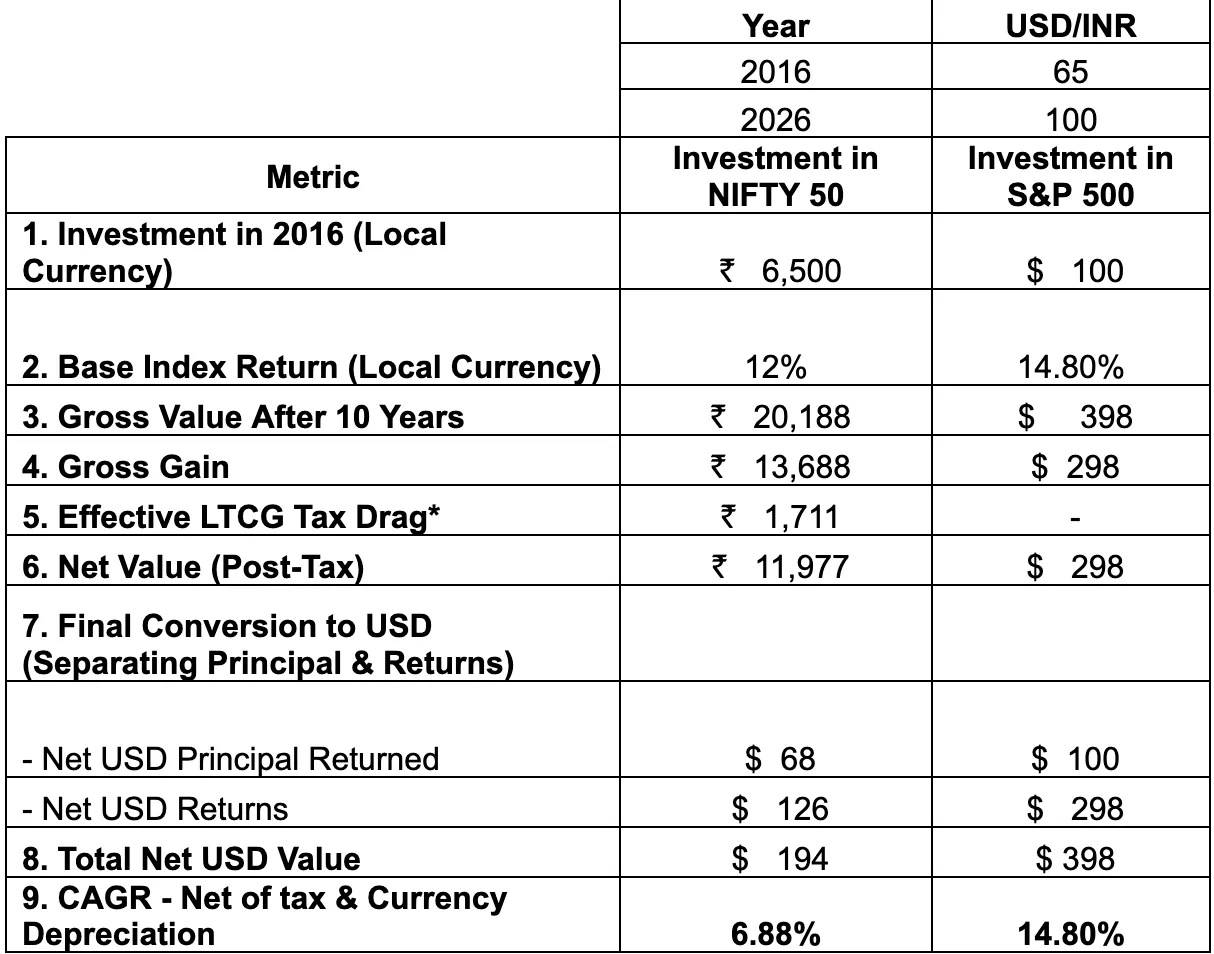
*Because India taxes the nominal INR gain (at 12.5%) before accounting for currency depreciation, the tax effectively acts as a disproportionately large drag on the final dollar-adjusted return. As a resident-based tax regime, the U.S. does not levy capital gains tax on non-resident foreign portfolio investors.
For global allocators managing pension funds and university endowments, the fiduciary question is unavoidable: Why should we take on emerging market risk, endure a 4% country risk premium, and navigate complex double-taxation to earn 6.88%, when we can earn double that return in the home market with zero currency risk?
Fixed Income Fix: Why Tax Cuts on G-Secs Are Not Enough
The government is not entirely blind to this dynamic. In a promising pivot, the President promulgated the Income-tax (Amendment) Ordinance on June 5, 2026, officially reducing the tax on interest and capital gains on Indian Government Securities (G-Secs) to zero for Foreign Institutional Investors (FIIs).
While this is a laudable step aimed at smoothing India's inclusion into global bond indices, mathematical realities dictate that it is insufficient to attract the necessary volume of global capital on its own. Even with a 0% tax rate, Indian debt struggles to compete with risk-free U.S. assets due to the relentless drag of currency depreciation:
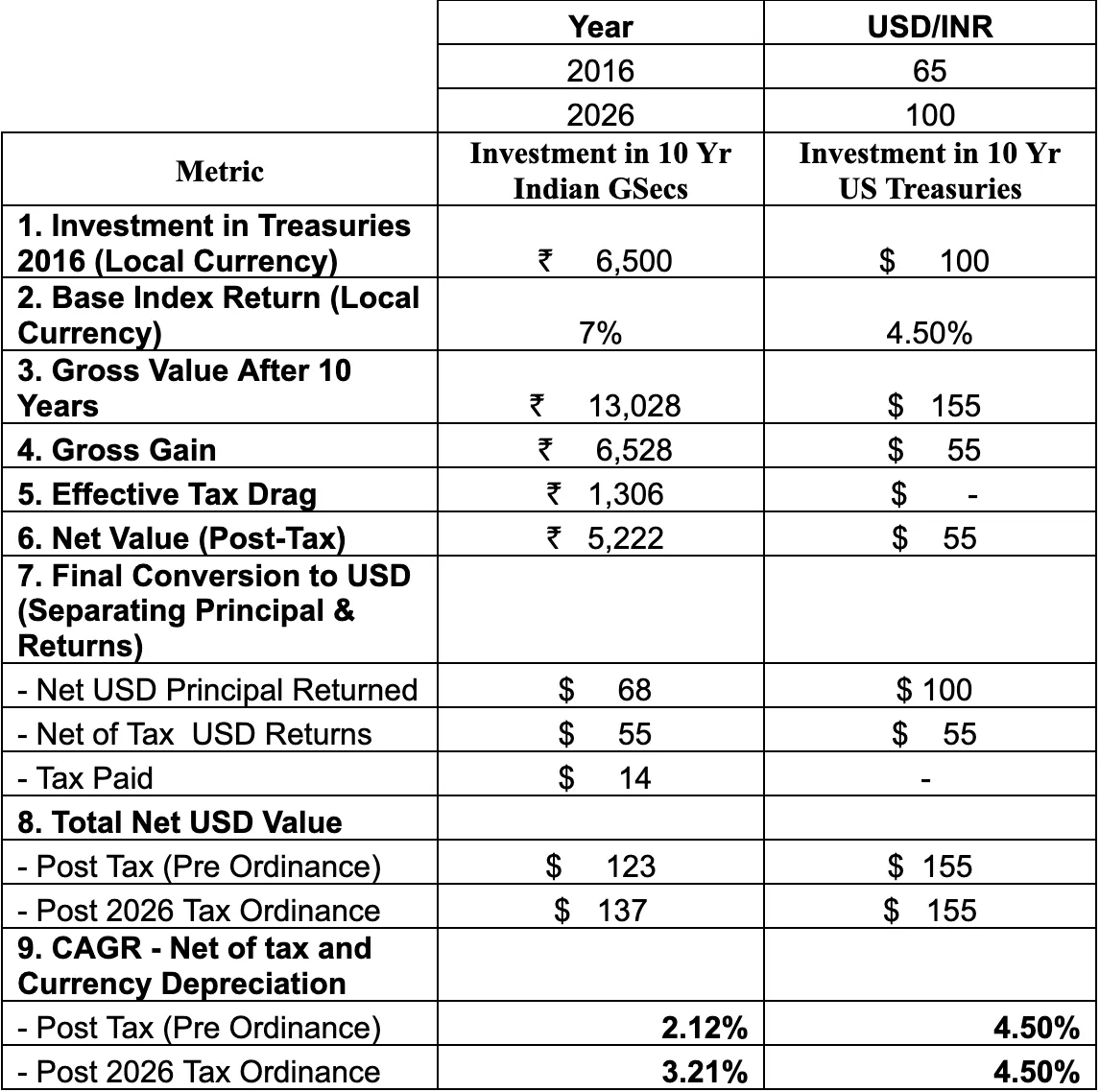
Despite the elimination of taxes on government debt, foreign investors still yield lower dollar-adjusted returns (3.21%) from Indian sovereign bonds than they do from "risk-free" U.S. Treasuries (4.5%). Because fixed-income yields in India cannot mathematically outrun the historical rate of Rupee depreciation, unlocking foreign capital must focus on equity and alternative asset markets, where gross returns are high enough to absorb the currency hit, provided they are freed from capital gains taxes.
The Silent Erasure of Principal due to Currency Depreciation
The mainstream financial narrative surrounding emerging markets suffers from a profound blind spot: it almost exclusively obsesses over the reduction of gains while entirely ignoring the destruction of principal.
As demonstrated in both the equity and fixed-income models above, the "Dual Effect" of currency depreciation is devastating. It does not merely shave a few percentage points off an investor's yield; it systematically erases their core capital base. A foreign allocator mathematically loses roughly 30% of their initial dollar capital over a decade in India before a single percentage point of true economic return is generated.
When this glaring lack of principal protection is mixed into India's broader regulatory cocktail, the investment thesis fractures severely. A foreign allocator is asked to accept a structural 30% erosion of their principal, yet they receive no compensating tax relief. Instead, they are subjected to a notoriously litigative tax department, high-pitched scrutinies, and arbitrary assessments. Fiduciaries are forced to pay punitive taxes on localized inflation while simultaneously fighting protracted legal battles just to defend their diminished dollar returns. This toxic combination of mathematical disadvantage and administrative harassment profoundly robs India of its attractiveness as a premier investment destination.
Taxing Phantom Gains: The Case for Dollar-to-Dollar Indexing
The severity of this mathematical drag is exacerbated by a crucial policy regression. Historically, India recognized the inherent unfairness of taxing currency depreciation and offered foreign investors the protection of "dollar-to-dollar" indexing. Under this regime, foreign allocators could compute their capital gains in their home currency, ensuring they only paid taxes on actual economic profits.
Though the erstwhile First proviso to Section 48 (corresponding to Section 72 of the Income Tax Act, 2025) allowed for dollar to dollar indexation of gains, it only applied to Non Resident Indians. FIIs were specifically denied this gain under Section 115AD of the Income Tax Act, 1961 (corresponding to Section 210 of the Income Tax Act, 2025). Today, a foreign investor might break even or actually lose money in pure dollar terms, yet still be hit with a massive capital gains tax bill in India simply because the asset's nominal Rupee value inflated. Reinstating dollar-to-dollar indexing, or better yet, abolishing the capital gains tax entirely for foreign investors, is a fundamental prerequisite for basic tax fairness, ensuring that investors are not penalized for the host nation's own currency depreciation.
The Economic Case for Zero Capital Gains on Foreign Capital
Arguing for a zero-capital gains tax regime for foreign investors, spanning Foreign Direct Investment (FDI), Foreign Portfolio Investment (FPI), and Alternative Investment Funds (AIFs), often invites pushback. Critics argue it is unfair to tax domestic investors while exempting foreigners. However, this conflates domestic tax policy with international macroeconomic strategy.
Abolishing the capital gains tax for foreign investors is fundamentally about lowering the cost of capital for Indian entrepreneurs and securing the nation's foreign exchange reserves.
- Eliminating Jurisdictional Friction: Shifting to a globally recognized resident-based model (effectively zero capital gains tax in India for non-residents) would instantly dismantle the administrative barriers keeping trillions of dollars of passive global capital out of the country. It signals that India is an open, modern market.
- Offsetting the "Risk Triad": As previously established, foreign investors already battle a structural 3.5% to 4% annual Rupee depreciation and a steep country risk premium. A source-based capital gains tax is the breaking point that turns a viable investment into an un-investable one. Removing this tax acts as a vital counterbalance, restoring the dollar-adjusted viability of the Indian market.
- The Multiplier Effect: The revenue the Indian government collects from foreign capital gains is a pittance compared to the profound economic benefits of unhindered capital inflows. Increased foreign investment drives up domestic equity valuations, allowing Indian banks, NBFCs, and infrastructure firms to raise growth capital at cheaper valuations. The downstream effects of job creation, infrastructure development, and increased corporate tax revenues far outweigh the direct capital gains tax receipts foregone.
The Structural Imperative: Lowering India's Cost of Capital
Arguing for a zero-capital gains tax regime spanning Foreign Direct Investment (FDI), Foreign Portfolio Investment (FPI), and Alternative Investment Funds (AIFs) often invites pushback. Critics argue it is unfair to tax domestic investors while exempting foreigners. However, this fundamentally misunderstands the ultimate goal: lowering the domestic cost of capital.
Currently, India’s cost of capital sits at a punitive 11%-13%, severely handicapping domestic entrepreneurs who must compete globally against peers in the U.S. and Europe, where the cost of capital ranges between 6%-9%.
This high cost is exacerbated by the Indian government's status as a massive borrower. To fund critical national infrastructure and manage fiscal deficits, sovereign borrowing continually absorbs domestic liquidity, effectively "crowding out" private enterprise and keeping domestic interest rates elevated. Domestic savings alone are mathematically insufficient to fund India's multi-trillion-dollar aspirations.
To lower this stifling cost of capital, India must drastically expand its total pool of available capital. Inviting unhindered, tax-free foreign capital dramatically increases liquidity in the system, forcing the cost of capital down. Cheaper capital directly translates into higher corporate investments, rapid job creation, and vastly expanded economic activity.
Abolishing capital gains for foreign investors is not a "concession to outsiders." It is a vital macroeconomic lever that raises domestic equity valuations, allows Indian firms to raise growth capital cheaply, and ultimately delivers profound economic benefits to domestic Indian investors and the broader economy.
Conclusion
India cannot have it both ways. It cannot aspire to be the primary engine of global growth while subjecting the fuel for that growth, foreign capital, to an anomalous, punitive, and administratively heavy source-based tax regime.
By abandoning the source-based model and adopting the global standard of resident-based taxation for cross-border investments, India would effectively eliminate capital gains taxes for foreign allocators. This single policy shift would instantly elevate India’s competitive standing, aligning its tax code with its economic ambitions, and ensuring a deep, permanent reservoir of global capital to fund its future.
DISCLAIMER
The views expressed herein are those of the author as of the publication date and are subject to change without notice. Neither the author nor any of the entities under the 3one4 Capital Group have any obligation to update the content. This publications are for informational and educational purposes only and should not be construed as providing any advisory service (including financial, regulatory, or legal). It does not constitute an offer to sell or a solicitation to buy any securities or related financial instruments in any jurisdiction. Readers should perform their own due diligence and consult with relevant advisors before taking any decisions. Any reliance on the information herein is at the reader's own risk, and 3one4 Capital Group assumes no liability for any such reliance.Certain information is based on third-party sources believed to be reliable, but neither the author nor 3one4 Capital Group guarantees its accuracy, recency or completeness. There has been no independent verification of such information or the assumptions on which such information is based, unless expressly mentioned otherwise. References to specific companies, securities, or investment strategies are not endorsements. Unauthorized reproduction, distribution, or use of this document, in whole or in part, is prohibited without prior written consent from the author and/or the 3one4 Capital Group.


-p-500.webp)


