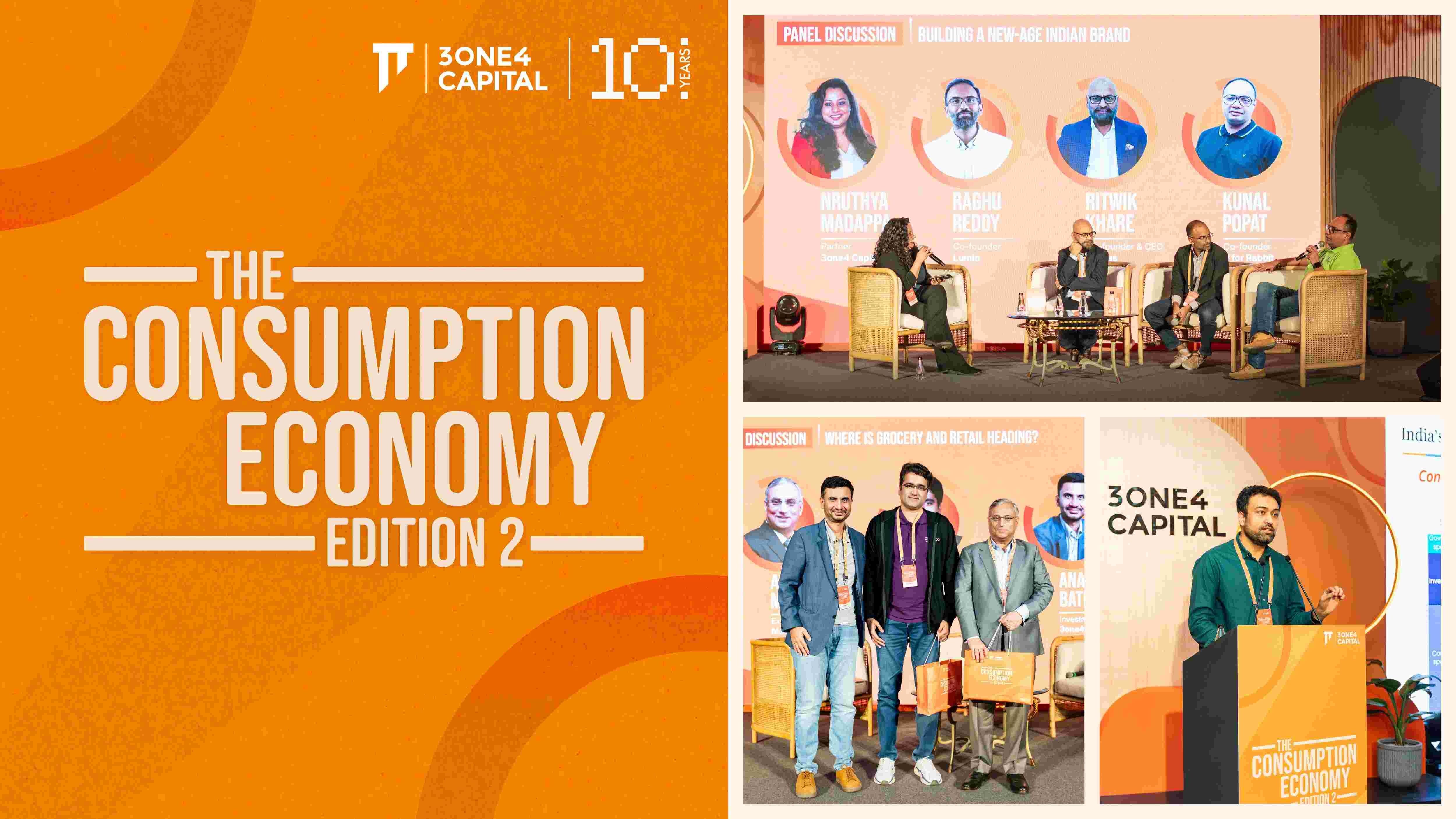
Why India’s Next Consumer Decade Will Be Defined by Trust, Intent, and Standards: Notes from The Consumption Economy (Edition 2)
We hosted the 2nd edition of The Consumption Economy, bringing together visionary founders at the forefront of India’s consumer technology. They shared insights on building category-defining businesses and platforms that resonate with a digitally driven demographic.
The event featured a keynote and two operator-led conversations that moved beyond stagecraft to examine what is truly changing in Indian consumption and what it now takes to build enduring brands and retail models. The mood was pragmatic, focused more on trust, unit economics and shifts in intent than on vanity-driven growth.
A Monumental Runway if Price And Value Align
Pranav Pai opened the evening by underscoring a powerful thesis. India’s consumption has already crossed $2.4 trillion and, at this scale, is positioned to more than triple over the next 25 to 30 years. This decade will witness two significant per capita income inflection points. The first, at $2,500, has already been achieved and the second is projected to fall between $4,000 and $4,500 by 2030. For an economy of India’s size, experiencing two such shifts within a single decade is extraordinary. It creates a vast and accelerating runway for consumer businesses that master price and value economics.
Even as global venture capital turns monolithic around AI, India’s consumption opportunity remains diverse, spanning categories from baby care to meat to aspirational services. These are areas that appear obvious in need but non-obvious in the business model. As Pranav noted, India could be among the last large venture ecosystems where a wide range of consumer categories can still produce enduring billion-dollar outcomes.
He further observed, “Even as global venture capital turns unidimensional around AI, India can still build meat companies, baby care brands, and billion-dollar outcomes. That diversity is a damn good thing.”
Crucially, the story is shifting from access and affordability to intent and standards. Rising affluence is pushing premiumisation from a niche preference to a mass transition, while value-based consumption is fragmenting, especially in health and wellness, into targeted needs for safer and more tailored products.
3one4 Portfolio examples such as Lumio and Elivaas illustrate how sharp customer insight combined with operational excellence can ride these intent curves and capture the structural shift toward higher quality and identity-driven consumption.
Building a New-Age Indian Brand: Product Truth Over Gloss
The first panel, moderated by Nruthya Madappa, brought together three founders who are rewriting the rules in their categories. Raghu Reddy, Co-founder of Lumio, a consumer electronics brand challenging incumbents in home entertainment; Ritwik Khare, Co-founder and CEO of Elivaas, which is setting new benchmarks for managed luxury vacation homes; and Kunal Popat, Founder of RforRabbit, a baby-care brand built on safety-first principles.
Nruthya steered the discussion with layered questions that cut past marketing gloss to the fundamentals of trust and operational discipline. She opened by asking what it really takes to earn loyalty in categories where shortcuts are common and standards are still evolving. “The hardest behavioural shifts are often invisible,” she noted. “Each of you has asked the Indian consumer to rethink deeply ingrained habits, and that is what goes into building fantastic consumer companies.”
From that point, the conversation unfolded into three themes that define the next generation of Indian brands.
Trust is earned through product truth, not marketing gloss
Kunal explained how RforRabbit entered a commoditised diaper category by focusing on what parents refuse to compromise on, specifically rash prevention through breathability and absorption design, reinforced with a distinct visual identity. The bet was that if quality speaks, trust follows, even at a premium. “We were intensely focused on quality from day one because the brand was born from personal parenting needs. Every product starts with one question, would I buy this for my child?” His point echoed Nruthya’s framing that trust begins with product truth, not advertising.
Community compresses the trust curve
Pivoting to Raghu, Nruthya pressed on the role of community in accelerating credibility for Lumio, which is positioned at the intersection of software and hardware and is rewriting the home entertainment playbook. Raghu described their approach saying, “Building credibility meant engaging tech enthusiasts, not influencers. We invited them into feedback loops, fixed issues in real time and turned early users into evangelists.” Nruthya highlighted how this approach reflects a broader shift in consumer behaviour, where trust now flows through peer networks rather than campaigns.
Operational excellence as the invisible backbone
When the discussion moved to hospitality, Ritwik added a perspective that aligned with Nruthya’s emphasis on respect for consumer time. “Money is just a smaller part of the equation. When customers give you two or three days of their time, that is the real trust you have to earn.” Elivaas has built its reputation on rigorous operational controls, including daily audits and feedback loops, to ensure consistency across properties.
As the panel explored premiumisation, Nruthya reframed the idea of “premium” as a discipline rather than a price tag. “Quality standards are not defined by certifications in India. You are literally rewriting what the rules should be, and that sets a very high bar.” She closed with a reminder that operational rigor is the invisible backbone of brand building.
“At the very core of exceptional brands is operational excellence. Everything that happens invisibly in the background determines whether a customer’s experience will delight or disappoint.”
Grocery and Retail: The Next Battles are Assortment and Standards
The second conversation brought Arvind Mediratta (Founder at Elixir Foods; ex‑CEO, Metro, India; ex-COO, Walmart, India & Senior Executive, Walmart US), Vikas Sharma (COO, Zepto), and Anand Batra (Investments, 3one4 Capital) to a simple opening question: grocery has existed forever, so what changed in the last five years? The answer was almost everything.
- Quick commerce fits how India already shops.
India’s long-standing habits such as low ticket sizes, hyperlocal focus and freshness-first preferences created a natural fit. Quick commerce did not invent a new behaviour. It removed friction from an existing one and scaled because it matched daily essential buying patterns. - Differentiated assortment is the real moat.
Arvind argued that if multiple players carry the same assortment, the game collapses into price and speed and nobody wins long-term. True differentiation comes from merchandising, curated selection, and quality‑led private labels, drawing analogies to Trader Joe’s and Aldi. Indian consumers will pay more for meaningfully different products, not cheaper copies. - Health, value, and experience are converging.
Consumers now expect convenience and ingredient trust. A rising health & wellness consciousness, demand for gourmet/curated experiences, and persistent smart‑shopper value orientation are reshaping baskets and store formats. The implication is clear. Omnichannel models that prove freshness and elevate theatre can earn loyalty and margin.
Profitability discipline threaded through the debate. The industry leaders acknowledged the disruption that speed has enabled, but returned to fundamentals of moats, economics, and cash. Arvind reminded the room that, “Sales is vanity, profit is sanity, and cash is reality. The question is not growth alone but whether these businesses will turn profitable.” He emphasised that without differentiated buying (not just selling), price transparency will keep compressing margins. Value creation sits where assortment and standards diverge meaningfully from the pack.
The Through‑line: Intent, Trust, and Operational Excellence
Across keynote and panels, a single idea kept surfacing. India’s consumption story is no longer defined only by access and affordability. It is increasingly shaped by intent, trust, and standards. Consumers are upgrading, but they’re also interrogating value more sharply. They’ll pay for quality but they won’t tolerate being taken for granted.
For founders, that means brand building must move in lockstep with operations, from community‑driven feedback cycles in electronics, to daily audit rituals in hospitality, to safety‑first cultures and global standards in baby care. For investors, it means underwriting businesses that understand why cohorts buy, not just how fast they can grow, rewarding differentiated assortment, price–value clarity, and repeat behaviours rooted in product truth.
Anand framed this investor lens with a simple question: “What is your moat? That is the first question. And then show me the money. At the end of the day, this is not an NGO. Investors will always ask for returns.”
If this decade delivers two consumption inflections, it will also demand two disciplines: the imagination to meet changing intent, and the rigour to keep trust compounding. Operators who treat “premium” as a standard to be upheld, not a price tag, will be the ones that endure.
DISCLAIMER
The views expressed herein are those of the author as of the publication date and are subject to change without notice. Neither the author nor any of the entities under the 3one4 Capital Group have any obligation to update the content. This publications are for informational and educational purposes only and should not be construed as providing any advisory service (including financial, regulatory, or legal). It does not constitute an offer to sell or a solicitation to buy any securities or related financial instruments in any jurisdiction. Readers should perform their own due diligence and consult with relevant advisors before taking any decisions. Any reliance on the information herein is at the reader's own risk, and 3one4 Capital Group assumes no liability for any such reliance.Certain information is based on third-party sources believed to be reliable, but neither the author nor 3one4 Capital Group guarantees its accuracy, recency or completeness. There has been no independent verification of such information or the assumptions on which such information is based, unless expressly mentioned otherwise. References to specific companies, securities, or investment strategies are not endorsements. Unauthorized reproduction, distribution, or use of this document, in whole or in part, is prohibited without prior written consent from the author and/or the 3one4 Capital Group.
.jpg)