
India's Energy Tech Transition Has Begun. Founders Will Build the National Champions That Power It.
Three energy shocks in six years have converted energy from a traded commodity into an instrument of statecraft. India has responded with the most coordinated energy diversification programme in its history, and the resulting market geometry is opening a generational window for founders building energy tech National Champions.
China's crude oil consumption peaked in 2024, and not because its economy slowed. The IEA confirms that combined gasoline, jet fuel, and diesel demand sat 2.5% below 2021 levels even as GDP grew at 4.5%. That outcome was engineered by a coordinated transition, through four pillars of:
- Renewables
- Nuclear power
- Coal conversion, and
- Transport electrification
Each pillar substituted imported energy with domestically controlled supply at industrial scale. The lesson is that energy transitions at the national scale are not incidental, they are built by intentional policy and coordinated industrial action.
The rest of the world is accelerating through the same transition. COVID broke energy supply chains, the Ukraine war weaponised natural gas supplies, and the Strait of Hormuz closure of March 2026 demonstrated that a 56-kilometre waterway can reprice a continent's industry within days. Energy capability is now a sovereign asset.
In our previous Signals pieces, we set out how India's industrial policy is evolving into an operating system, and how that operating system is funding the hard middle of the materials value chain. This next piece turns the same lens on energy, amongst the largest physical systems in any economy and the one being rewired fastest.
Our view is that India is executing all four pillars of that playbook simultaneously, and building the next two layers of the energy stack earlier in its development than any economy before it. That combination has created the conditions for a generation of energy tech National Champions, and the flywheels have been initialised by founders we have partnered with.
The Shape of the Market
The Age of Electricity Has Been Declared
Global energy investment reached $3.3 trillion in 2025, and its composition tells the story more clearly than its size. Roughly $2.2 trillion flowed to renewables, nuclear, grids, storage, and electrification, twice the $1.1 trillion that went to oil, gas, and coal. A decade ago, that ratio ran the other way. The IEA now expects investment in electricity supply and infrastructure to reach $1.6 trillion in 2026, roughly 50% more than all spending on bringing oil, gas, and coal to market combined. Solar alone, at $450 billion, is the single largest line item in the world's energy capital budget, and grid-scale battery investment has crossed $66 billion a year.
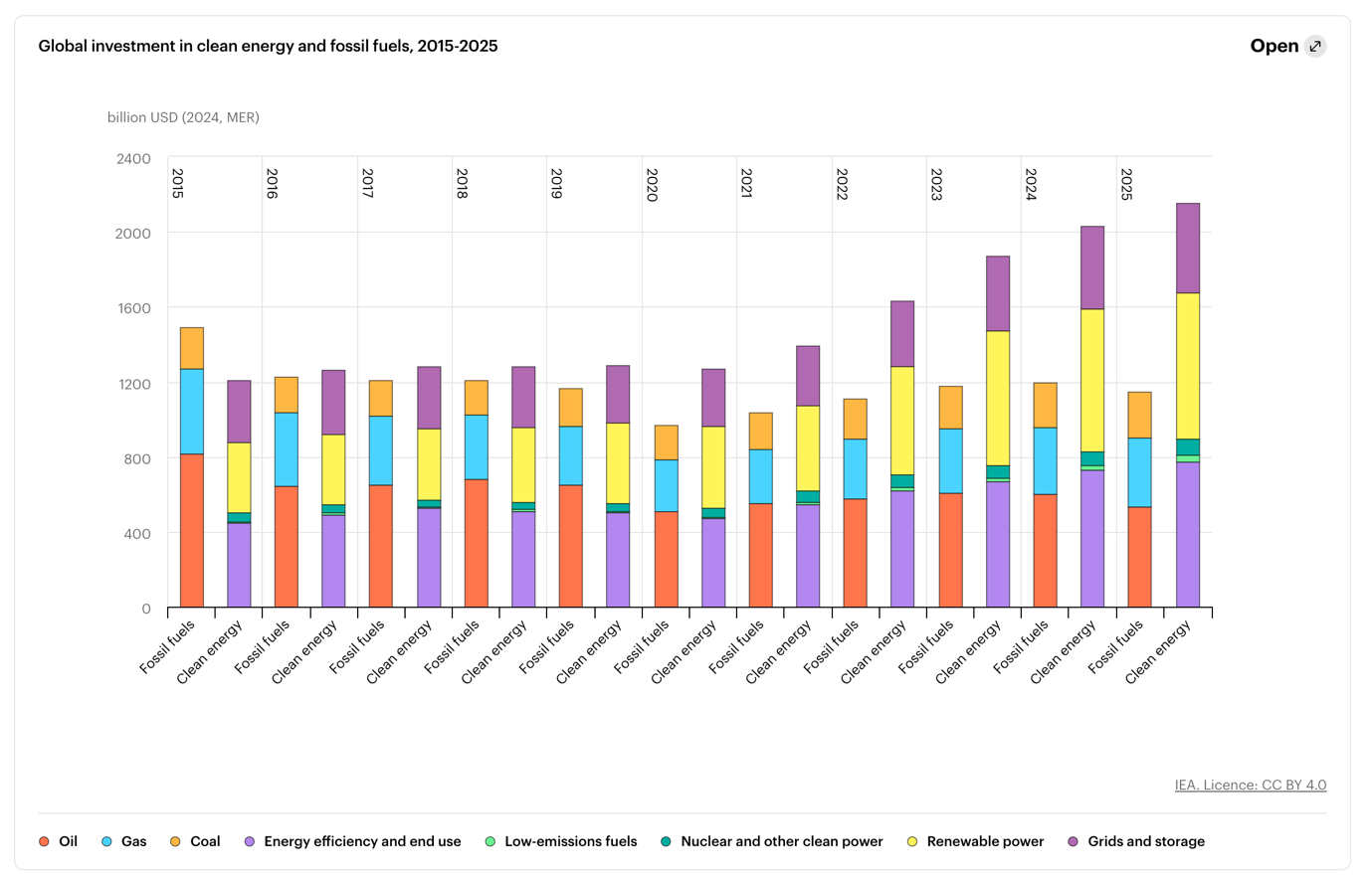
Global energy investment, clean vs fossil, 2015 vs 2025-26. Data: clean energy is $2.2T vs fossil fuels at $1.1T in 2025. Sources: IEA World Energy Investment 2025
The demand side explains the acceleration. Electricity demand from industry, cooling, electric mobility, and data centres is compounding simultaneously, with AI-optimised computing the newest and steepest curve. Hitachi Energy describes the resulting equipment demand as a manufacturing supercycle, and the description is accurate. This is a structural reallocation of the world's largest capital pools toward electrons, not just another subsidy-led growth pull-up.
Geopolitics Has Repriced Energy Security Into Industrial Policy
The three recent shocks did more than move prices. They changed procurement logic for every nation state. When Iran closed Hormuz in March 2026, Asian LNG prices surged over 140%, India invoked the Essential Commodities Act to ration natural gas, and the IEA called it the largest supply disruption in the history of the global oil market. Europe's post-2022 experience with Russian gas had already established the template. Governments now treat generation capacity, grid equipment, storage chemistry, strategic reserves, and fuel conversion technology as sovereign assets to be secured, not commodities to be sourced at the lowest landed cost.
This is the transition from petrostates to electrostates that we described in our earlier writing, now visible in budget lines rather than forecasts. The leverage that hydrocarbon exporters held for half a century is spreading out across the nations and supply chains that control electrotech manufacturing and deployment.
The Priority Has Moved from Generation to Transmission and Distribution
The most investable insight in global energy today is that the constraint has shifted. Generation has become cheaper. Delivery and transmission is the bottleneck. More than 2,500 GW of renewable, storage, and large-load projects are stalled in grid connection queues worldwide, per the IEA's Electricity 2026 report. Annual global grid investment of around $400 billion must rise by roughly 50% by 2030 just to keep pace with demand, and Bloomberg expects grid spending to cross $500 billion in 2026.
The equipment layer is where the shortage is most acute. Wood Mackenzie's surveys show standard power transformers averaging 128 weeks for delivery in the United States and generator step-up units averaging 144 weeks, with some orders stretching to four years. Demand for generator step-up transformers has grown 274% since 2019, prices are up 77%, and roughly 80% of large power transformers used in the US are imported. Grain-oriented electrical steel, produced domestically by a single American supplier, is the choke material beneath the entire category.
This is the smile curve from our materials thesis applied to energy. Panels and cells have commoditised toward Chinese marginal cost, and the durable margin has migrated to the equipment, storage, integration, and intelligence layers that turn cheap generation into reliable delivered power. The margin has moved from the electron to the equipment. Whoever manufactures transformers, switchgear, conductors, and storage systems at quality and speed now holds the pricing power that panel makers surrendered years ago.
Storage Is the Fastest-Repricing Layer in the Stack
Turnkey battery storage costs fell roughly 40% in 2024 alone, and the consequence is architectural rather than incremental. Storage has moved from a peaking substitute to the grid's backbone flexibility asset, the technology that converts variable solar into firm, dispatchable power. Ember's data shows the share of Indian renewable tenders paired with battery storage climbing from about 12% in 2021 to half of all tenders in 2024. Where solar goes, batteries now follow within a single procurement cycle.
The Shape of the Market in India
India Is Industrialising on the Electrotech Fast Track
Ember's January 2026 analysis frames India's position with a comparison every investor in this sector should internalise. When China crossed 1,500 kWh of electricity use per capita in 2004, coal generation was roughly ten times cheaper than nascent solar, and coal predictably supplied nearly 70% of China's generation growth over the following decade. India is crossing the same 1,500 kWh threshold now, at a moment when solar plus storage costs about half as much as new coal.
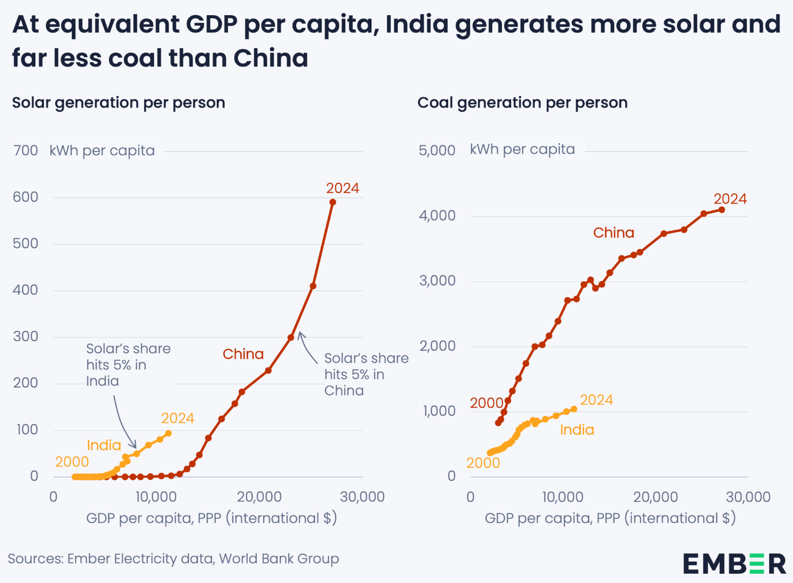
The energy path that made economic sense for China at India's stage of development no longer exists. A cheaper one has replaced it. Every economy before India industrialised by burning. India will be the first scale economy with the option to industrialise by wiring.
The divergence shows up across both generation and industrial development. India reached meaningful solar penetration at a far lower income level than China, and at comparable stages of development already generates several times more solar and wind electricity per capita. Just as importantly, India has achieved comparable levels of electrification while relying on dramatically less coal, making it the first major industrial economy with a credible pathway to industrialise on electricity rather than hydrocarbons.
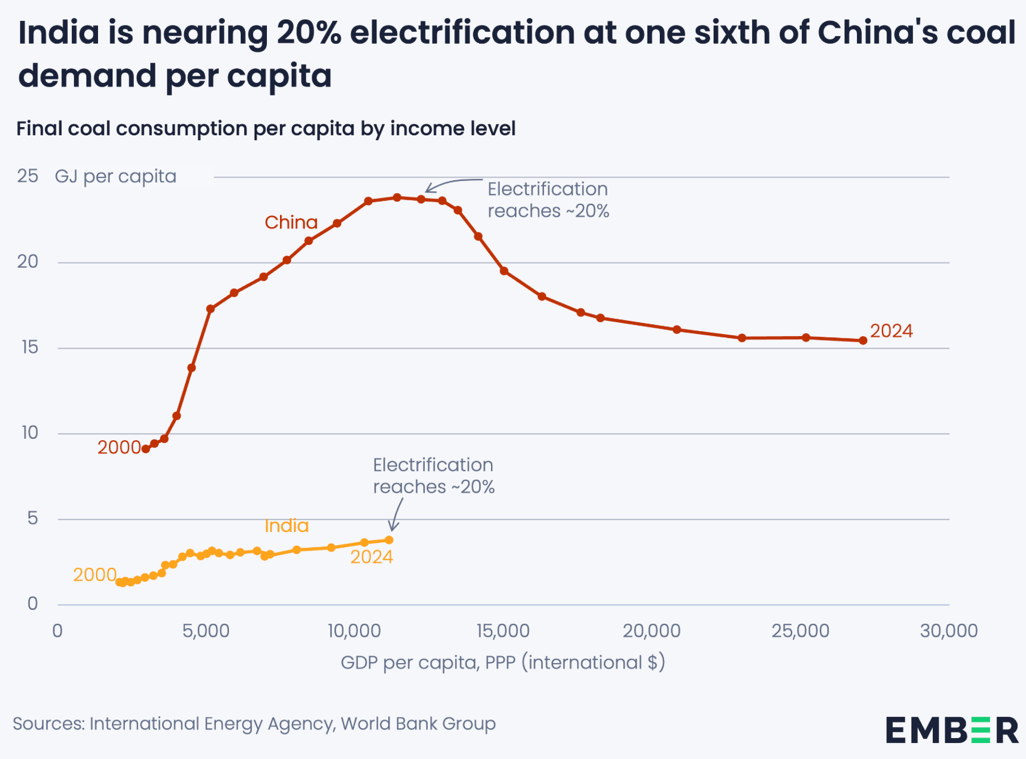
As per Ember, “Electricity has reached 20% of final energy at just 4 gigajoules (GJ) of coal per capita, versus 24 GJ when China crossed the same threshold. At a similar level of development, India has reached the same milestone using roughly one-sixth of the coal”.
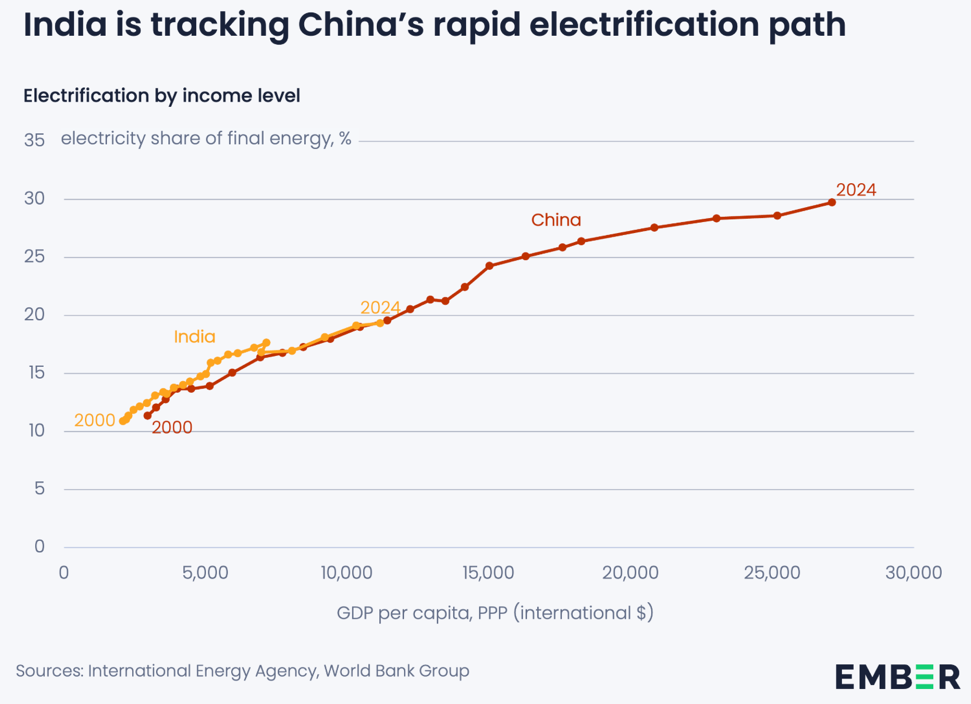
There are clear structural reasons why India’s electrification trajectory mirrors China’s. At similar stages of economic development, India’s buildings demonstrate higher electrification levels. This is largely driven by climate: our thermal needs revolve around cooling, which is inherently power-driven, whereas China’s massive winter heating demand is split between electricity and direct fossil-fuel combustion.
Sectoral dynamics matter too. China’s heavier reliance on core manufacturing makes deep electrification harder to achieve rapidly. Even so, matching China’s pace on an income-adjusted basis is a major milestone and a vital marker of economic competitiveness in an era where high-value growth is fundamentally electric.
The data indicates new advantages forming in India with respect to velocity of adoption and the avoidance of legacy costs.
- India reached a 5% solar share of generation at around $9,000 of GDP per capita in PPP terms, a milestone China required roughly $23,000 to hit.
- At the income level where China generated about 37 kWh of solar and wind electricity per person, India already generates around 205 kWh, roughly 5.5 times more.
- Solar supplied 9% of India's electricity in 2025, up from 0.5% a decade earlier.
- Per capita coal generation stands at 1 MWh, about 40% of China's level at the equivalent income, and Ember projects that India will likely reach $20,000 GDP per capita without coal generation ever exceeding what China was burning at $5,000.
- Electricity has reached 20% of India's final energy consumption at just 4 gigajoules of coal per capita, against the 24 gigajoules China required to cross the same threshold.
- India has hit the same electrification milestone using one-sixth of the coal.
The transport data completes the picture. India's per capita road oil demand, at 96 litres, is about half of China's 2012 level and is close to peaking. EVs crossed 5% of car sales in 2025, India leads the world in electric three-wheeler adoption, and the country's electrification rate is growing by around five percentage points per decade. Coal-fired generation fell in both China and India in 2025, the first such decline in 52 years driven by clean energy growth rather than economic contraction, per Carbon Brief.
India is tracking China's electrification curve while avoiding its fossil fuel one. If this continues, the single biggest vulnerability in India’s trade balance is also managed faster than anticipated.
The Power System Has Crossed from Deficit Management to Platform Economics
The foundation for this fast track is a power system that has quietly completed its reliability phase. India's installed capacity reached 520.51 GW by January 2026, with the national power shortage falling from 4.2% in FY14 to 0.03% through December 2025. FY26 delivered a record 52,537 MW of capacity addition to January alone, of which 39,657 MW was renewable, including 34,955 MW of solar. Installed solar has grown from 3 GW in 2014 to 140 GW, and on 29 July 2025, renewables met 51.5% of national demand of 203 GW, the first day more than half of India's electricity came from clean sources.
The financial layer has turned as well, and this is the underappreciated reform. India's distribution companies posted a collective profit of Rs 2,701 crore in FY25, reversing losses of Rs 67,962 crore in FY14. AT&C losses fell from 22.62% to 15.04%, outstanding generator dues collapsed from Rs 1.4 lakh crore in June 2022 to Rs 4,109 crore by February 2026 under the Late Payment Surcharge Rules, and 5.62 crore smart meters are installed. A power sector that pays its bills on time and meters its consumers digitally is a power sector that private capital can build on. The Government of India estimates over Rs 50 lakh crore (approximately $565 billion) of investment opportunity across generation, transmission, distribution, and storage through 2032.
The Four Pillars Are Funded, and India Is Building the Next Two Earlier
China crossed peak oil through renewables, nuclear power, coal conversion, and transport electrification. India's mission stack now funds the same four pillars with hard budgetary outlays, and the deployment cadence separates it from earlier announcement-only cycles.
- On the first pillar, renewables, PM Surya Ghar carries ₹75,021 crore for one crore rooftop households, the National Green Hydrogen Mission at ₹19,744 crore has allocated 862,000 tonnes per annum of production capacity and 3,000 MW of annual electrolyser manufacturing, and the transmission plan behind them commits ₹9.15 lakh crore to expand the network to 6.48 lakh circuit kilometres by 2032 against a projected peak demand of 458 GW.
- On the second, the SHANTI Act of December 2025 ended a six-decade nuclear monopoly, the Prototype Fast Breeder Reactor achieved criticality in April 2026, and the ₹20,000 crore Nuclear Energy Mission targets 100 GW by 2047 with five indigenous SMR designs by 2033.
- On the third, the coal gasification programme's ₹64,000 crore project pipeline against a 100 million tonne target has produced its first commercial-scale template in the BCGCL and L&T ammonium nitrate plant in Odisha.
- On the fourth, PM E-DRIVE commits ₹10,900 crore across vehicle categories with ₹2,000 crore for roughly 72,000 public chargers, PM e-Bus Sewa and its Payment Security Mechanism underwrite over 38,000 electric buses, SPMEPCI anchors electric car manufacturing with minimum investment thresholds of ₹4,150 crore per applicant, and a further incentive scheme for private bus fleet electrification is in advanced design.
More important than any individual programme is the cadence and coordination. Unlike earlier announcement-led policy cycles, every pillar now carries funded missions, implementation agencies, and measurable deployment milestones. India is executing renewables, nuclear power, coal conversion, and transport electrification simultaneously, while beginning to industrialise the hardware and market layers that historically emerged much later.
The market is already responding. Once policy created visible demand, private capital and procurement activity accelerated almost immediately, with storage providing the clearest example.
The Fifth Layer is Indigenous Manufacturing of Transition Hardware
The fifth layer is now arriving earlier in India's development than anticipated: indigenous manufacturing of the transition's hardware. The shift from fossil fuels to electrotech represents a fundamental economic transition: from resource extraction to precision manufacturing. This shift plays directly to Asia’s industrial strengths, with India uniquely placed to benefit. If any nation possesses the demographic scale, domestic market depth, and economic momentum to emerge as the global manufacturing economy, it is India.
Crucially, global geopolitics has aligned with domestic ambition. As advanced economies push to de-risk supply chains and secure alternatives to single-source dependencies, India is steadily positioning itself as an indispensable electrotech partner.
From Electronics to Electrotech
India’s manufacturing trajectory is following a proven playbook: mastery in consumer electronics serves as the operational gateway to clean technology. The engineering, assembly, and supply-chain proficiencies built for consumer devices extend directly into solar cells, advanced batteries, and electric vehicles.
The baseline is already expanding rapidly:
- Electronics Manufacturing: The domestic electronics sector grew nearly sixfold from $22 billion in FY15 to roughly $130 billion in FY25.
- Mobile Assembly: Mobile handset production surged from just 2 million units in 2014 to over 300 million a decade later.
- Solar Value Chains: Domestic module manufacturing capacity has hit 120 GW—a twelvefold rise over ten years, ensuring domestic self-sufficiency. Upstream capability is now generating pace: domestic solar cell capacity, virtually nonexistent a decade ago, now stands at 18 GW.
- Next-Gen Tech: Targeted Production-Linked Incentive (PLI) schemes are building early-stage ecosystems for advanced chemistry cells, specialty chemicals for battery components, solar cells, and green hydrogen electrolysers.
The Strategic Levers of the Clean Energy Orbital Shift
Beyond manufacturing exports, electrifying rapidly on the back of renewables provides India a few structural advantages over legacy industrial models:
- Deployment Velocity and Modularity: Rapid industrialisation demands immediate, low-cost power. Unlike thermal power plants, which face multi-year gestation and construction timelines, solar assets deploy in months. Their modularity allows decentralised adoption at every scale, from commercial rooftops in Mumbai to utility-scale parks in the Thar Desert.
- Strategic Energy Sovereignty: India currently spends roughly 5% of its GDP annually on imported fossil fuels, straining the current account deficit and exposing the macroeconomy to geopolitical volatility. Leapfrogging directly to electrotech increasingly insulates India from global energy shocks and limits long-term import vulnerabilities.
- Avoiding Stranded-Asset Liabilities: Building greenfield capacity avoids the massive legacy write-downs now facing established economies. With new solar generation already undercutting the marginal operating costs of existing coal thermal units, running legacy assets is becoming uneconomic. India, by building clean from the outset, can industrialise with minimal stranded-asset exposure.
Deployment velocity is a particularly new strength in India's energy transition. For instance, the Viability Gap Funding programme for storage has grown from 4 GWh in 2023 to 13.2 GWh, with a second tranche of ₹5,400 crore for 30 GWh approved in May 2026, and the ₹18,100 crore ACC PLI targets 50 GWh of domestic cell manufacturing, all gated by a 20% minimum domestic content rule that explicitly covers energy management software. Policy gates of this kind are protected demand for Indian builders. The National Critical Mineral Mission and the rare earth magnet scheme, covered in our materials piece, secure the upstream.
The storage pipeline shows how quickly this architecture converts into market formation. India's cumulative tendered energy storage capacity surged from 6.8 GW in 2018 to 90.7 GW in 2025, with 69 tenders totalling 102 GWh floated in the past year alone, per IEEFA and JMK Research. Installed grid-scale BESS, at roughly 1.8 GWh in March 2026, is projected to reach about 5 GWh by the end of 2026, a near tenfold jump in a single year, on the way to the CEA's requirement of 236.2 GWh by 2031-32. Velocity is a measurement of the intensity of intent, and India is serious about the scale of its energy transition.
India is charting a distinct development pathway—one where modern renewables and electrification drive industrialisation, rather than clean-up operations arriving as an afterthought.
By anchoring its growth in electrotech, India secures three vital priorities at once: industrial scale, energy security, and swift power expansion. As the world’s most populous economy, India’s transition offers a compelling demonstration effect for the Global South: clean technology is no longer a constraint on industrial growth, but its fastest catalyst.
The Sixth Layer Is an Energy DPI, and It Is the Quiet Revolution
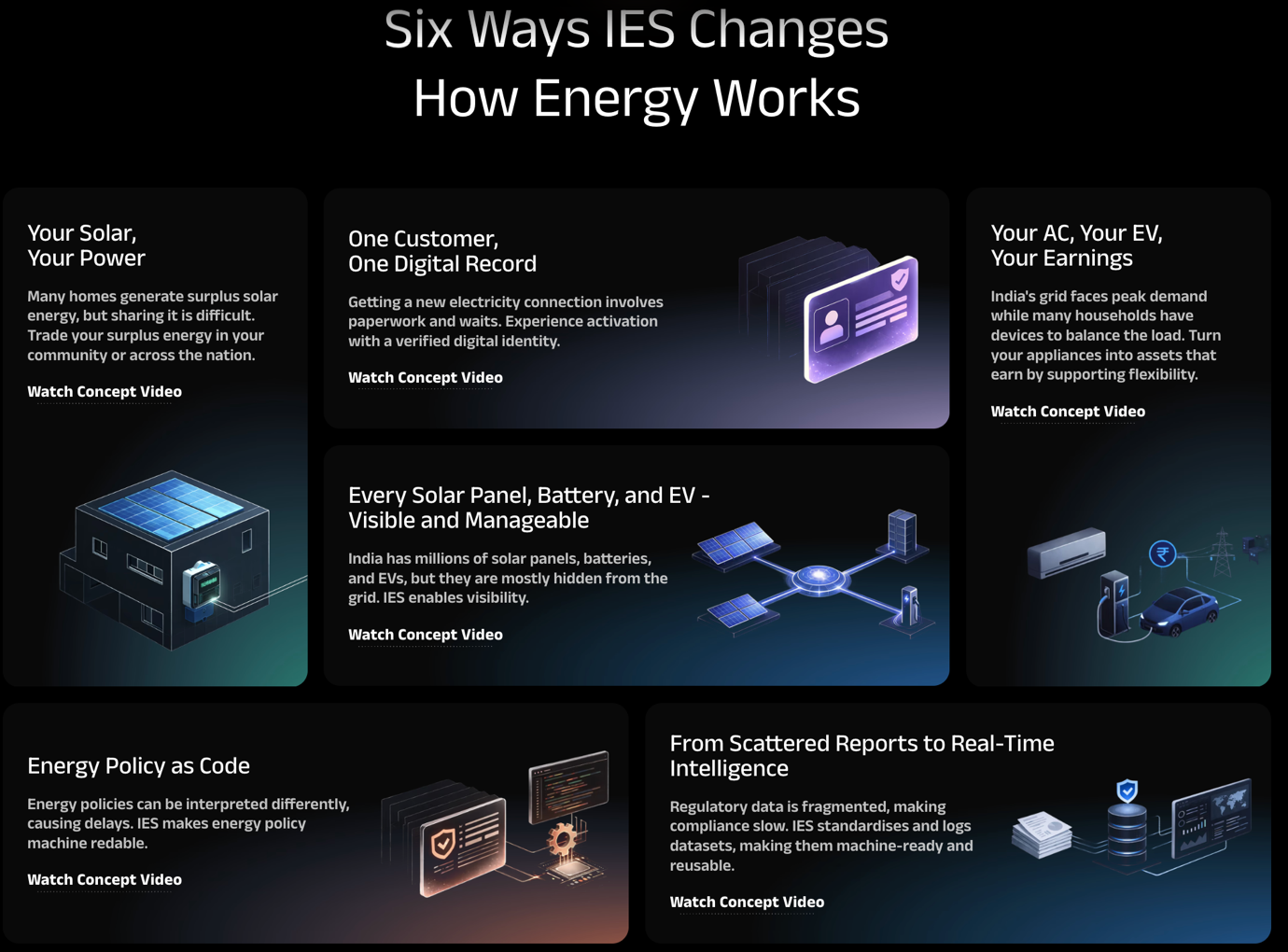
Source: IES, Ministry of Power India
The least discussed and most consequential shift is happening in how electricity is bought and sold.
- Electricity futures launched on NSE and MCX in July 2025, giving generators and buyers their first true hedging instruments, and spot prices declined roughly 14% in the following nine months as forward visibility improved.
- The CERC's market coupling reform, operational from January 2026 with Grid India as the Market Coupling Operator, is unifying price discovery across the three power exchanges toward one nation, one grid, one price.
- The Electricity (Amendment) Bill, 2026 rationalises cross-subsidies and allows industrial consumers to procure power directly, and Green Energy Open Access rules now guarantee time-bound approvals for any consumer above 100 kW.
- The India Energy Stack (IES) is a Ministry of Power initiative. This collaborative, ecosystem-first approach is bringing together policy leadership, institutional reach, and global best practices to build digital public infrastructure for India's power sector.
Read together, these reforms are constructing the demand-side rails of an energy DPI. India built the payment rails before the fintechs arrived. It is now building the power rails before the next-gen energy companies arrive. In payments, the rails were identity and transactions, and the products became UPI apps, credit, brokerage, and commerce. In power, the rails are open access, exchange coupling, derivatives, and smart metering, and the products will be structured energy contracts, retail platforms, trading engines, and virtual power plants.
The market gap those products will fill is measurable. India's power sector remains only partially deregulated, DISCOMs still carry roughly 93% of volume, and open access rules differ across 28 states in their surcharges, wheeling charges, and banking provisions. The large independent power producers concentrate on gigawatt-scale portfolios for enterprise buyers. India's commercial and industrial renewables segment is projected to reach 60 to 80 GW by 2030, compounding at 18.8% annually, with open access expected to carry 60 to 75% of new additions. The mid-market businesses beneath the IPP radar, paying Rs 11 to Rs 19 per unit to their DISCOM while renewable supply clears far lower, represent a cumulative electricity spend of roughly $25 billion a year with no structured seller serving them. Regulatory complexity of this kind is precisely the moat that rewards technology-led intermediaries, and it is where our newest energy thesis operates.
The Prize Is Macroeconomic, and It Compounds into Every Layer
The terminal value of this entire programme sits on the national balance sheet. India's trade deficit is, at root, an energy problem. Crude oil, at roughly $130 billion of net imports, is close to 30% of all merchandise imports and the dominant cause of the current account deficit, and India spends roughly 5% of GDP annually on fossil fuel imports. Remove oil from the import basket and the non-oil current account already runs a surplus on the strength of services exports.
Every EV sold, every GW of solar commissioned, and every tonne of coal converted to chemicals compresses that import line from below, while the services surplus grows from above.
As we argued in our Peak Coal analysis, an Indian current account surplus before 2035 is a credible economic projection, not just a policy aspiration. The rupee has depreciated roughly 40% against the dollar over twelve years, with oil shocks as the primary transmission mechanism. When the energy transition mitigates that channel, India's growth in rupees finally equates to growth in dollars. That single conversion raises the dollar returns of every long-duration investment in the country, which is why we treat energy tech as a portfolio-level thesis rather than a sector allocation.
The Geometry of Performance. Our Thesis in Action.
Our energy portfolio spans the layers of the stack described above: market access, grid hardware, charging and storage, mobility, and financing. Each company maps to one of the winner archetypes from our Shape of the Market framework.
Exponent Energy is a Category Creator.
Exponent built the full energy stack, spanning its e^pack battery, e^pump charger, and e^plug connector, that charges any commercial EV from 0 to 100% in 15 minutes on standard LFP cells. TUV India validated its packs at 3,000 cycles with just 13% degradation, against an industry standard of 30% over 1,500 slow cycles. The company closed a Rs 200 crore (approximately $21 million) round in June 2026 co-led by 360 ONE Asset and TDK Ventures, with Hitachi Ventures making its first Indian energy investment, taking total funding to $65.7 million. Exponent has expanded from charging into Exponent One, a telemetry-underwritten financing arm, and Exponent Oto, a retrofit platform converting CNG autos to electric in 24 hours, and in January 2026 launched India's first all-sleeper electric intercity bus fleet with Fresh Bus. Exponent is building the energy layer that makes commercial electrification an operating expense decision rather than a technical risk.
Yulu is a Full-Stack Challenger.
Yulu operates India's largest shared commercial EV fleet for last-mile logistics, turned EBITDA positive in 2024, and has crossed 2 billion green kilometres of cumulative rides. Its demand anchor is the structural growth of quick commerce and hyperlocal delivery, the segments where the total cost of ownership (TCO) advantage of electric two-wheelers is most decisive. Yulu demonstrates that in the commercial segments that consume most of India's last mile fuel, electrification wins on economics.
Vidyut sits beneath the transition's financing layer.
Vidyut separates the vehicle loan from the battery, financing the vehicle through a term loan while the battery, which represents 30% to 40% of an EV's cost, is paid for on a flexible pay-as-you-use subscription. Underwriting runs on battery health telemetry rather than borrower proxies alone, which cuts the upfront cost of ownership by 40% to 50% for the price-sensitive driver-owner segment. From financing, Vidyut has expanded into insurance, servicing, and resale across more than 30 cities, building the integrated ownership layer that converts EV TCO from a spreadsheet argument into a lived monthly reality.
Neufin powers the transition's market-access layer.
Neufin is building the energy equivalent of an MVNO for India's mid-market, a tech-led clean energy retailer that aggregates renewable supply from third-party generators and delivers it to businesses through flexible, structured contracts, with no asset ownership required on either side. The platform offers over 80 renewable supply options across more than 15 states, with contract tenures running from three months to 25 years for any business with demand above 100 kW, and has contracted over 360 million units of clean energy for customers including the Mahindra Group, Club Mahindra, Smartworks, and the HiTech Group. Its advantage is not cheaper electricity, but flexible market design. By matching contract tenures to customers' operating horizons and aggregating renewable supply across multiple generators, Neufin converts regulatory complexity into a software and market-access advantage. Neufin reduces customers' energy costs by up to 40% with tenures matched to their planning horizons, and it is the company in our portfolio built most directly on the energy DPI architecture described above.
Ayr Energy is a Territorial Superpower, built in India for the World.
Ayr designs and manufactures critical power grid equipment, spanning power and distribution transformers, high-voltage circuit breakers, and medium-voltage switchgear, applying the automotive playbook of standardised architectures with late-stage customisation to what category incumbents still build bespoke. Manufacturing runs through partnerships with established Indian equipment makers whose capacity was built ahead of domestic demand, letting Ayr deliver power transformers in 40 to 72 weeks against the 120-week industry average documented by Wood Mackenzie, on a supply chain that bypasses China entirely. The model is compounding at commercial scale. Within a year of emerging from stealth in September 2025, backed by 3one4 Capital, General Catalyst and Energy Impact Partners, Ayr has built an order book exceeding $500 million and powers over 20 GW of new project capacity, selling into an American market that imports roughly 80% of its large power transformers. Ayr is Indian engineering and manufacturing capability aimed directly at the single most supply-constrained category in the global energy transition.
The Whitespaces: What We Are Looking For
The energy whole chain still has large gaps, and each is an invitation. We are actively looking for founders building deep capability across the following areas.
Grid-enhancing technology and transmission IP.
India curtailed roughly 300 GWh of clean electricity in a single quarter because generation outran transmission, and Ember documented around 4 GW of solar facing complete curtailment on some days in December 2025. High temperature low sag conductors with carbon fibre composite cores, dynamic line rating, advanced power flow control, and topology optimisation can carry 1.5 to 2 times the power on existing towers with no new land. Against a Rs 9.15 lakh crore transmission build, this is the supply-constrained, IP-gated opportunity we flagged in our materials piece, and it remains open.
Storage software, alternative chemistries, and long-duration systems.
The 20% domestic content rule for BESS explicitly covers energy management system software, creating a protected market for Indian battery intelligence, dispatch optimisation, and safety systems. Beyond lithium, sodium-ion, flow batteries, and thermal storage address the supply concentration that currently routes 94% of India's lithium-ion imports through a single country. Second-life batteries and materials recovery, covered in our materials thesis, complete the loop.
Energy markets and exchange infrastructure.
Composite energy credentials, demand side flexibility, and deepening distributed resources create India's first genuine power market microstructure. Peer to peer energy exchange policy will enable prosumers to buy and sell energy directly with each other, even across different DISCOMs. Demand Side Flexibility mechanisms will enable consumers to reduce or shift their electricity usage in response to grid signals or price incentives, and be verifiably compensated for doing so.. Forecasting engines for generators facing scheduling penalties, algorithmic trading systems, virtual power plants aggregating distributed assets, demand response platforms, and procurement software for the commercial and industrial segment are categories that barely existed in India three years ago and that market coupling now makes viable.
Last-mile distributed energy.
India's low-tension commercial connections, the 5 to 20 kW loads of every retail shop, bank branch, and small site in the country, fall below the open access threshold, lack rooftop space, and have no renewable option today. Group net metering, micro-solar virtual power plant structures, and aggregation models that serve this layer address a market where alternatives simply do not exist, and pricing power follows. Emerging standards for DER (distributed energy resources) visibility will give utilities and system operators a consistent, trusted view of all distributed energy resources (rooftop solar, batteries, EV chargers) connected to the grid. When this is live, a new wave of distributed energy solutions will be deployed to serve regional demand.
Industrial electrification and the inside-the-fence power layer.
As factories electrify processes and add automation, the electrical infrastructure inside the plant, spanning intelligent control panels, busducts, motor control centres, power factor correction, drives, and PLC-based automation, becomes a scaled, technology-led category of its own. India's manufacturing buildout under PLI and the National Missions multiplies this demand, and the incumbent supply base is fragmented, analogue, and ready for a modern engineering-led challenger.
Nuclear energy supply chain and SMR components.
SHANTI opened deployment, and as we argued in our nuclear writing, the deeper opportunity is the component and systems layer. Instrumentation, simulation, safety systems, precision fabrication, coolant systems, and fuel cycle technology for the five indigenous SMR designs targeted by 2033 will define who captures the value. The handful of nations with credible nuclear industrial bases will export this capability for decades.
The data centre energy stack.
India's data centre capacity is set to grow from roughly 1.3 GW to 9 GW by 2030, and AI-optimised servers consume up to ten times the power of standard racks. Behind-the-meter generation, high-density power electronics, advanced cooling, and grid-interactive campus energy systems sit where compute demand meets the power system, and hyperscaler capital has already committed tens of billions of dollars to Indian sites.
Solar upstream manufacturing and equipment.
India's 144 GW of module capacity sits atop imported polysilicon, ingots, wafers, and much of the cell layer. The capital equipment, process IP, and precursor materials for these upstream stages are the solar equivalent of the refining gap we identified in materials, and government project allocation is increasingly structured to require Indian-made cells and wafers rather than Indian-assembled modules.
Commercial fleet electrification at scale.
Trucks alone consume over 28% of India's diesel, and commercial vehicles account for roughly 76% of transport fossil fuel demand. Heavy-duty electric trucking, freight corridor charging infrastructure, megawatt charging systems, and vehicle-to-grid architectures for fleet depots are the next layers above the two-wheeler and three-wheeler beachhead our portfolio has already established.
The Enabling Factors
Three constraints will govern the pace of everything above, and they are worth tracking as a distinct category.
- The first is execution discipline in manufacturing economics as India on-shores more of its strategic requirements and a rainforest of vendors are being scaled by the ecosystem effects. Indian buyers draw hard lines on margins and price tolerance. The builders that survive this pricing pressure will emerge with genuinely competitive cost structures and can take their capacity and capabilities global.
- The second is transmission of the budgetary outlays and National Missions aimed at the energy stack. Since a bulk of the national grid capex is accelerated by these initiatives, they are a significant contributor to the go-live velocity of national capacity.
- The third is policy durability, the argument we have made in our writing on the factors of trust. An energy transition spanning two decades cannot be built on policy that survives only as long as its authors hold office, and safe harbour mechanisms that protect these missions across electoral cycles remain the single most valuable reform available. The more instructive test of the mission stack will be its fourth and fifth years of execution, not its first.
The Energy-Tech Value Chain Is Already Reorienting To the New Architecture
The clearest evidence that this architecture is working comes from the Indian operating companies themselves. In late August, a leading domestic brokerage convened the full renewable value chain at a conference, spanning developers, EPC firms, equipment manufacturers, transmission suppliers, and storage companies, and the reports describe an industry that has already reorganised its capital around the shifts described above.
Four trends stand out:
- tender design has changed what gets built and how,
- backward integration has become a survival requirement,
- every manufacturer is converging on the same full-stack equipment ambition,
- and the order books have quietly gone global.
Start with tender design. Standalone solar and wind tendering is being phased out, with firm and dispatchable renewable energy formats emerging as the industry norm. Developers expect the generation oversizing that these round-the-clock commitments require to add a structural layer of module demand on top of headline capacity targets.
The demand mix is rotating in parallel. With utility-scale additions moderating in the near term on transmission bottlenecks and a backlog of awarded capacity awaiting PPA tie-ups, commercial and rooftop demand have become the growth engines, and the industry now treats roughly 60 GW of annual solar installation as the sustainable base with a path towards 80 GW pa as grid availability comes online. ReNew's trajectory shows where the commercial demand is coming from: its C&I portfolio has reached 2.9 GW, with Amazon, Microsoft, and Google together accounting for roughly half of contracted offtake, and management pointing to Indian data centre capacity approaching 10.7 GW by FY31 as the next demand layer. Rooftop growth has turned structural rather than subsidy-led, with participants projecting around 20 GW of sustainable annual demand as subsidies phase out, on generation economics of roughly ₹2.5 per unit against grid tariffs near ₹9. When the unsubsidised economics are 3.5 times better than the grid, policy stops being the reason the market exists and becomes the reason adoption accelerates.
The integration trend is more telling than the forecasts. Waaree Energies is building the complete chain from polysilicon through ingot-wafer of 10 GW and cells at 15.4 GW to modules at 28 GW, with the first 2 GW of its new cell facility expected operational by September 2026. ReNew runs 6.5 GW of module and 2.5 GW of cell capacity, is adding 4 GW of TOPCon cells with an ingot-wafer facility targeted for early CY28, and reported manufacturing EBITDA margins of 34% in Q1FY27, proof that the upstream layers carry structurally better economics than assembly. Jakson Green is constructing 3 GW each of cell and wafer capacity in Madhya Pradesh, and Adani New Industries is scaling from 4 GW to 10 GW with its existing cell plant running above 95% utilisation. The discipline beneath this is consolidation arithmetic. Management commentary at the conference suggested that against roughly 200 GW of reported Indian module nameplate capacity, effective bankable capacity is only 60 to 80 GW once wafer formats, certification, and utilisation are adjusted for, and participants projected sustainable return ratios of 20 to 25% for integrated manufacturers as sub-scale assemblers exit over the next three to five years. The pattern repeats one layer down in materials. Borosil Renewables saw solar glass margins collapse to 8 to 10% under dumped imports, recover past 30% within four quarters of the December 2024 anti-dumping duty, and is now expanding capacity by 60% into a market still 3,000 tonnes per day short of domestic demand.
Whole-chain policy and whole-chain capital are converging on the same conclusion: in this industry, the middle of the chain is where both resilience and returns live.
The third trend validates the equipment thesis directly. Manufacturers are integrating horizontally into storage systems, transformers, and inverters, with Waaree targeting 85 to 90% of a renewable project's total wallet through this expanded platform. Storage was unanimously identified as the next value creation engine, with the industry planning against the same trajectory the CEA has published, roughly 35 GWh of BESS requirement in FY27 growing to 236 GWh by FY32. Waaree already operates about 5 GWh of containerised BESS capacity with 16 GWh more planned, and Pace Digitek, which pivoted from telecom infrastructure into energy, now holds ₹8,600 crore of energy orders in a ₹10,900 crore order book, with downstream cell-to-container capex of only about ₹30 crore per GWh. The candour matters as much as the ambition: participants advocated a calibrated approach to domestic cell manufacturing, given its capital intensity and technology risk, while expecting the durable profit pool to accrue precisely there. That is the same conclusion we reached in our materials analysis of the ACC PLI, now voiced by the operators building the capacity.
The fourth trend is the one we find most significant. The export order book has arrived ahead of schedule. Waaree draws roughly 60% of its ₹60,000 crore order book from the United States and is fulfilling it partly through 1.6 GW of American manufacturing capacity, doubling by end-2027, with realisations of 30-35 cents per watt and EBITDA spreads of 5-7 cents. That spread is the on-shoring lesson in a single number: Indian manufacturers are learning to price, certify, and localise inside the world's most protected clean energy market and still earn a margin. Suzlon carries a 21.5 GW installed base across 17 countries and has launched its 5 MW turbine platform in India and Europe simultaneously. Sterling and Wilson is executing projects in South Africa and Egypt as domestic EPC players pivot to overseas turnkey work. KPI Green has signed an MoU with the Government of Botswana for 5 GW of development. Jakson Green has secured long-term green hydrogen and ammonia offtakes with HPCL, BPCL, and Coromandel. Participants attributed the surge to AI and data centre power demand in the US and Europe, amplified by China plus one sourcing, with prospective FTAs expected to extend the cost advantage. Trade barriers are why localised manufacturing footprints and diversified export geographies are becoming part of the winning configuration. A value chain built to substitute imports is discovering, faster than anyone planned, that its larger market is the world.
One highlight deserves mention, because it confirms a whitespace we named earlier in this piece. A listed composites manufacturer mentioned that its carbon composite core for high temperature low sag conductors, the reconductoring technology that can roughly double the current on existing transmission lines, is on the verge of final OEM qualification in a global category where a single global supplier holds more than 90% share. The transmission IP opportunity we have been describing is no longer theoretical. Indian industry is already qualifying for it.
Conclusion
The State has built the demand rails, funded the four pillars, gated the hardware for domestic builders, and rewired the market structure. The shocks have supplied the urgency, and the economics have permanently crossed over. India is industrialising on electricity where every predecessor industrialised on hydrocarbons, and the companies that build the equipment, storage, intelligence, and market layers of that system will compound for decades, first for India and then for the world.
The industrial winners of this decade will be decided in the hardware and the market infrastructure, not the headline capacity numbers. Founders now have more room than ever to build full-stack energy National Champions, from IP and manufacturing to market platforms and global go-to-market.
We are backing the people building that capability from the ground up, and we are looking for many more. This is India for the world, built for electrons.
DISCLAIMER
Details of all the funds managed by 3one4 capital can be found here: https://www.3one4capital.com/aif-registration-details
For informational purposes only. This content does not constitute an offer to sell or a solicitation of an offer to buy units of any fund. Investments in AIFs involve market risks.
The views expressed herein are those of the author as of the publication date and are subject to change without notice. Neither the author nor any of the entities under the 3one4 Capital Group have any obligation to update the content. This publications are for informational and educational purposes only and should not be construed as providing any advisory service (including financial, regulatory, or legal). It does not constitute an offer to sell or a solicitation to buy any securities or related financial instruments in any jurisdiction. Readers should perform their own due diligence and consult with relevant advisors before taking any decisions. Any reliance on the information herein is at the reader's own risk, and 3one4 Capital Group assumes no liability for any such reliance.Certain information is based on third-party sources believed to be reliable, but neither the author nor 3one4 Capital Group guarantees its accuracy, recency or completeness. There has been no independent verification of such information or the assumptions on which such information is based, unless expressly mentioned otherwise. References to specific companies, securities, or investment strategies are not endorsements. Unauthorized reproduction, distribution, or use of this document, in whole or in part, is prohibited without prior written consent from the author and/or the 3one4 Capital Group.


