The 3one4 Summit 2026: A Decade of Building, and What Comes Next
Ten years ago, 3one4 Capital was founded on the conviction that India's next chapter would be written by a new generation of founders building from within. On March 10, that belief brought together over 300 investors, founders, and partners in Bengaluru to mark a decade of building together and look ahead to what the next one holds.
The Summit is our annual platform to unlock new ideas, align on opportunities, and reaffirm our collective ambition. The tenth edition carried the weight of a milestone, marking a decade of deep partnerships. Every session stayed anchored in operating reality and long-term outcomes, carrying the same through-line that progress compounds when conviction meets discipline. We heard from infrastructure builders and founders scaling high-trust systems, and together their conversations offered a clear view of the playbooks shaping India's next decade.
As India moves toward becoming the world's third-largest economy, innovation, infrastructure, and digital transformation are compounding across every sector to shape its rise. Summit 2026 spotlighted the institutions backing the founders driving this shift, while reaffirming 3one4's commitment to building sustainable, future-facing ecosystems.
From Outcomes to Operating Systems: A Decade in Review
Before asking what comes next, it is worth understanding what the last ten years actually produced and, more importantly, how.
The morning opened with the Annual General Meeting, a closed-door session for the firm's LPs and institutional partners, where the four partners walked through ten years of performance, process, and the architecture behind what 3one4 Capital will look like in the decade ahead.
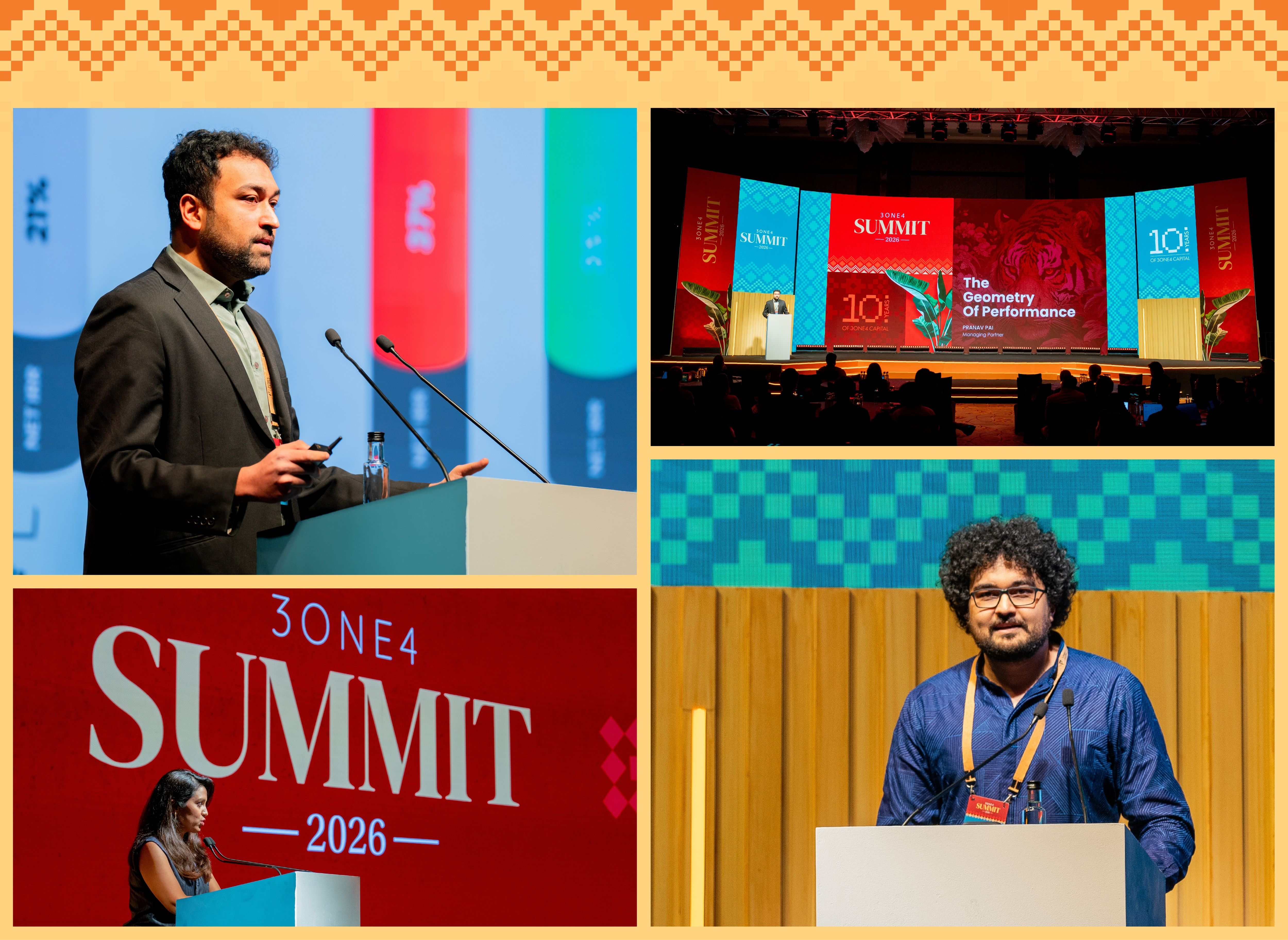
The portfolio today carries over $11 billion in enterprise value, with five unicorns, eight soonicorns, and over $2.47 billion in follow-on equity raised across 250+ rounds. Behind every one of those numbers is a founder who believed in something before the market did, and a firm that stayed close through every stage of that journey. Pranav Pai mapped how portfolio outcomes, exits, and winner archetypes intersect with digital public infrastructure, formalisation, and enterprise adoption to broaden the base for durable company building. The firm’s focus remains on repeatable behaviours that convert to DPI over time, including precision around capital, measured risk, and the conversion of paper value into returned value.
This discipline has been intentional. In 2016, 3one4 Capital was built from first principles, with a deliberate focus on aligning the firm's incentives with long-term value creation. Siddarth Pai reflected on the philosophy that has shaped the firm's approach to capital stewardship and the principles that have defined it over the past decade. He discussed valuation practice and portfolio construction, making the case that discipline compounds most visibly when teams treat each rupee of LP capital as a mandate to be earned rather than a resource to be deployed.
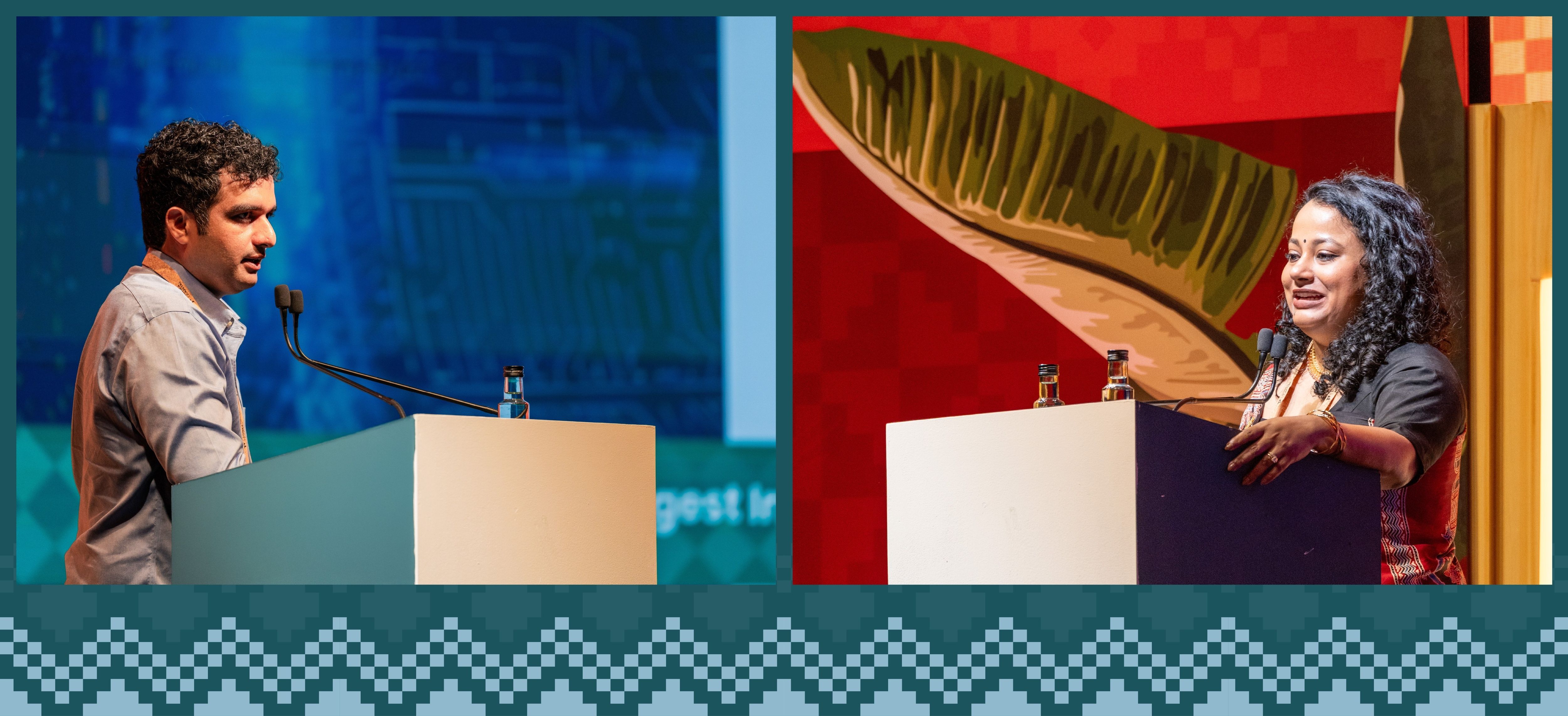
The categories that drove returns over the last decade, including SaaS, fintech, and consumer, have largely been discovered, and private equity is now a well-resourced player in all three. The venture opportunity lies elsewhere, and Anurag Ramdasan traced where it is heading: applied AI, deep tech, and manufacturing moving from non-consensus to next consensus, and operator-led playbooks that sharpen the wedge, certify quality, and prove repeatability in one geography before widening the aperture.
Identifying the right theses is only half the work. The other half is the infrastructure that turns early conviction into outcomes. The operating system that does that was detailed by Nruthya Madappa. She focused on turning early-stage theses into coalition support and market access, building global corridors, and driving high graduation rates through intentional execution support. Venture returns are manufactured through deliberate narrative seeding, the patient building of investor coalitions, and the engineering of conditions that make an early-stage company the market consensus. The conversation reframed platform support from soft power to hard enablement with real pathways to customers and capital, regulatory fluency, and the discipline to stay with a company through friction, pivots, and scale.
With the operating system in place, the natural question that followed was what the largest technological shift of our time actually changes for the markets and companies 3one4 is building into.
Quantifying AI: A View from the Markets
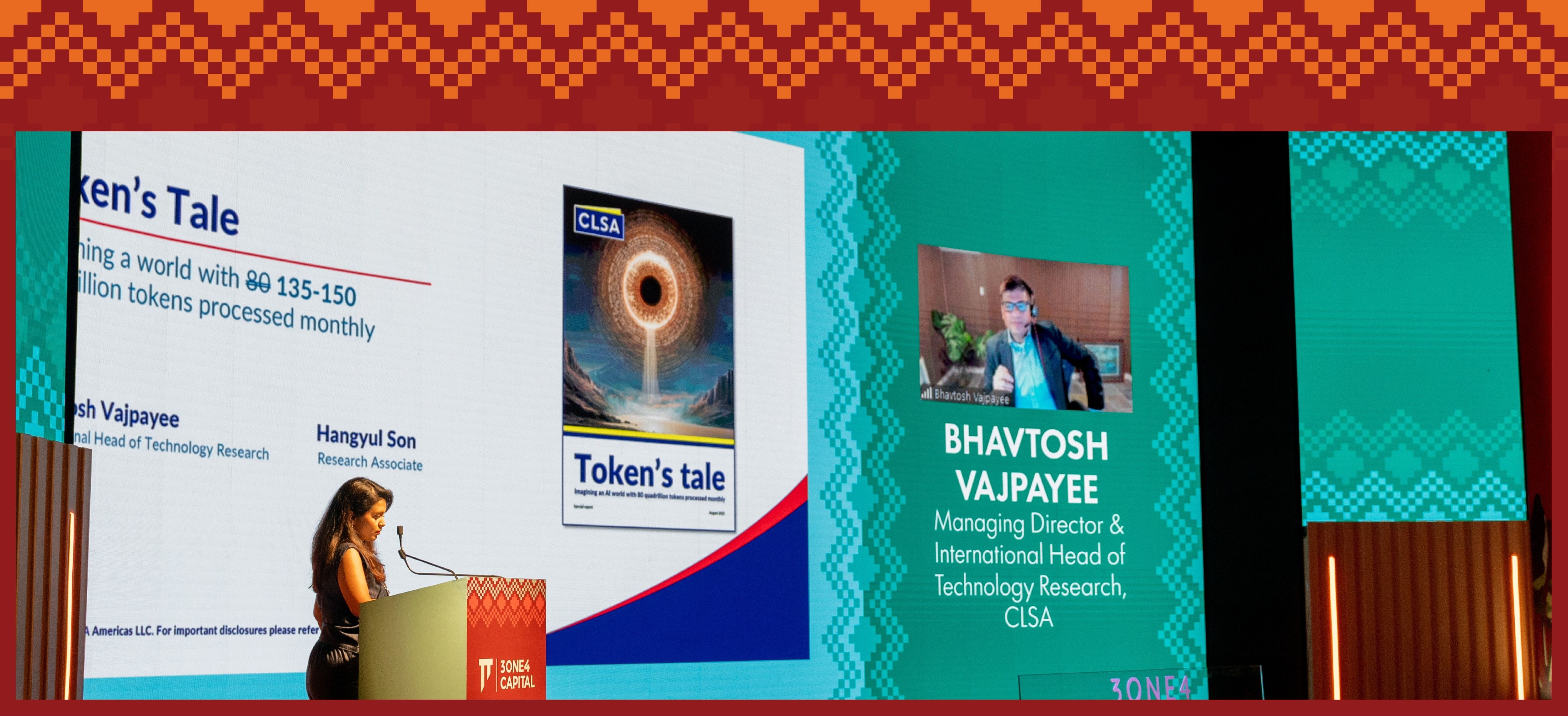
Today, we are earlier in the AI cycle than most market commentary acknowledges. The world currently processes approximately 2 quadrillion inference tokens a month, and when mapped against the full scope of potential AI use across knowledge work, creativity, and physical systems, the eventual demand is closer to 135 quadrillion.
To bring rigour to that conversation, the Summit turned to Bhavtosh Vajpayee, Managing Director and International Head of Technology Research at CLSA, who grounded the AI dialogue in fundamentals that often get lost when the discourse swings between euphoria and alarm. The infrastructure being built today is funded by four companies whose combined operating cash flows are approaching a trillion dollars a year, and the cost per token will continue to fall as more efficient chips enter the installed base.
For India, the implications are counterintuitive. AI is more likely to expand the addressable market for Indian services than to displace it, as judgment-intensive roles once considered too complex to offshore become viable for the first time. Capturing that opportunity, however, will require the right policy foundations, backed by clear rules, enforceable contracts, and governance frameworks that give companies and capital the confidence to commit for the long term.
Fireside Chat: Building the Guardrails
From the technology markets, the day turned to the policy frameworks that will determine how those markets are governed. Shri Sanjeev Sanyal, Member of the Economic Advisory Council to the Prime Minister; Secretary, Government of India, joined Siddarth Pai for a conversation that moved from macro complexity to first-order frameworks for policy and markets.
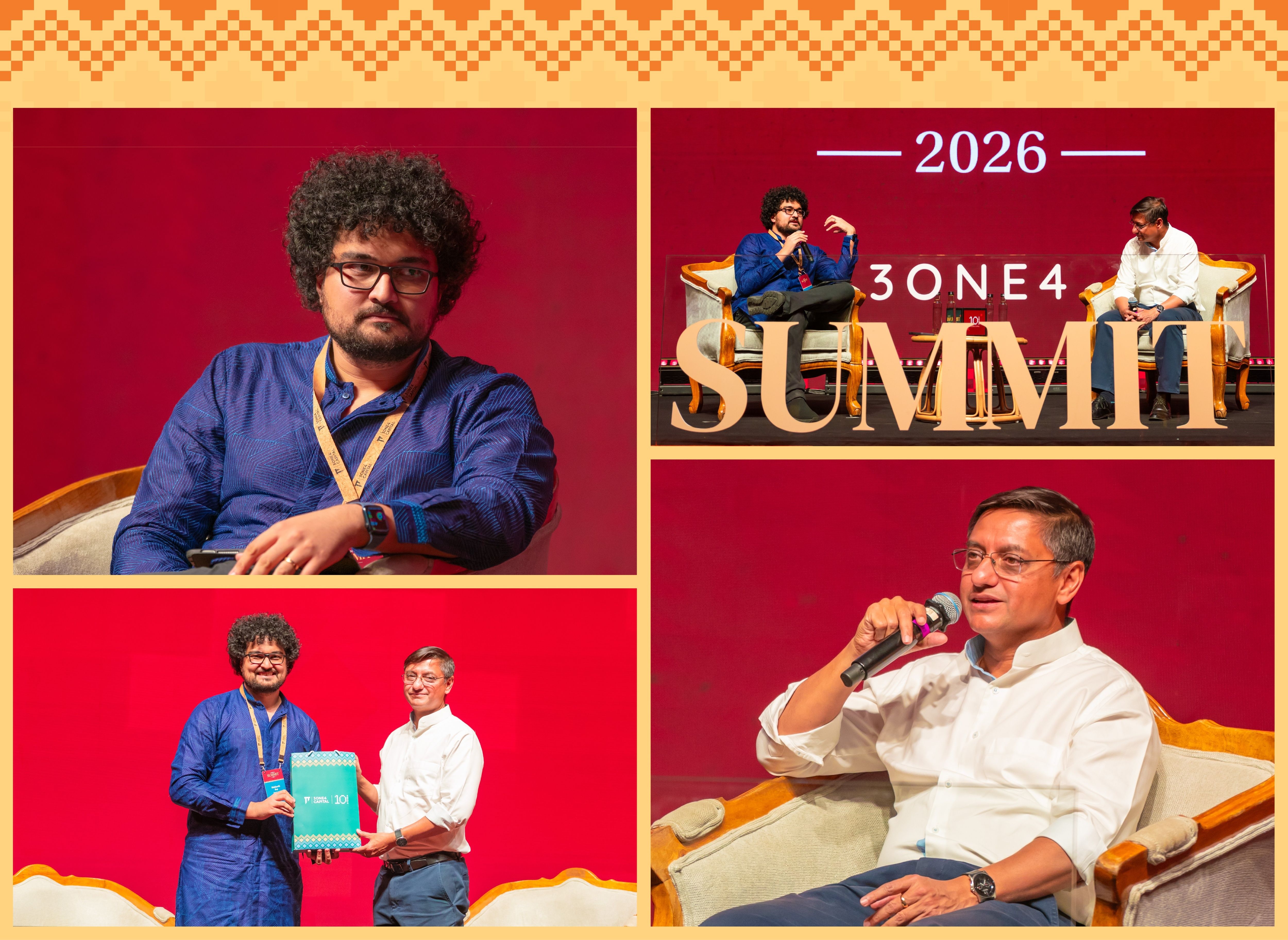
The world is a complex system, Sanjeev argued, and the appropriate response is to build for resilience. That requires reducing fragility through contract enforcement, regulatory transparency, and human-in-the-loop safeguards to prevent automated systems from propagating errors.
On India's structural priorities, Sanjeev focused on municipal infrastructure and contract enforcement and introduced the concept of a Transparency of Rules Act, which would create one authoritative, timestamped, publicly accessible source of truth for all rules and regulations. A system in which ignorance of the law is not a defence must, at a minimum, give citizens a fighting chance of knowing what the law actually is.
On AI governance, he drew an analogy to financial market regulation, arguing that effective oversight does not require predicting where the technology will go. It requires skin‑in‑the‑game for accountability, compartmentalisation to avoid system‑wide cascades, explainability audits, and circuit breakers for when models encounter failure modes – the same principles that keep financial systems stable without regulators needing to forecast markets.
Clear rules, consistently enforced, are the substrate on which markets and trust are built. And trust, once built, is what allows companies to scale. The most vivid proof of that is in the companies themselves.
CentreStage | Portfolio Showcases: Execution as a System
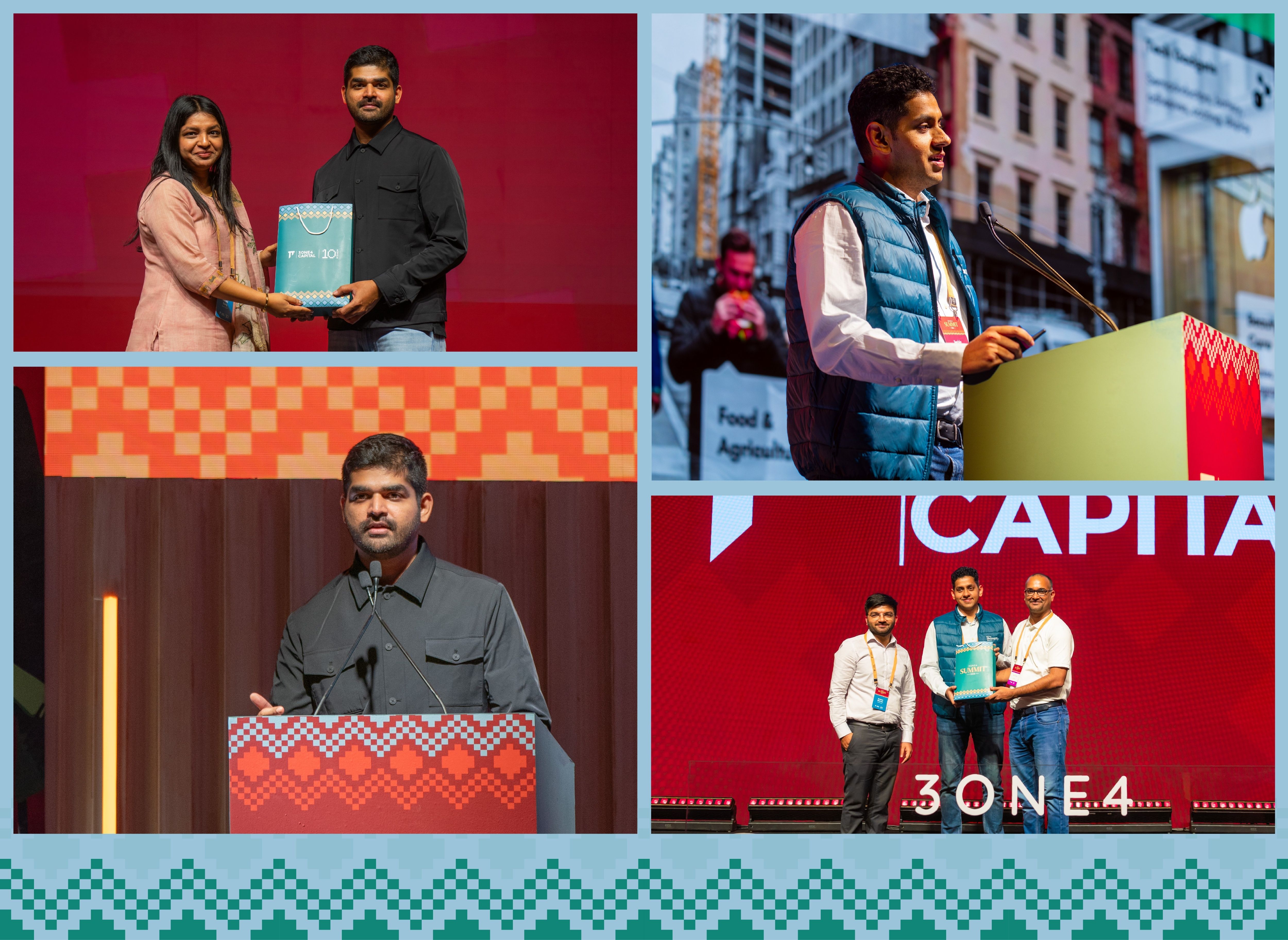
Theses are only as good as the companies that prove them. The afternoon brought 3one4's investment philosophy to life with CentreStage offering a direct view into what is being built across the portfolio. Four founders took the stage, each from a different sector, and together they presented a vivid account of what precision and long-horizon execution produce.
Unbox Robotics – Precision at Throughput
Pramod Ghadge (Co-Founder) has built a modular swarm robotics platform deployed across India, Europe, and the United States, with over 600 robots sorting more than 200 million packages annually. The company's most recent system in Belgium, with 155 robots sorting 5,000 packages an hour across 2,000 destinations, is among the densest sortation systems in the world.
Scimplify – Science‑First Manufacturing
Sachin Santhosh (Co-Founder) showcased a science‑first speciality chemicals platform that orchestrates R&D, scale‑up, and distributed manufacturing with compliance‑grade reliability. With an AI-enabled orchestration platform, the company now serves 500+ customers across 17+ countries, with $100M+ ARR, and a network of 500+ factories mapped with granular capability data.
Dhan – Compounding with Discipline
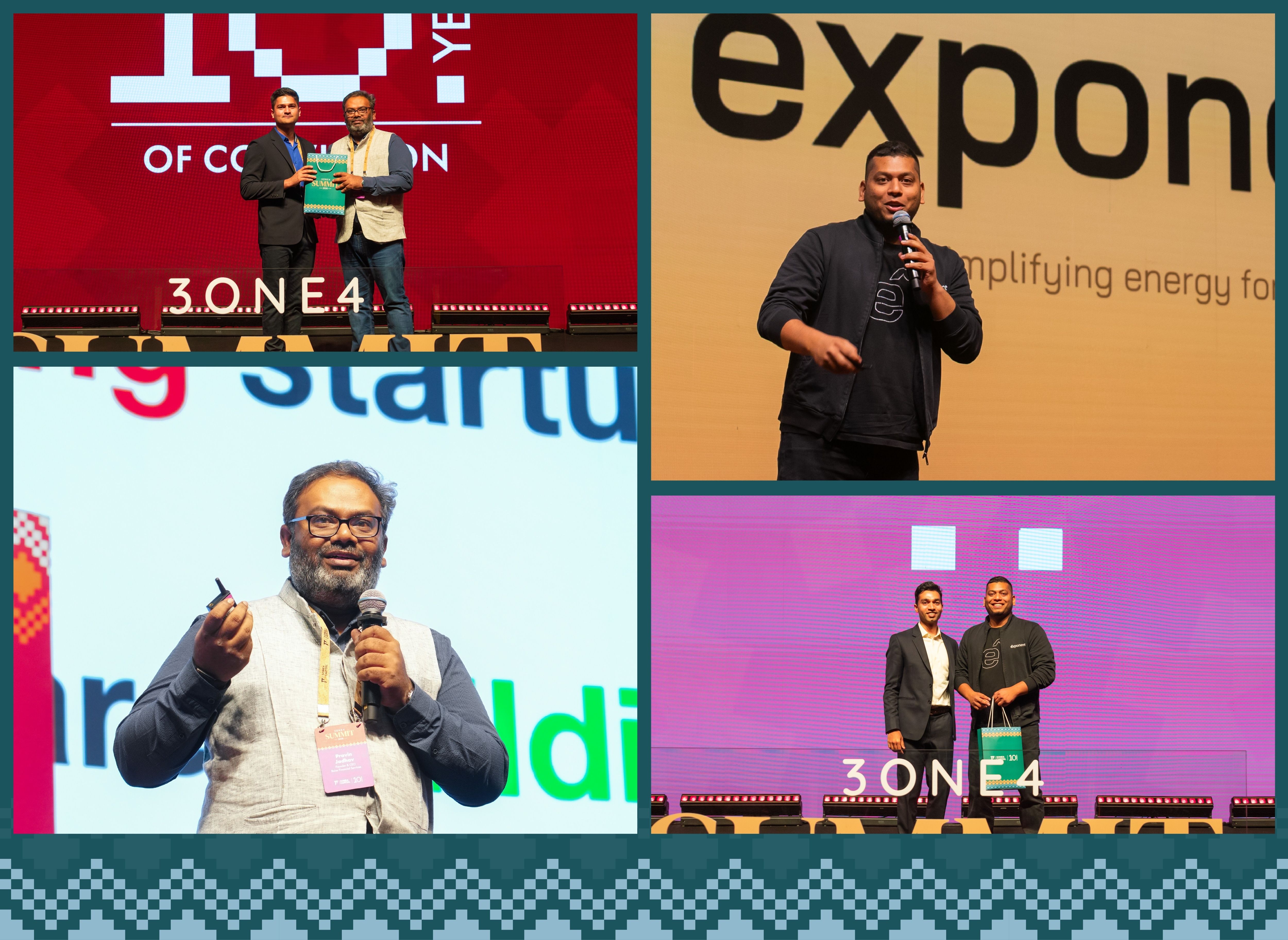
Pravin Jadhav (Founder) outlined high‑efficiency fintech playbooks that compound through disciplined, API‑led expansion and high‑retention investor workflows. He presented a trading and investing platform built in Mumbai that has generated over ₹2,500 crores in revenue in four years, holds ₹950 crores in free cash, and operates at 65% EBITDA margins. The emphasis was on serious, long‑horizon users, precision around unit economics, and platform reliability that earns trust.
Exponent Energy – Fifteen‑Minute Reality
For commercial vehicle fleets, energy downtime is an economic cost that compounds daily. Arun Vinayak (Founder) introduced 15-minute fast-charge technology engineered for 3,000+ cycles under warranty, achieved through battery management, system safeguards, and a charging architecture that extends useful life while keeping vehicles productive. Exponent recently signed a programme to deploy its technology across 2,500 buses with one of India's largest OEMs.
Each of these companies started as a thesis about an underserved problem. What they share is the discipline to stay narrow long enough to go deep, and the ambition to scale once the foundation was proven. That combination is also what defines the longest arcs in Indian institution building.
Fireside Chat: Building India's Deeptech Century
A conversation about building for the long term in India would be incomplete without the people who have demonstrated the willingness to invest in things that may not pay off for decades. Kris Gopalakrishnan, Co-Founder, Infosys; President, Infosys Science Foundation; Chairman, Indian Institute of Science (IISc), and T.V. Mohandas Pai, Chairman of 3one4 Capital, spoke about what that commitment looks like in practice and the compounding national capacity across science, talent, and capital.
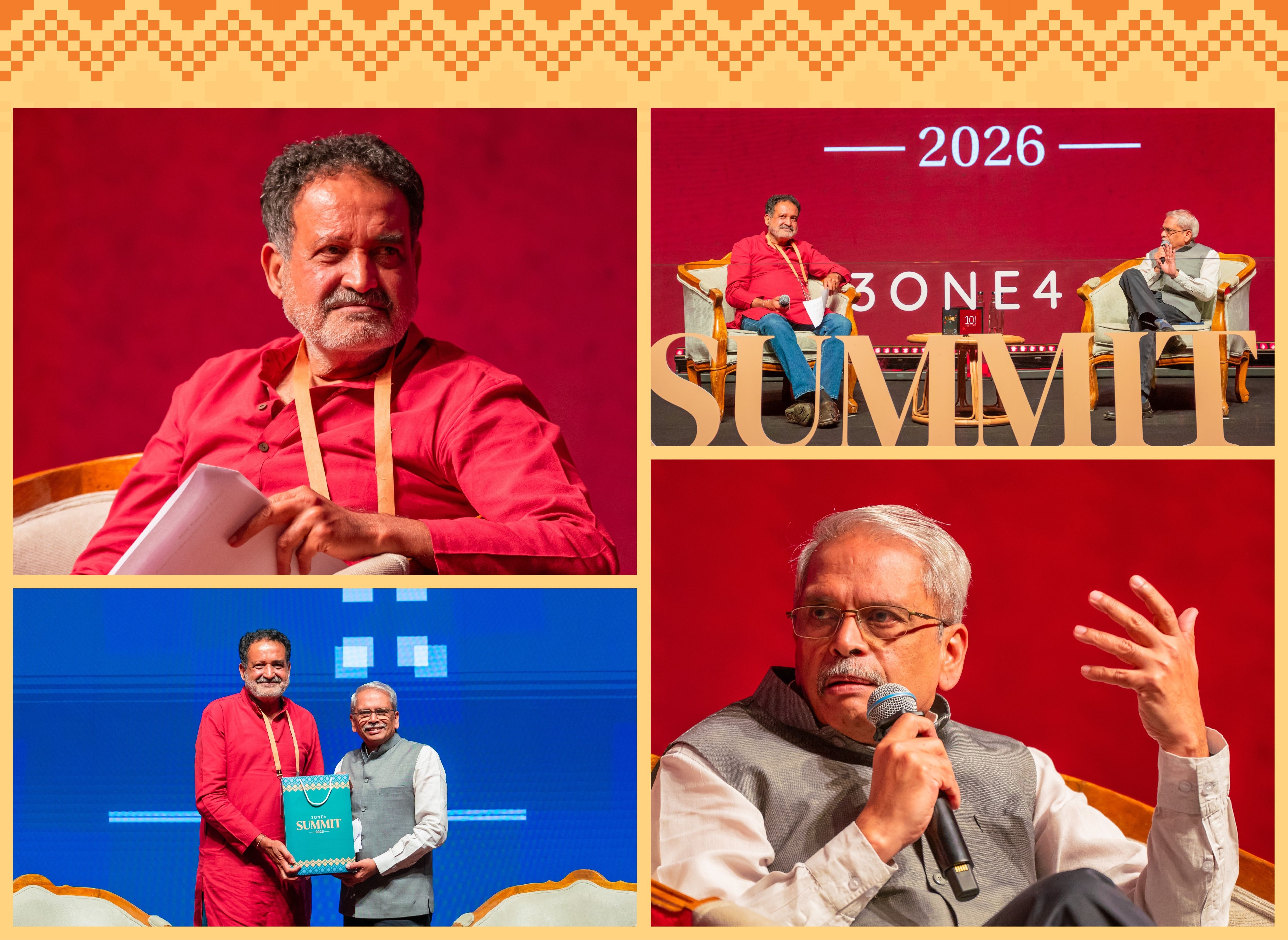
India's IT industry, Kris reflected, was built by companies that competed fiercely but worked together to build the sector, sharing training, quality standards, and market access because they understood that individual scale required a rising tide.
That same long-horizon conviction is what drew him to invest Rs 675 crores of personal capital in neuroscience research at IISc and IIT Madras over 20 years, with no commercial timeline. He described the origins of the government's Rs 1 lakh crore RDI Fund, structured to flow through managers like 3one4 rather than be administered by the state, as a bold step toward building national technology champions at scale.
Kris and MDP also touched on how patient capital and mission-mode programmes, from brain science and analogue computing research to quantum and materials, can seed the next wave of Indian multinationals. Kris told the founders in the room that India's best decades lie ahead, and the companies being built today will define them.
Ten Years In, and the Work Ahead
Siddarth Pai closed the Summit with a vote of thanks that reflected on what ten years of building alongside extraordinary investors and founders has yielded and on the responsibility that comes with it. A decade of disciplined investing has shaped 3one4 Capital’s approach to venture in India, with conviction expressed as stewardship and ambition expressed as operating systems that actually scale.
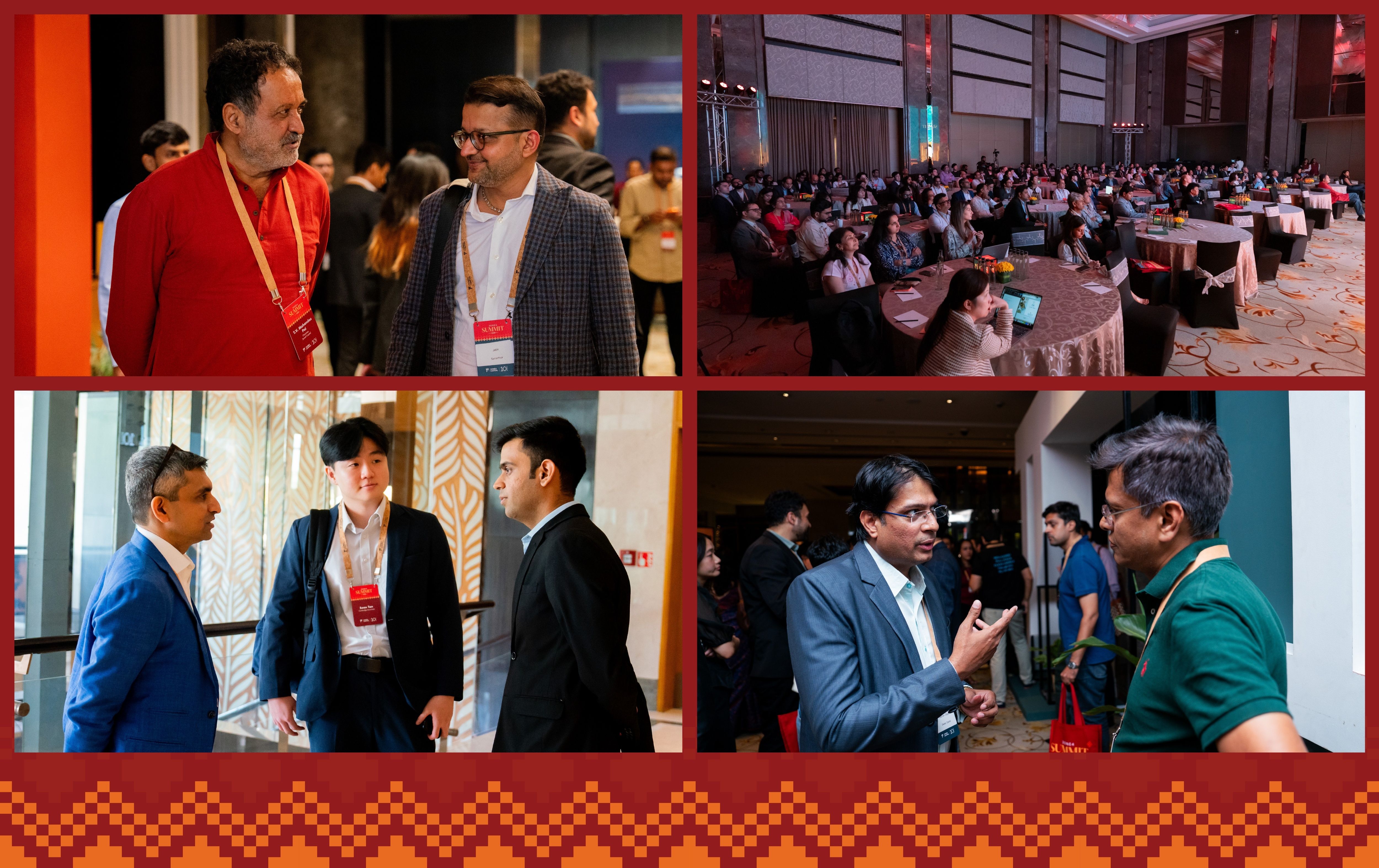
As India moves into its next phase of growth, 3one4 Capital remains committed to pioneering at the intersection of innovation and institutionalisation, offering the access, discipline, and support required to back founders who build the defining companies of this generation.
The next chapter will be defined by clarity of purpose and a responsibility to deliver on the outcomes that matter most. Summit 2026 was a celebration of ten years and a reaffirmation that the future is not something that happens to us. It is something we build every day.
DISCLAIMER
The views expressed herein are those of the author as of the publication date and are subject to change without notice. Neither the author nor any of the entities under the 3one4 Capital Group have any obligation to update the content. This publications are for informational and educational purposes only and should not be construed as providing any advisory service (including financial, regulatory, or legal). It does not constitute an offer to sell or a solicitation to buy any securities or related financial instruments in any jurisdiction. Readers should perform their own due diligence and consult with relevant advisors before taking any decisions. Any reliance on the information herein is at the reader's own risk, and 3one4 Capital Group assumes no liability for any such reliance.Certain information is based on third-party sources believed to be reliable, but neither the author nor 3one4 Capital Group guarantees its accuracy, recency or completeness. There has been no independent verification of such information or the assumptions on which such information is based, unless expressly mentioned otherwise. References to specific companies, securities, or investment strategies are not endorsements. Unauthorized reproduction, distribution, or use of this document, in whole or in part, is prohibited without prior written consent from the author and/or the 3one4 Capital Group.
-p-500.webp)